“What’s the use of writing a great blog post that never makes it to page one of Google?”
This was the question Ruth asked me around 2022 and this question shaped how I approach every piece of content I write. It is this same question that is behind this post.
Bloggers who grow without paid ads aren’t getting lucky. They’re following repeatable SEO writing tips and process and they haven’t gotten less important just because AI now summarizes answers directly in search results. If anything, it matters more.
This is because, when a searcher already has a quick answer from an AI Overview before they’ve scrolled past the fold, your content has to earn the click, not just rank for it.
I’ve used some version of this process on every post I’ve written since I started with SARMLife, and I’ve adjusted it every time Google’s algorithm or reader behaviour has shifted under it.
What you’re reading now is the SEO tips I use and teach for writing blog content that ranks and gets clicked, updated for how search actually works in 2026.
What is a blog post?
A blog post is a single piece of published content on a blog site accessible via the World Wide Web. The content is majorly written content that may or may not be supported with images (images are a MUST for optimization, though)
For instance, what you are currently reading is referred to as a blog post.
Simply put, SEO (Search Engine Optimization) writing is creating and writing content that’s structured and worded so search engines can understand it and people actually want to click on it.
It’s a balancing act between the algorithm and the human reader and the posts that rank highest are the ones that satisfy both at once instead of favoring one over the other
Hubspot defines SEO writing as writing content to rank on the first page of search engines such as Google.
Optimizing starts with the content creation process, from the topic ideas to the writing and the images; the content is deliberately created and organized to ensure it fits the baseline requirements of search engine optimization and even goes beyond it.
It’s worth separating SEO writing from SEO strategy. Strategy is the bigger picture and includes site architecture, backlinks, technical health, among others.
SEO writing happens at the page level: the words, structure, and formatting decisions that determine whether a piece of content earns a place on page one.
A technically flawless site can still lose to a weaker-authority competitor with a better-written post, because Google rewards content that answers the query better.
Another important fact to note is that SEO writing starts before you type a single sentence. It starts with your topic selection, your audience research, and your keyword research and it doesn’t end until you’ve added alt text to your last image and double-checked your internal links.
This is what ultimately differentiates SEO writing from the basic content/blog writing.
Features of an optimized blog post
The features of an optimized blog post are pretty direct but also easy to miss, especially when you are batch-creating content. We created an SEO blog post guideline to ensure you don’t miss anything while creating optimized content for your website or clients.
For you to write what counts as an optimized blog post, it needs to have these features:
Some writers can be a little lax about what they put in their introductions.
After deciding to click, your introduction is the first impression a reader will have of your post and writing style. They decide whether to keep reading within the first few lines, even before they’ve consciously registered the decision.
Tell them plainly and sincerely what they’ll get from the post. Think of it as the abstract of a research paper (a concise summary of the main work).
There are different types of introductions you can use for your blog posts, as explained in one of our Instagram posts.
· An organized, paragraphed layout
Did you know that long paragraphs reduce readability?
Research has discovered that most readers scan the whole post before deciding if it is read-worthy or not.
Long, unbroken paragraphs are one of the fastest ways to lose a scanning reader. Break your ideas into 2–3 sentence chunks, and use subheadings generously enough that someone could understand your post’s structure and flow from the headers alone.
If your blog posts contain long paragraphs, more than half of your readers will bounce out and not likely return.
· Genuinely useful and well-researched content
Length has stopped being a reliable advantage years ago.
What matters most now is whether your content actually answers the reader’s question more completely, more clearly, or more usefully than what’s already ranking.
This is where good research comes in.
You need to identify the pain points of your target audience and give them content that is beneficial to them. Your content should also contain verified facts and visual engagements.
· Links to authority websites
You might think that having an external link in your blog post will make you lose originality, but this couldn’t be more wrong.
Citing credible sources when you reference data, statistics, or claims builds trust with readers and signals credibility to search engines. If readers are able to trust your sources, they will also be able to trust your advice when it comes.
This not only makes your content rankable, it is also good for your overall SEO?
Not sure your current content hits all five? Our SEO consulting service includes a full content audit against this checklist.
Many writers have been stuck with SEO writing, or as some people call it, SEO blog writing and the frustration can make you question your writing skills. Maybe you own a website, or you hope to take your SEO content writing game to the next level as a freelancer to land high-paying clients.
Whichever class you belong to, I’m here to guide you step by step and show you how to write a compelling, fully optimized blog post.
These SEO writing tips might seem like a lot, but it is achievable and gets easier to implement with consistent practice.
The SEO writing tips for higher ranking:
Identify your audience
Know your content bucket
Come up with topic ideas
Optimize the topic ideas
Research the topic ideas
Research keywords
Research content around the keywords
Create your headline
Create your SEO outline
Write your content
Insert visual content
Since SEO writing skills go beyond just blog writing, most of what makes your blog posts optimized is the research you put into it before typing away at your keypads, just like I’m doing right now.
If you check out our blog post on 12 Ways to make money blogging, I wrote there that one of the most significant milestones that any blogger can cross is the ability to recognize and know their target audience.
Why is this important?
Your target audience is the one interested in your content and will want to click open that blog post because it addresses either their curiosity, fears, or pains. If you don’t know your target audience, you cannot create content relevant to a specific group of people.
You end up with no niche and no audience.
Here’s what to do:
Map their pain points, fears, and curiosities — what they’re trying to solve.
Read what competitors are already publishing to see which angles are saturated and which are underserved.
Check commonly searched terms using free tools like Google’s “People also ask” boxes and autocomplete.
Talk to real people in that niche directly — DMs, surveys, and comments surface language you’ll want later for keyword research.
· Know your content bucket.
A content bucket is a segment of the entire content you want to relay to your audience. Each content bucket should address various aspects of your business while also reflecting your overall message as a brand/business.
Content buckets are vital because they help you narrow down your ideas and distribute content across your audience.
List 3–5 buckets that together represent your full brand message (for an SEO agency, that might be content writing, keyword strategy, technical SEO, and local SEO).
Make sure each bucket maps to a stage of your reader’s journey — some buckets should target beginners, others should target people ready to hire help.
Avoid overlapping buckets that will compete with each other for the same keywords once you start publishing.
When you want to write a blog post, you select a content bucket and find topic ideas around it.
For example, if you are a fashion blogger, your content bucket might include accessories, dresses, color combinations, or even make-up. If you want to write a blog post, you can find out pain point around accessories for beginners, and experts alike.
This particular process might not need you to go online because you can develop topic ideas based on your experience, expertise, and interactions with people. Otherwise, you can check other similar websites and get inspiration from their content; it is entirely legal.
I recently wrote some ideas for a friend in a different niche from mine. At first, I had no idea what topics were good and not-so-good, but I ended up checking other blogs in the same niche as hers. The summary is that the content was created while also maintaining originality.
If your content bucket of choice as a relationship expert is breakups, you might think of topic ideas like:
Why new couples breakup
How to avoid a breakup
How to maintain long-distance relationships
What ladies/men do after a terrible breakup
Mind you, these are JUST ideas and have not been verified yet.
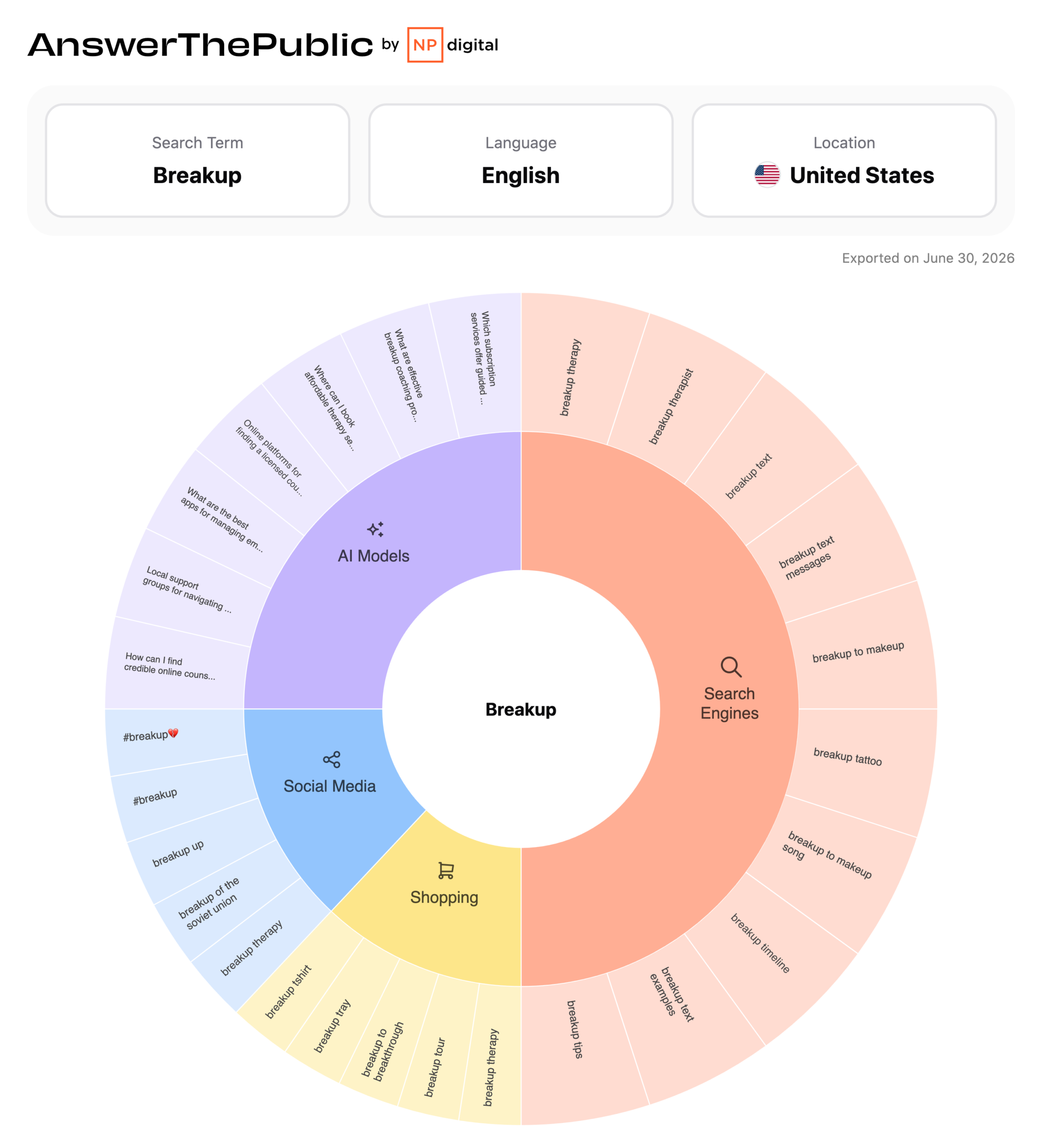
For search engine optimization, you want to ensure your topic ideas are relevant to people’s interests. This is where you can use tools like answerthepublic.
This tool gives you a compilation of all the questions people are asking about a particular keyword.
Now that you have a topic idea, log on to the site, type in your keyword of choice (1-3 words), and watch the magic!
Take, for instance, that your keyword of choice is simply ‘breakup,’ you’ll see a screen similar to this:
Now, you have dozens of options, and all you have to do is pick one.
The above image is just a part of the result page. You don’t have to be worried about coming up with relevant topic ideas anymore. You have over a hundred ideas in a single content bucket.
Imagine having up to five content buckets! Mind-blowing!
· Research the topic ideas.
You now have a verified idea you can use. The next step is to run that idea through Google.
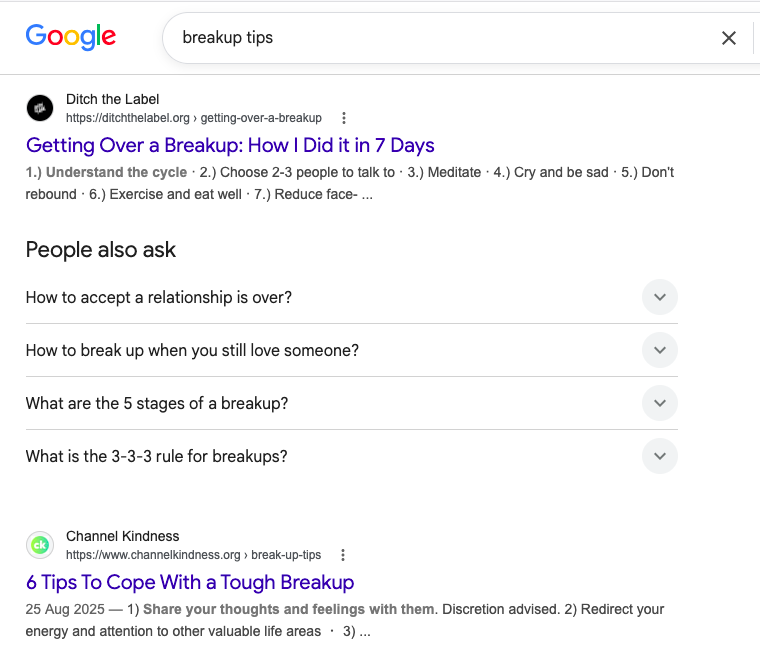
From answerthepublic.com, your verified idea might be ‘breakup tips’ – this is what you type in Google search.
Why?
You want to compare them with existing blog posts, and you do this by checking the similar keywords used by the top-ranking websites.
In addition to the keywords, you also check the headline structures and the meta description.
Let me share a tip with you.
One of the points in my SEO checklists is that your focus keyword should be part of your headline and URL. To fully confirm what focus keyword others use, you can check their headlines and URL and then research that keyword.
Any website with its focus keyword in both places is knowledgeable in SEO writing, and you should visit these websites for content inspiration.
Now, you have a keyword to verify.
· Research keyword(s).
This part is so exciting! Ubersuggest is the best keyword research website out there, in my opinion.
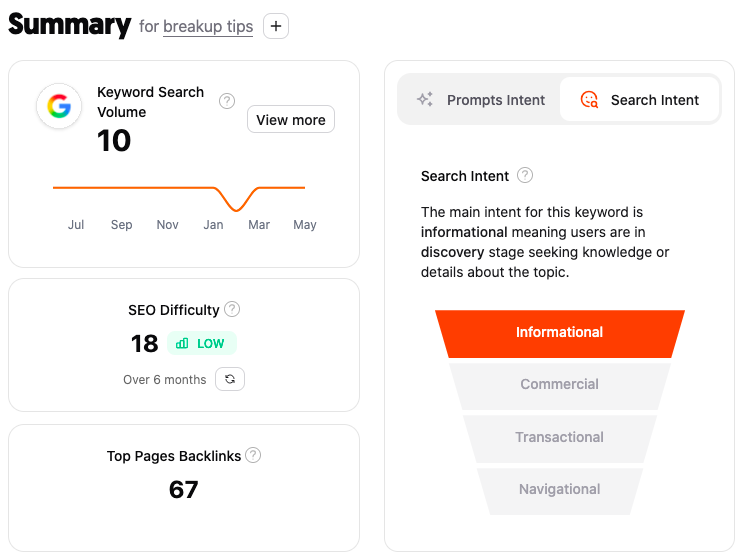
When you upload your keyword on Ubersuggest, it analyzes that word. It gives you real-time data, including search volume, cost per click, SEO difficulty, other keyword ideas, and content ideas you can use along with the keyword you entered.
From the above example, you’ll notice the keyword overview, which consists of:
Search volume
SEO difficulty
Top pages backlinks
Search & prompt intent
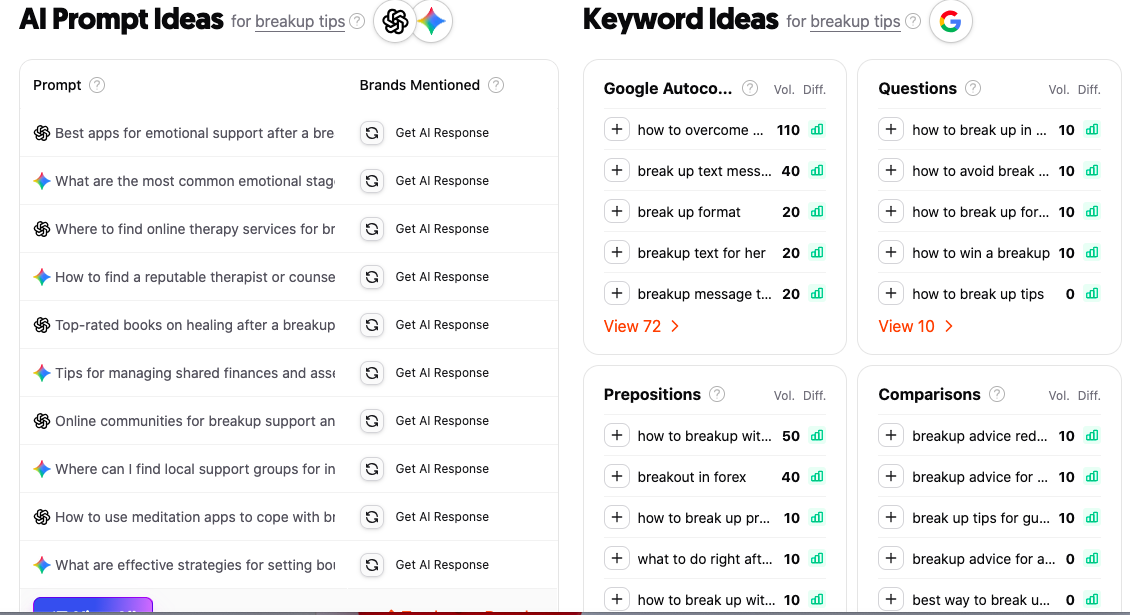
Scrolling down, you see the AI prompt ideas and keyword ideas, which give you statistics on other keywords you can use.
It shows the trend for each keyword and the top-ranking websites for it, alongside the keyword overview statistics for each keyword idea.
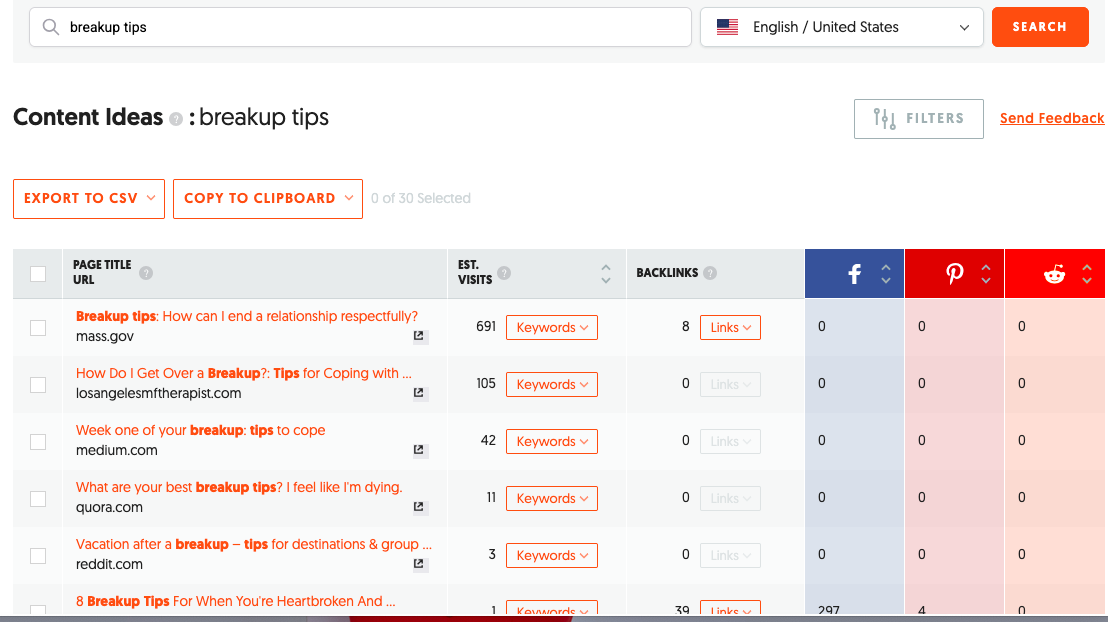
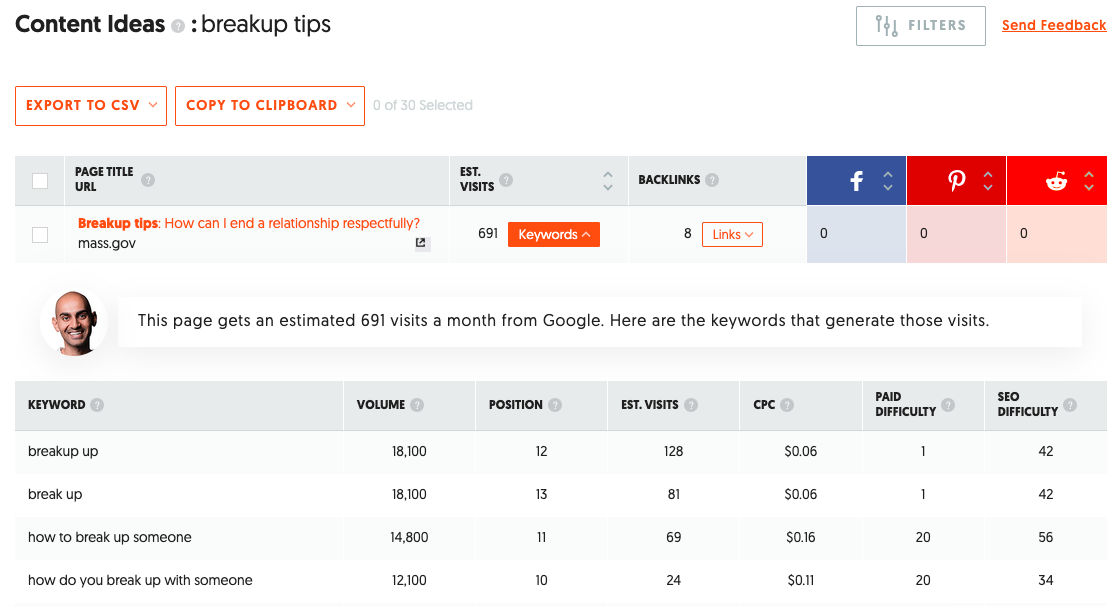
You can also check out the ‘content ideas’ segment under ‘competitive research’, where you see existing content with that keyword; in this case, the keyword is ‘breakup tips.’
The fantastic thing about this content idea segment is that it shows you the monthly estimated visits to that website and the keywords that bring this organic traffic. It also shows the number of backlinks, so you know if the website is really credible, and the number of social media links (Facebook).
You know what? You get this much information for free and even more information when you subscribe to the paid version.
The paid version, among other features, provides breakdown statistics on which device generates the highest search volume (mobile or desktop).
· Research content around the keywords.
This is the same step as researching the topic ideas from AnswerthePublic. The only difference is that you have several related keywords to type in Google search.
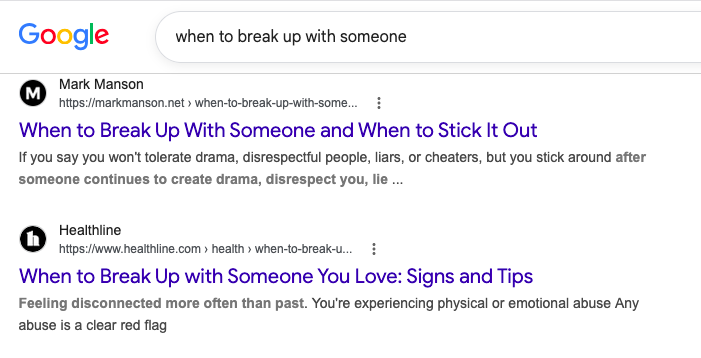
In this case, your keywords of choice can be ‘when to break up with someone’ or ‘break up with him’ which are related to your current focus keyword. Also, you can still go with the focus keyword ‘breakup tips’. The goal is to decide on which keywords will offer you the best possible advantage.
For example, I can decide to go with ‘when to break up with someone’ and make the others my secondary keyword if I have an advantageous position in terms of SEO difficulty and search volume.
Note: One of the best SEO writing tips to hold on to is using a medium tail keyword as your focus keyword and long tail keywords as your other keyword ideas. All your keywords should not be more than five (5) or less than three (3).
If your focus keyword becomes ‘when to break up with someone,’ you use Google search query to find content related to that query, noting the headline and content structures.
· Create your headline.
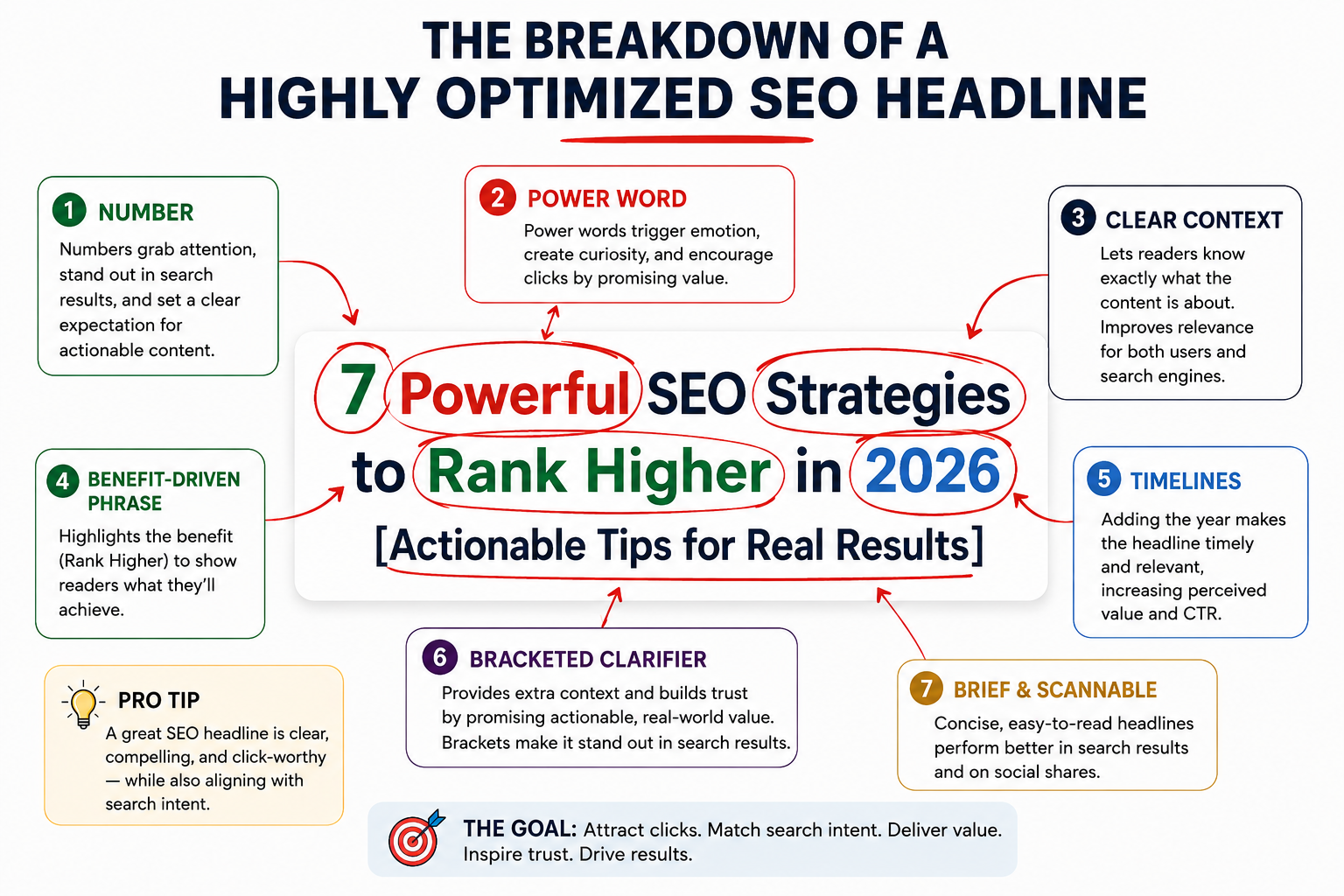
From the above SERP of the focus keyword ‘when to break up with someone,’ you can see several headline structures around the keyword.
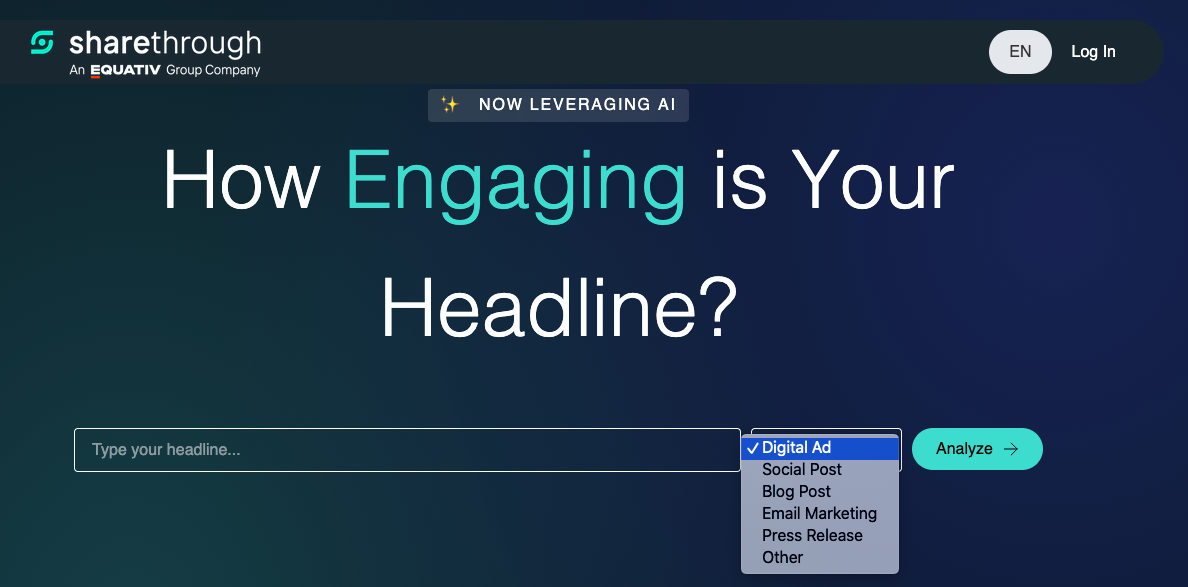
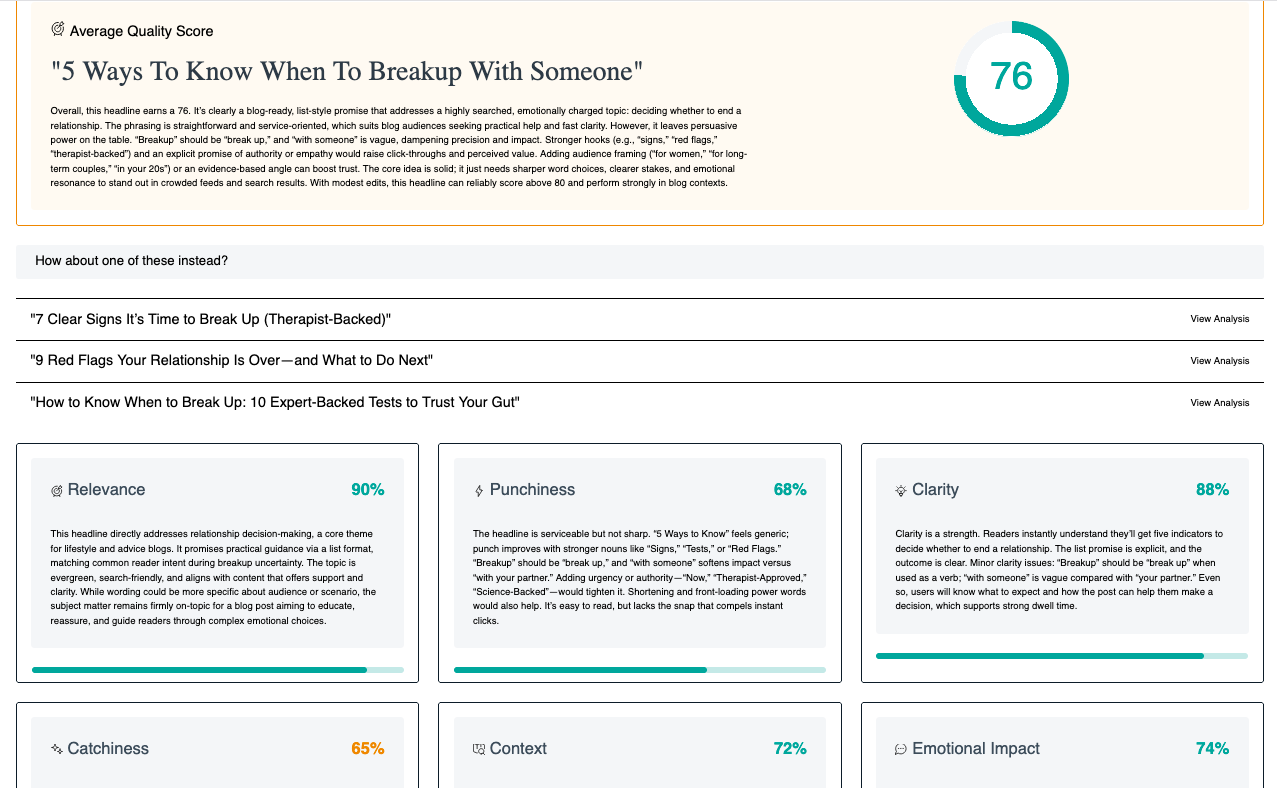
As earlier stated, you need to have a compelling headline that will make the reader want to click on your page. Sharethrough Headline Analyzer is a good, free, and accessible platform for writing a compelling headline, and you can also use it to verify the viability of your headline.
The platform analyzes your headline, gives you a score, and suggests ways you can make it better.
Before you write out a headline, note these points for SEO:
Your focus keyword must be in your headline with no added word(s) in between. Use any of the formats below:
Prefix, (focus keyword), suffix.
(Focus keyword), suffix.
Prefix, (focus keyword).
Your headline should not be too long to avoid being cut off like the ones below.
Use context words.
Use numbers, preferably odd numbers.
Run any headlines you come up with through the headline analyzer, follow these rules, and ensure your scores are above average.
· Create your SEO outline.
To create your outline, check out the top-ranking websites from the Google search query you carried out.
Compare at least five (5) different websites and note their content structure.
Afterward, create your outline and include a new point that is relevant to your content. OR
You can elaborate on a point mentioned briefly in other posts.
The goal throughout is to give reader value your competitors didn’t provide. That’s the actual reason a post outranks pages with more domain authority.
· Write your content.
You have your keywords, outline, and content inspiration. All you have to do is write.
However, it is important to know that writing isn’t just writing. When it comes to an optimized post, you have to be intentional and a little bit technical, especially when it comes to the placement of your keywords, links, images, and even your subheadings.
Here are my favorite SEO content writing tips to keep in mind when writing your optimized blog posts:
Does SEO writing still matter with AI Overviews summarizing search results?
Yes, even more than before. AI Overviews handle the basic “what is this” answer, which means your content’s job has shifted from informing to earning the click after the answer is already visible.
How long should an SEO blog post be?
Long enough to answer the question completely and out-deliver what’s currently ranking. There’s no fixed word count that guarantees ranking anymore; depth and usefulness matter more than length alone.
What’s the single highest-impact tip in this list?
Keyword research (tip 6). Every other tips including your headline, your outline, your content itself, depends on having the right keyword foundation first.
Can I do all these myself, or should I outsource it?
Plenty of bloggers run this whole process solo, and it’s entirely learnable. If you’re managing it alongside running a business, our SEO writing service and SEO consulting service cover different parts of this depending on how hands-on you want to stay.
What’s the easiest mistake to make in this process?
Skipping tip 1 (identifying your audience) and jumping straight to keywords. Keywords tell you what people are searching; only audience research tells you why.
If you follow these SEO writing tips, your blog posts will be sure to make the front pages.
If you need me to assist you with your SEO writing, or you need more detailed and vocal coaching, you can set up a meeting with me HERE or check out our SEO writing services.
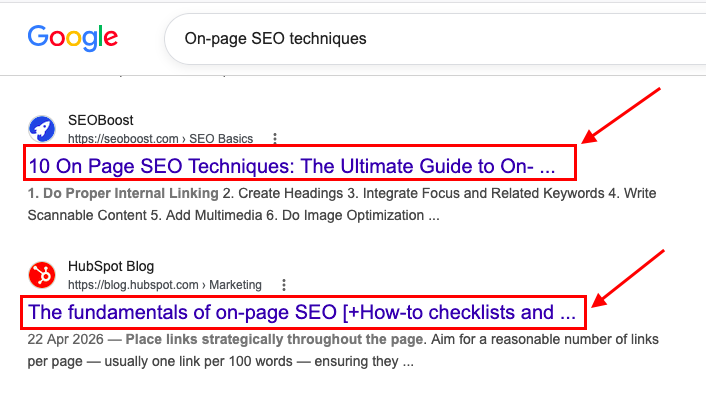
Have you ever questioned why certain pages from specific websites consistently rank high on Google?
They understand the importance of implementing off-page and on-page SEO techniques.
These SEO experts acknowledge that creating appealing content is not all there is. The ability to match Google requirements and searcher’s query using specific on-page SEO techniques explodes the traffic of any website and increases its rank.
As a beginner, navigating the world of SEO (on-page and off-page) can be overwhelming, just like when I started in 2019. I’ve learned from industry experts, tried many things, and kept updated on SEO changes and updates.
In this blog post, I’ll walk you through a practical but simplified on-page SEO guide, organized into chapters, explaining the fundamentals and creating a build-up to the more technical aspects of on-page SEO.
What Is On-page SEO?
Search Engine Optimization (SEO) is perfecting your website and its content to improve its visibility and traffic through various activities such as keyword research, linking building, auditing, etc.
SEO includes steps taken to make your website appealing to users and search engines, such as Google.
When search engine crawlers navigate your website, they audit it to determine if it matches user intent and accessibility.
If your website appears perfect, they relay this information back to the server, and you stand a chance of increasing your rank on the search engine results pages (SERPs).
Therefore, it concerns all the activities to improve your website traffic and ranks.
There are three types of SEO. They are:
On-page SEO
Off-page SEO
Technical SEO
On-page SEO, or on-site SEO, refers to any activity you carry out on your webpage to help increase its rank and traffic.
Let us relate this to a typical life scenario for a better understanding.
Congratulations! You just purchased an apartment, but you noticed the decorations don’t suit your taste, and you need to make it appealing to those who might visit.
You will carry out certain activities, such as painting, curtain fixing, positioning of furniture, and so much more, to make your home beautiful and appealing to visitors, known as interior decoration.
With this analogy, I won’t be wrong in saying on-site SEO is the interior decoration of webpages. It is the activities performed to make your webpage more appealing to search bots and users, which in turn helps boost your rank.
Difference Between On-page SEO and Off-page SEO
Both SEO strategies focus on achieving the same objective, but their work is slightly different.
Their focus:
On-page SEO focuses on researching and optimizing your content to rank for organic searches, focusing more on the web pages than the website.
Off-page SEO focuses on increasing the power of your website; it also focuses on how Google and viewers accept your content. This strategy is often not within your control; it is concerned with how powerful and famous your site is, and this is achieved by earning backlinks when appealing content is made.
It determines how high you will rank on search results.
Their factors:
On-page SEO factors include:
Title tags
Meta description
Header tags
Alt text Image
Page experience
URL structures
Internal linking
Page load speed
Quality of content
Mobile-friendliness
Off-page SEO factors include:
Number of backlinks
Quality of backlinks
Link relevancy
Social shares
Reviews
Brand mentions
Why Is On-page SEO Important?
The center of attention of on-page SEO is helping search engines (Google) and users to understand and relate to the content on your website better.
Therefore, it is crucial because it helps create a better understanding of your webpage. For example, the meta description and title tags—these tags are displayed on the browsers; it is the first text the user comes in contact with. When written well, it gives the users an idea of what your content is all about.
Here are some benefits of on-page SEO for your website:
1. Reduces clickbait
No one will want to visit a shop that doesn’t provide what they need. To make your customers stay, you will have to provide solutions to their problems.
When certain factors, such as expertise and relevant content, are met, click baits will be reduced because you offer appropriate answers to your audience’s needs.
2. Increases searcher’s time spent on your content
This importance is interrelated to the reduction of clickbait.
Users who see what they are looking for tend to stay and spend more time digesting your created content.
3. Increases relevance
It helps improve the quality of your webpage by satisfying users and gaining users’ loyalty by providing a positive page experience.
4. Assists search engines in determining what your page is about
On-page SEO is not only concerned with improving user understanding but also with search engines. Factors such as HTML codes tell Google what your page is about. Experience, Expertise, Authoritativeness, and Trustworthiness (E-E-A-T) enable Google to weigh the value of your content to prevent the spread of false information.
Google’s E-E-A-T stands for Experience, Expertise, Authoritativeness, and Trustworthiness. It was coined to evaluate the quality of content displayed on websites.
The E-E-A-T concept is not a ranking factor but a vital quality evaluator factor.
In recent times, there has been an increase in the demand for validated information. Google uses this principle to probe every content upload to determine if they are from reliable sources.
Hence, website developers are expected to display relevant and reliable information that can be vouched for.
Experience
Google is keen on matching users’ intent precisely and expects each website to display a level of experience in content creation irrespective of their niche.
To create effective content, Google expects you to have exposure to events that improve your knowledge of that particular niche.
This factor is related to the expertise factor.
Expertise
Continuous exposure to activities specific to a particular niche improves your knowledge, and through experience, you are informed about different problems and topics surrounding your niche.
Over time you become an expert in your field, having a high skill level and knowledge to solve those problems effectively.
For example, a brand known for SEO content creation will rank lower when they create health-related content because Google identifies that brand under the SEO expert niche and can’t trust their content to be one of value in comparison to various medical websites.
Authoritativeness
The authoritative factor concerns your website’s fame, influence, and power.
Your website should be famous for constantly providing truthful content that various websites in your niche attest to and link back to.
This factor helps in boosting backlinks which automatically increases ranks.
Trustworthiness
Earning users’ trust can be difficult but possible; it is easier to gain the trust of someone physically, but in this field, there isn’t a familiar relationship between you and your viewers aside from the content you create to match their specific intent.
This is why Google emphasizes creating truthful content; it beckons users’ trust and keeps them loyal to you.
How to optimize for E-E-A-T
Showcase your authors in your bio to establish expertise.
It is no hidden secret that many individuals patronize brands with names. Adding your author’s name to a blog post ensures users trust you.
Create a bio page stating your qualifications in the niche of your choice by writing about the duration of your service or your accomplishments and area of study in your bio.
A bio helps Google to be aware of your content creator and their expertise.
The factors below are essential for an impressive bio:
Name
A picture
Credentials
Position
Contact email or number
Work with trusted sources.
In carrying out your research, every data collected must be from a reputable source with high authorities. Avoid backlinking to websites that are known for spreading false information. Google can pick on tabs of such linking, which can respectfully hurt your website’s reputation.
Design beneficiary content.
The backbone of major ranking factors—every optimization strategy is null and void if the content is useless to users. Create a post that captures the users’ interest and provides a solution to their needs.
2. Title tags
a. What are title tags?
Title tags, or website page titles, are valuable factors you should consider; they are a HyperText Markup Language that describes the title of a webpage.
It is not visible on the website page but on the browser tabs and Google’s search result page.
b. Why are title tags important?
i. They promote understanding.
All optimization processes aim to achieve search engines’ and users’ understanding.
It is of vitality that your page and its content should be easy to grab fully and not in bits.
Title tags aid in achieving this by capturing the words that best describe your content briefly with your focus keyword inclusive.
ii. They influence users’ clicks.
Because title tags are visible on the browser tab, they will likely be the first thing users see about your content.
They play a massive role in determining how users perceive your page.
For example, when a title meets the exact query by capturing the relevant keywords and other related factors, the user is of the impression that your content is the perfect match to that specific query and will waste no time clicking.
iii. They improve page rank.
Click-through rates influence SERP ranking.
Suppose eight results match a specific intent, and Google notices many users clicking on the fifth result and staying for a long time. This automatically tells Google that the page with more traffic matches the user intent better than the rest, and in a couple of minutes, that page ranks higher above the rest.
c. Tips to write a perfect title tag
i. Match search intent by including a question form.
Title tags in question form often get a higher click-through rate. For example, “What are SEO black hats?” This title notifies the user that your page provides the answer they seek.
ii. Write in sentence case or title case.
Your titles should be written in a sentence case or a title case.
In a sentence case, only the first letter of the title is in the upper case, while the title case has the first letter of each word capitalized, except for the articles.
Example of a title in a sentence case: “Where are the search engines?”
Example of a title in a title case: “What Are Search Engines?”
iii. Keep the title between 40-50 characters.
It is ideal to keep the title within 40-50 characters. A shorter title may not provide room to add the relevant keyword, and a more extended title of 70-80 characters may not capture the user’s interest. Hence, it is advisable to keep the title at a moderate length.
iv. Include numbers or years.
People are attracted to unique title tags. Talking about uniqueness, adding a year or number to a title creates curiosity in the users to discover what your page offers.
For example, this title, “11 Unique SEO Trends in the Year 2023,” tells users that my content is about recent SEO trends, and I have unveiled 11 new practices to boost their SEO strategies.
Educational titles also have a higher chance of getting clicks.
v. Include keywords.
Top-ranking pages, when analyzed, often rank for some keywords. You must include the relevant keywords that match the specific intent in your title.
vi. Make use of power words.
Power words are words that increase the strength of your title. These words are capable of captivating the interest of internet users, and they can trigger emotional responses.
Examples of power words are ultimate, monetize, effortless, etc.
The more powerful words you use that converge emotional response, the more clicks you get.
vii. Make sure they align with your content to prevent clickbait.
This tip is crucial; the amount of time a user spends on your page is analyzed by Google, which tells search engines that your content was beneficiary to the user.
It is useless to optimize your title tags when your content is different from the title. Google sees this as deceptive; every title tag should reflect your content.
3. Meta descriptions
a. What are meta descriptions?
Meta descriptions are the sentences below the titles; they help to describe what your page is about.
Meta descriptions can influence your websites. Search engines often display these descriptions as a summary of your page. A well-detailed meta description can impact your click-through rates and increase website traffic.
Most times, web developers fail to add a meta description, and search engines automatically pick a sentence from their content and use it as a meta description. I highly advise against this, as the text search engines might choose may not be an accurate summary of your content.
A short description does not give room for a well-detailed explanation of your page’s content, and users might not know what to expect from such a page. I definitely will not click on a page that does not give me an insight into its content; it can be risky.
ii. Make it appealing.
Your meta description should communicate the benefits of your content. Make it compelling by initiating emotional response through the insertion of content values.
iii. Include keywords.
Keywords are a critical factor, and they cannot be overrated. Including the appropriate keywords in your meta description is vital. Emphasis should be made on keyword stuffing; avoid using numerous keywords that are not relevant to your description.
iv. Match search intent.
This factor is essential; your meta description should align with the user query.
v. Avoid using the same meta descriptions for different pages.
For each page, provide a different meta description; this will help tell search engines the uniqueness of each page and its content.
When you use the same descriptions, search engines assume your content pages provide solutions to the same query.
4. Header tags
a. What are header tags?
Header tags are also referred to as heading tags. These tags arrange content based on priority or importance and differentiate the various subheadings in content.
The header tags concept establishes informational ranks in your content creation, and HyperText Markup Language accepts up to six header tags in page structuring.
Here is a specification of header tags and their uses.
H1 Tag
The H1 tag is the title tag; it captures the context of your content and is used to attract users’ attention. This tag describes the page’s primary purpose and is usually infused with the focus keyword.
H2 Tag
The H2 tags are subheadings used to break the content into subsets of various sections. It is ideal for inserting your focus and secondary keywords in this header.
H3 Tag
The H3 tags are a division of the H2 tags; they can be used to explain the H2 concept. The H3 tag describes in detail the concept of header tags.
H4 Tag
The H4 tags are also subsets of H3 tags used to explain the listed points in an H3 tag. Most often, these tags are arranged in bullet points.
H5 Tag
They are used to broaden the points made in header 4.
H6 Tag
They are also used to explain some micro points in header 5.
b. Importance of headers tags
It helps search engines understand your content.
Adding appropriate headers to your content makes it easier for readers to interact with your created content. It makes the journey smooth and easy, readers will easily digest your content, and the time spent on your page by your visitors increases.
Additionally, header tags influence the time spent on your page, decreasing the bounce rate.
Users who find your webpage appealing and easy to understand will stay and absorb your content in a stretch.
c. Optimizing your header tags
To optimize your header tags to increase your rank chance, you will have to do the following:
Use one H1 title per page:
Using multiple header tags for a page will confuse search engines and reduce your rank drastically.
Google will not understand what your content is about and will not know what to rank you for.
Make it unique:
Use keywords, questions, or power words to make every heading appealing to users.
Reflect your content in it:
All header tags should correlate with the post title. Only write a subheading that captures the accurate picture of your content.
Keep it short:
They should be kept brief, with 50-60 characters. Ensure at least one of your header tags from the H1 includes your focus keyword.
5. URLs and URL structure optimization
a. What are URLs?
URLs means Uniform Resource Locator; it is a specific web page address that helps people locate you.
It is seen in the address bar at the top of a web browser.
b. What are URL structures?
URL structures are the various elements that make up a URL.
A URL structure can include the following:
HTTP (Hypertext Transfer Protocol)
www (subdomain)
Domain name
Path or page
c. How to create a perfect URL
Keep it short and readable.
Add a keyword.
Your domain name should be easy to spell and attractive.
Domain main should be easy to pronounce.
Name the page in a way that explains the content of the page.
6. Image alt texts
a. What are image alt texts?
Image alt texts are text descriptions of your images; they work by adding a text tag to the HTML codes of the image placed on your website.
These texts are not visible to users, but search engines see them and use them to match your image to what users are searching for.
b. The usefulness of image alt texts
They are beneficial in SEO. When a user inputs a query of an image, a search engine crawler looks at the text on the back end of the website to select the best images that match such intent. When done right, it can help your image to rank above the others on Google.
c. Tips for writing a fantastic image alt text
Don’t stuff keywords:
Don’t add multiple keywords to your image text; it makes it difficult for Google to know how the image relates to your content.
Don’t repeat yourself:
Don’t use the same words or keywords for different images on your website.
Don’t tag non-essential images:
Every text used should be an accurate description of the image.
Be specific:
Be detailed as possible, and avoid using irrelevant words to describe the image. Don’t write “a picture of” or “an image of” at the beginning of your descriptions.
7. Internal links
a. What are internal links?
These are links from a page on your website to another page on your website.
For example, here’s an internal link to another page on the SARMLife website.
READ MORE: HOW TO MAKE MONEY BLOGGING (Coming soon)
Internal links link a page to another page where their content is interrelated.
b. Why is internal linking important?
It helps increase page authority, boosting organic ranking.
When a specific page on your website generates higher traffic than other pages, you can introduce an internal link to drive traffic from that page to the less-ranking pages.
c. Quick tips for internal linking
Determine your page rank:
Tools such as Ahrefs can help you track your page and determine the exact page that needs to be featured in an internal link.
Add internal links from relevant pages:
Every page you internally link to should be related to the content topic.
Always link a page that gives more insight into your topic.
8. External links
a. What are external links?
These are hyperlinks on a page that references an external domain; it means linking to a domain outside your site as a reference or additional source.
b. Why are external links important?
Linking to other websites is a good SEO strategy, and Google states that linking to authoritative websites provides value for your users.
So, link to websites that follow the E-E-A-T principle, and it is also best to link to websites in your niche.
9. Use keywords
a. What are keywords?
Keywords, as the name implies, are words and phrases internet users type in search engines to find results.
They are vital as they link searchers’ queries and your content.
b. Types of keywords by length
i. Long-tail keywords:
Long tail keywords are made by combining more than four words.
A long tail keyword is usually longer than the other types of keywords.
For example, “red apple shops in Manchester.”
These keywords are particular and leave you no doubt of what the searcher wants.
ii. Medium-tail keywords:
They are less specific than long-tail keywords and less competitive than short-tailed ones.
It usually consists of 3-4 words.
For example: “red apple shops.”
This keyword shows what the user wants (looking for an apple shop) but does not specify the location.
iii. Short-tail keywords:
These keywords are very competitive, with 1-2 words. They are not specific, attract high search volumes irrespective of the niche, and don’t accurately describe your content.
For example, “apple” and “red apple” are short-tail keywords that contain only the subject matter.
c. How to use keywords
Specific rules are applied to keyword usage, and you must consider them to optimize your content.
i. Place keywords in the right place.
The proper placement of keywords is vital for SEO.
There are specific places where your focus keyword must appear on your page. They are:
Title tags
Meta description
Header tag(s)
Alt image text
Conclusion
Body of your post
ii. Include long tail keywords.
Long tail keywords have a specification function and are best used to attract users to your site.
iii. Avoid keyword stuffing.
Avoid using the same keyword multiple times without a natural occurrence.
10. Sitemaps
What are sitemaps?
Sitemaps are records of your website’s important pages or URLs. They assist search engines and users in finding your website’s different pages.
Importance of sitemaps
i. For easy website navigation:
Sitemaps make it easy for internet users to find their specific intent on your page in less time.
ii. Enables web spiders to understand your website:
They help search engines understand your content and your page.
Types of sitemaps
There are two types of sitemaps:
HTML sitemaps (for users)
XML sitemaps (for search engines)
i. HTML sitemaps:
The hypertext markup language sitemaps are solely for users, making it easy for users to find what they require on different pages on your website.
HTML sitemaps reduce the time spent by users searching for answers on your website.
ii. XML sitemaps:
The extensible markup language sitemaps are the most common.
They are created for search engines as they provide a hierarchy of your pages’ information to the search engines, which makes it easier for web crawlers to understand and reduce the time spent indexing your website.
This sitemap also tells the search engines the last time a page was updated.
11. Featured snippet optimization
a. What are featured snippets?
According to Google, featured snippets are special boxes where the format of a typical search result is reversed, showing the descriptive snippet first.
They are short, brief answers to users’ questions at the top of SERPs and help answer them immediately.
The paragraph snippet amounts to seventy percent of the total features, ranging from 40-42 words and 250 characters.
They mostly occur in question-form searches and have post titles that start with “How,” “What,” or “Why.” These suggest that they give educational and beneficiary information.
ii. List:
It amounts to an average of 19% of total featured snippets. They consist of about 44 words.
iii. Tables:
They are 6.3% of total featured snippets. They consist of 40 to 45 words.
c. How to get featured snippets position for your posts
Identify the opportunities on Google using Ahrefs.
Discover content ideas by using Answerthepublic.
Carry out keyword research.
Use a header when answering questions.
Match user intent by providing valuable information.
Add relevant graphics that match your content.
Organize your content ideally and attractively.
Validate your content by ensuring each piece of information is accurate and trustworthy.
Analyze your competitors to know what they do better to get more featured snippets.
Update your outline to fit recent trends and queries.
12. Get a rich snippet with structured data
a. What are rich snippets?
Rich snippets are search results that draw your attention to structured data on web pages.
They are used to provide relevant information to users immediately and provide solutions to urgent searches.
They are Google search results that provide additional information, add visual interest, and make it easier for users to digest content.
b. Types of rich snippets
i. Movie Markup
This markup displays information about a specific movie and shows the movie’s release date, cast, run time, and genre.
ii. Product Markup
This displays specific information about a product; such information includes price, availability, and product ratings.
iii. Music Markup
This markup gives relevant information about an artist’s music and displays album names and specific release dates.
iv. Reviews Markup
The reviews markup will show the star ratings below a description in the search results.
v. Events Markup
Events markup provides information on specific events, such as where they occurred and the time and date of the event.
vi. Recipes Markup
The recipe markup allows you to show certain cooking elements such as ingredients, diets, and calorie contents of the meal.
c. How to optimize for rich snippet
i. Build up your data.
Organize your data structure. Although structured data may not be a ranking factor, it assists Google in understanding your website and makes it more attractive.
There are rules to everything in life; in most areas, when rules are broken, inevitable consequences are faced. This is the same for Google.
Google has specified specific rules which have to be followed no matter what. Google needs you to follow such rules because it is more concerned with increasing a positive user and page experience.
We have uncovered how you can perform on-page optimization. Now we will look at the “don’ts of on-page SEO,” also known as the black hat SEO techniques.
You should avoid these when optimizing your webpage.
1. Keyword stuffing
What is keyword stuffing?
Keyword stuffing is inserting important keywords in written content, meta descriptions, and title tags.
Keyword stuffing is a search engine optimization (SEO) technique once considered a ranking strategy used in previous times.
It is also known as spamdexing. Here, keywords are added to meta descriptions, content, and anchor text, aiming to increase the website’s ranking unfairly.
Keyword stuffing may result in a temporal or permanent website ban on search engines.
Why keyword stuffing doesn’t work?
There are various reasons keyword stuffing does not work.
I don’t want to read content that repeats the same word multiple times without a proper natural occurrence.
Multiple insertions of a particular word tend to disrupt a user’s journey. Because you are more concentrated on writing for search engines, you neglect the most crucial factor of the user experience.
When users search and don’t find what they need on your site, they will leave to search somewhere else.
There will be a reduction in your website’s reputation.
In recent times, search engines are focused on relevant and helpful content.
Hence, keyword stuffing won’t work. Major search engines use algorithms that can find and eliminate such unfair practices.
This old spamming technique focused on writing content exclusively for search engines. The writer inserts keywords in large amounts and colors the font to sort the color of the background, making the multiple occurrences of keywords invisible to users unless highlighted.
Why hidden text doesn’t work
Although you can use this technique to cover spoilers and conceal specific data from unenlightened users, search engines note it as a punishable crime.
These texts are not hidden from search engines. Google reads the hypertext markup language (HTML), a programming language webpages are written in.
HTML has color code instructions, which help search engines discover these texts. When found, your website can get penalized.
3. Repetitive text
What is repetitive text?
In repetitive texting, certain words and sentences are usually used multiple times.
The writer inserts unnecessary links into these words, interrupting the understanding of the content, hoping to increase website rank.
Google’s algorithm has made it possible to recognize unnecessary linking and texts that are not naturally occurring.
Cloaking, as the word entails, means to hide, disguise, or mask up.
It is when content presented to search engines is entirely different from that presented to the human user.
This technique screams deception as the search engine and users are on different pages.
A user inputs a query, and search engines select the best pages based on the information presented to meet the user intent. If a user clicks on a page presented by a search engine and the content doesn’t fit in any way to this query, users can get frustrated.
Search engines prioritize the user experience above all ranking factors, and cloaking doesn’t comply with Google’s standards.
Getting caught by search engines will result in penalties.
On-page SEO Analyzers
What are on-page SEO analyzers?
These are software application tools that assist in search engine optimization. They are created with the sole aim of making the optimization process easy and faster.
Google constantly releases updates, and it can be challenging to keep up with all of Google’s changes. These automated tools use a certain level of artificial intelligence to reduce stress and help you rank.
How can on-page SEO analyzers increase your rank?
There are various ways these analyzers can help increase your rank; these are but a few.
Content idea guides
These analyzers are assistants that help make search engine optimization easy and less stressful.
Tools like AnswerThePublic help you discover what users are searching for.
This tool gives you an idea of your niche, and you can map your content to fit users’ recent searches.
Website audit
With the discovery of these tools, it is now easy to run a site analysis any time, any day. Tools like Screaming Frog help identify missing pages, meta descriptions, and keywords.
It also discovers errors you may not have noticed in URLs and codes.
Keyword research
These tools help discover keywords relevant to the particular content you want to create. It provides proven words that will assist in optimizing your content better.
Track progress
SEO users track their progress based on their ranks.
When content created doesn’t rank, we take it to mean we should improve our SEO strategies.
It is often difficult to track your content’s performance, especially when they are numerous. These analyzers help you track your progress and notify you when ranks fluctuate.
Best on-page SEO analyzers
1. Ahrefs
Ahrefs is a fantastic advanced SEO tool with a vast database and a large crawler.
Although quite expensive, it is one of the best tools for keyword research, SEO analysis, and reports.
The website audit by Ahref is effective and efficient; it also suggests solutions to lapses on your website.
It checks the properties on your website and generates relevant keywords and links.
It can explore the competition in your niche and run a competitive analysis on your competitor’s website to discover their SEO strategies.
Ahrefs helps monitor your ranking profiles and gives you updates on rank fluctuations. It assists you in giving your best and enables you to modify your SEO strategies to create better content.
It grants you free access to products to help you manage your website’s SEO.
It gives you an insight into customers’ behavior across different platforms to help you understand your customer’s journey and how they interact with your sites.
The access it grants you is expected to help you optimize your marketing ROI (return on investment).
Furthermore, Google Analytics generates a detailed explanation of your data analysis and manages your data efficiently.
Features of Google Analytics
Built-in automation
Reporting
Advertising workspace
Exploration
Data collection and management
Integration
Pricing
Free
3. AnswerThePublic
AnswerThePublic is a search discovery listener and keyword tool that listens to data from search engines like Google and provides you with a list of questions that people are searching for around your chosen keyword.
It allows you to structure your content to appeal to your audience and increase traffic and conversions.
Features of answerthepublic
Keyword research
PAA (People also ask) insight
Keyword visualization
Pricing
Individual plan- $9/month
Pro plan-$99/month
Expert plan- $199/month
4. Screaming Frog SEO Spider
Google’sfamoussite crawlers are not the only ones capable of crawling websites.
Screaming Frog SEO Spider is an excellent and powerful site crawler capable of crawling large and small websites.
The tool performs a wide range of activities.
It can be used to find broken links and server errors; it discovers errors in URLs and fixes them.
It can generate perfectly modified XML sitemaps and images, track your SEO success and identify lapses in your SEO strategies.
Features of Screaming Frog
Broken link finder
Duplicate contact finder
Title page and meta descriptions analyzers
XML sitemaps generator
Integration
Site audit
Grammar checks
Pricing
Free plan– comes with limited features.
Paid version– $199 yearly.
5. SEOmator
SEOmator is an SEO audit software application and web crawler that grades different SEO factors on your website, such as internal and external links, page speed, and rank tracking.
It assists with on-page and technical SEO optimization and monitors and analyzes competitors’ metrics. It’s a fantastic tool for website optimization.
Features of SEOmator
Keyword research
Rank tracker
Backlink checker
Reporting
YouTube rank tracker
Pricing
Lite – $49/month
Standard – $99/month
Advanced – $279/month
Google’s Ranking Factors
What are ranking factors?
Growing up, maintaining a specific grade and position in school was a great obsession of mine.
Constantly getting my desired position came with a feeling of satisfaction, and when I missed it, I was furious with myself and determined to do whatever it took to regain it.
Ranking in SEO can be related to our schooling experience; it refers to the position of your content on the search engine results pages (SERPs).
The worst place to be is the second page of SERPs because people hardly go there.
I cannot remember the last time I looked at the second page. You and other internet users can probably relate to this experience.
A popular SEO joke suggests the second page as the best place to hide a dead body because the chance of finding it is low.
Ranking factors are the criteria and signals used by search engines to evaluate a web page to determine its rank.
Having a page that ranks first means when users insert their query, your page is the first webpage that pops up and matches their intent.
These factors determine how high and low you rank on a search engine.
To be part of the first page of SERPs, you must meet these criteria.
Types of ranking factors
There are various ranking factors, and it is often difficult to know what area a factor falls under.
With this in mind, I have differentiated various ranking factors into their specific types.
More so, this differentiation will help you identify the particular ranking factors you need to optimize.
There are four types of ranking factors:
1. On-page Google ranking factors:
This is also known as the on-page SEO checklist, the criteria that must be met on a website and are within the control of the web developer.
On-page ranking factors list includes the following:
i. Relevant/High-quality content:
Beneficiary content is still a chief determiner of rank, and every content published should provide a positive user experience.
ii. Optimization of keywords:
Choose keywords that have a high traffic potential. The keyword chosen should blend naturally with search intent.
2. Off-page Google ranking factors:
These external factors are not much within your control and can be challenging to manipulate.
Backlinks are chains between one webpage to another, creating a relationship between two or more websites. The number of backlinks you get can boost your rank.
ii. The number of relevant domains linking to you:
The website content linking to you is crucial; Google considers this factor and checks the website content to determine if they fall under your niche.
For example, as an SEO writer, linking to a hair growth website is irrelevant. It assumes my content is created for people in my niche, so an external link of such will be highly useless to my users.
iii. The number of unique domain linking:
Getting a large number of backlinks seems good, but guess what! Getting backlinks from unique, trustworthy, efficient domains is top-notch.
Google sees a backlink as a voucher, and when it comes from a page known for providing quality, helpful content, it increases your influence in your niche.
To get such quality links, you must create quality content that matches user intent perfectly.
iv. Total relevant anchor text:
Anchor text is a word where links to other websites are inserted in.
Google’s policy states that anchor texting should be done cautiously, and the words used should give the users and search engines an idea of the link.
3. Technical ranking factors
This SEO strategy concerns a site’s technology regarding its content and structure.
You might have excellent content, but it will be challenging to rank if your site has technical issues.
Technical Google ranking factors list includes:
i. Page speed:
This is the amount of time taken for your website to load.
Every aspect of SEO is essential. If you create content that fits user intent but has a slow website, you risk facing penalties from Google, and your content might not be visible on the first page of SERPs.
ii. Mobile-friendliness
An increase in mobile users simultaneously led to the rise of internet users.
On April 21, Google updated its algorithm to increase the ranks of pages that are friendly to mobile users.
This algorithm is specific to mobile users and doesn’t consider the whole website but single web pages.
iii. Architecture of website
It can also be called a website blueprint, and it is the plan used in creating the website design, specifying different makeup and function of a website.
The structure of a website makes it easy for users to navigate and find helpful information. It also helps search engine crawlers better understand what your content is about.
Site security refers to the protocols to prevent scams, hacking, and errors (cyber attacks). Google is adamant about users’ safety.
Having a secure site is crucial. If your website is attacked, it can be blocklisted, resulting in traffic loss.
4. Performance and Behavior ranking factors
These factors relate to site exhibitions and users’ behavior when interacting with your site.
Performance and behavioral ranking factors include:
i. History and age of domain:
The age of your domain can affect its rank.
When search engines notice an old domain with a history of constantly delivering relevant content, it automatically ups your rank.
ii. User experience:
This is an important ranking factor.
Google monitors how users relate to your content by analyzing the time spent on your website. If the time is short, Google tags it as your content unable to satisfy users’ needs. Still, when users spend quality time on your web page and keep coming back to your content, Google suggests user satisfaction was achieved and increases the rank of your website.
On-page SEO Optimization Using AI
Ways AI can be used in on-page optimization
There are various ways AI can improve a website, and it is not specific to some functions but cuts across different SEO strategies and technical search engine optimization.
They can be used to:
Choose your topic.
Get your topic analyzed.
Run data analysis.
Develop your content.
Website audits.
Competitors analysis.
Broken link building.
Keyword research.
Benefits of using AI for on-page SEO optimization
i. Performs site audit:
The principal aim of artificial intelligence is to perform cognitive tasks better and faster than humans.
AI is a brilliant tool for data analysis and discovering content gaps.
On-page SEO optimization with AI can help mount your content by examining top-ranking content and discovering certain areas you need to improve on.
ii. Speeds up the research process
A common issue writers face is creating relevant content on a subject they are not experts on.
To overcome this issue, writers conduct intensive research and study to understand better and create beneficiary content.
AI can help speed up the research process and overcome this issue by providing content topics and well-constructed content outlines.
iii. Provides a solution to writer’s block:
Some AI tools that help in content writing also solve writer’s block and make writing efficient, saving time and preventing you from overworking.
Cons of using AI for SEO
Artificial intelligence is considered an effective tool to improve SEO strategies but isn’t short of disadvantages.
They are dependent on data analysis. When used in writing content, there may be some disadvantages.
Here are the disadvantages of using AI for SEO.
i. Provides content that sounds robotic:
Content generated with artificial intelligence is often presented with this problem.
Some applications can’t understand users’ feelings and how humans will react to written content, so it creates content based on data analyzed and the algorithm it uses. Hence, you will have to read and edit AI-generated content.
Technological advancement has created AI in SEO tools to understand human needs and interact with web pages like a human will.
ii. Plagiarism and lack of originality:
Most AI tools steal pieces of information from different websites and paraphrase them. AI-generated content may include parts of different content on a website; this technique is against Google’s already-set guidelines and can lead to penalties when discovered.
Because artificial intelligence relies on collecting data from available sources, it cannot generate its text, doesn’t understand human emotions, and cannot write a text to relate to the predicted feelings of the users who may visit the website.
iii. Contents are below the E-E-A-T protocol:
Experience, Expertise, Authoritativeness, and Trustworthiness is a principle Google uses to score and evaluate content.
Google tries to promote trustworthy websites that provide valuable content to users and reduce misinformation and the creation of harmful and useless content.
Artificial intelligence does not have expertise in various aspects of life, so its delivery will be less accurate than that of a human expert in such a field.
This reduces users’ trust in your website because the content made cannot provide needed solutions.
FAQs on On-page SEO
What is the difference between on-page SEO and technical SEO?
On-page SEO is concerned with your elements such as content, meta tags, title tags, image Alt text, and headers that are visible to the users.
Technical SEO mainly concerns search engine crawlers; they include page speed, website architecture, HTML, and more.
What does on-page SEO include?
It includes optimizing factors such as title tags, meta descriptions, featured snippets, image optimization, headers, and more.
How to rank on Google’s first page?
To rank on Google’s first page, you must optimize your content and website while focusing on user experience.
Conclusion
On-page SEO is one of the only things within your control in SEO, and it increases the chance of your page ranking higher on Google if all ranking factors are met.
It is a flavoring technique that adds more taste to your content.
To be an expert, you will need to take note of all optimization points listed in this practical guide, as being an expert requires constant practice.
How helpful was the practical guide to you? Let’s know by leaving a comment below.
Many web owners focus on writing optimized content but are not concerned about the images and videos they put out there.
Image SEO Optimization is an essential part of your SEO content writing process. Skipping this part when writing and uploading your blog posts will make your blog posts incomplete and your content strategy a flop.
If you need a reason to start optimizing your images, then take your pick:
Image SEO optimization contributes to your on-page SEO score.
20-22% of searches are made via Google Images Search! Imagine ranking high for image searches.
Image Search results now appear on regular SERPs, giving you a double opportunity to rank.
Many internet users’ attention spans are reducing daily, and Google knows this too. Hence, its search result pages focus on giving the most accurate and engaging result, which includes images and videos.
You’ve probably been told that alt texts are essential to image SEO optimization, but what happens when Google can identify your images without them?
Don’t get me wrong; alt texts are still essential for image optimization. However, there are many other image SEO practices besides this.
I have eighteen (18) carefully explained ways—that’s not alt-text—to optimize your images for search engines.
What Is Image SEO Optimization?
Image SEO is the process of optimizing your images for search engines.
When your images are optimized, you increase the chances of ranking in Google Images Search results like this.
With image SEO optimization, you can describe your images to search engines so they can correctly display your content to users in the proper context, rank for image searches and increase traffic to your site.
Why Image Optimization Is Important
There are several reasons why image optimization is an essential part of SEO, including:
a. Search results are evolving.
How Google presents search results nowadays has changed from how we knew it one or two years ago.
Now, Google often displays visual content with organic results and sometimes prioritizes web pages with images and videos more than those without.
Google Images Search is this part of the Google Search:
It means that when your images are optimized, you are allowing your content to rank among this 22.6% of Google Images searchers.
c. Images are a part of on-page SEO.
On-page SEO best practices include image SEO because images can increase the user experience on your page.
Images help reduce the intensity and density of text-based posts and help the reader understand your content better.
Depending on your images’ engagement, they can keep readers on your page longer.
Original images in your posts can also increase external links to your site, especially when they are of high quality and value.
READ MORE: LATEST ON-PAGE SEO PRACTICAL GUIDE FOR BEGINNERS (Coming soon)
d. It increases rank chances.
When you optimize your images, you get more chances to rank for your posts.
Search results are changing, but optimizing your images can increase page speed and website accessibility.
How to Do Image SEO Optimization
With Google’s Cloud API, the image content description accuracy is astounding.
When you upload a picture on Google Cloud Vision API, it can describe the content of your image with almost a hundred percent accuracy.
This is without any previous image optimization process. So, do we need to go through the process of image SEO?
YES! Because the API can get confused between similar pictures—for example, cheese and butter, almond milk, and regular milk.
Google Cloud Vision API might get the content but miss its specificity and context altogether; in other words, they’re not PERFECT.
Hence, you need to learn how to do image SEO optimization for your content to help Google understand your images better!
Here are the ways to do image SEO optimization:
1. Rename your image files.
You should rename your image files after downloading or creating them to fit the context of your content.
Google has also stated that a descriptive file name can help search engines to better understand your content by highlighting the subject matter.
For example, if you own a pet shop and have several pictures of cats, it will be inappropriate to name the images ‘Cat 1,’ ‘Cat 2,’ ‘Cat 3,’ and so on. Instead, you want to make sure the file names are descriptive and unique from each other.
So, rather than having ‘IMG_20230305_145147_740.JPG’ as a file name, you have ‘white-Persian-cat,’ ‘orange-Abyssinian-cat,’ etc.
To write a proper file name, it must:
Be descriptive: The file name should accurately describe the image content or the blog post topic.
Be straightforward: Avoid beating around the bush and adding unnecessary detail to the file name.
Be short: Your file name should be at most 30-40 characters; anything aside from this is excessive.
Have relevant keywords: Your file name should have at least one keyword; it can be the primary keyword for the post or the other keywords.
Use hyphens to separate words: Google recommends using hyphens instead of underscores.
Always check for the file names of all your images before uploading them on the internet. Also, ensure the file names are translated if your website is in other languages.
2. Use optimized alt texts.
This rule is probably one of the first golden image optimization rules!
What are alt texts?
Search Engine Journal describes alt texts as “text alternative to images when a browser can’t properly render them.”
Like the file names, alt texts are texts used to describe the content of your images but usually in a more descriptive and specific way.
Alt texts show on the top left corner of a broken image so that the reader can still know what the image is all about from the alt text.
When you use alt texts, it is not only visible to a reader, but it is also visible in the cached version of your page. Optimizing your alt texts will increase your chances of ranking in the top result page for Google Images searches because Google gets enough information about the image from your alt text, including the important keyword.
People with sight disabilities also need alt texts to hear instead of see the images, and because these texts are visible in the cached version of a page, users and search engines can access them.
Also, when you have to link to an external site, you can use the alt texts as the anchor text for the image.
How to write optimized alt texts with examples
Precise and straightforward
Descriptive not spammy
Keyword rich
Here are examples of alt texts:
Bad Alt text:
<img src=“cat-1.jpg” alt=“Cat”/>
<img src=“IMG_20230305_740.jpg” alt=“White cat”/>
<img src=“white-persian-cat.jpg” alt=“White persian cat”/>
Good Alt text:
<img src=“white-persian-cat.jpg” alt=“White persian cat with a blue yarn”/>
Better Alt text:
<img src=“white-persian-cat.jpg” alt=“White persian cat, holding a blue yarn with its front paws”/>
Perfect Alt text:
<img src=“cat-1.jpg” alt=“White persian cat holding a blue yarn with its paws and sitting on a green, round persian rug”/>
If you have difficulty writing good alt texts, you can use the Image SEO Plugin by WordPress to develop the perfect alt text for your images.
This plugin uses artificial intelligence to create alt texts for bulk images automatically.
Image captions are important image SEO optimization factors; they are small texts that appear below an image and describe what the image is all about.
Google uses your page content, including captions and titles, to determine the image’s subject matter.
Hence, ensure your images are placed near relevant sentences or words in your post.
Also, captions are great for providing additional background stories to your images, allowing a reader to see the image’s importance while skimming through your page.
4. Use the best file format.
Before uploading any image on your website, you must ensure it appears in the correct format. The most common format for a web page is usually PNG or JPEG.
Here are examples of standard image formats:
JPEG: These are the most popular and acceptable image formats. They have adjustable quality, can be compressed to small sizes, and are best for photographs.
PNG: These are high-quality images but are usually large. They are helpful when using a transparent background or for line drawings and texts.
WebP: This is the only image format that supports images and animated images without compromising on animated frames and color depth. They are helpful if you need higher compressions than PNG and JPEGs but are not supported by older browsers.
GIFs: These are the best formats for animating images.
SVG: These file formats are mainly used for icons and logos but are unsuitable for photos.
5. Know your website’s width.
If your site’s maximum display dimension or width is 720 pixels (px), no matter the image’s pixel, your website won’t display images wider than 720px for any device.
The image will be resized to fit your site’s width if you have a responsive website. However, the downside is that the browser must load the entire image in its full size before adjusting and displaying it in the required size.
This process increases the time it takes for the page to load, affecting user experience and increasing the bounce rate.
It means you need to know the maximum width of your website so you can resize images within that range.
6. Define your image dimensions.
What are the width and height of your images?
You need to define the dimensions of your images because not only does it aid user experience, but also enables the browser to size the images before they are loaded on the CSS.
When browsers size your images before loading them, they know beforehand the amount of resource space needed to load the entire page, preventing page jumping or content shifting, which affects your CLS scores.
Another unspoken rule of image optimization is to ensure all your images are compressed. According to a page weight report by HTTP archive, images take up to 21% of an entire web page’s weight on average.
Uploading big-size images to preserve the quality can lead to low page speed, affecting your page’s bounce rates.
Whatever software you use to compress your images, make sure to compress externally before putting the images on your site instead of having to compress the images while the page is loading to reduce the load on your site.
You can also use an image CDN to detect the user’s device and optimize the images before they are shown.
8. Disable attachment pages.
Attachment pages or media pages are automatically generated by WordPress, which stores only the uploaded media attachments.
They are thin content pages that are unfortunately accessible under their URL because WordPress stores them in your database as posts. As you might already know, thin content pages harm your SEO.
Also, attachment pages can take attention away from your main post. For example, when you upload a blog post with five images, WordPress automatically generates six URLs—five URLs for the images and one URL for the original post.
What happens if Google directs traffic to one of the attachment pages instead of the original post?
To avoid Google doing this, redirect attachment pages or disable them altogether because of the danger to your SEO.
9. Create original images.
As much as there are millions of stock images to choose from, it doesn’t beat the originality of creating your images from scratch.
Optimizing stock images will work, and you might rank high for it. Still, if you want uniqueness, create original, high-quality images.
Most stock images have a generic look, and to stand out from the thousands of websites in your niche with the same stock images, you need to up your game.
Some bloggers outsource graphic designers to help them design images, charts, and infographics. While this is very effective, you might be unable to afford a graphic designer.
There are design apps you can use to create stunning designs. You can create designs from scratch or use the available templates.
Here are some ways you can create original images for your website:
a. Canva:
You can use Canva to design anything; it has ready-to-use templates, and you only need to insert relevant information. You can get templates for infographics, graphs, invoices, blog graphics, blog banners, etc.
b. Pixellab:
PIXELLAB is a design app that is available for mobile and desktop devices. It started as an image editing tool but has been used for more original and breathtaking designs.
If you want to use PIXELLAB to create original images, you need to be good at designing from scratch without any form of template.
c. Screenshots:
You can take screenshots on your mobile or desktop to add to your post. When using Mac or Windows, specific applications allow you to export screenshots in multiple formats. These are:
Here is a shortcut to take screenshots on your desktop devices:
Windows + shift + S
After taking the screenshots, you can export them to other software or access them on your clipboard.
Original images are also great for backlinks, especially when they are pictorial summations of niche-relevant topics—for example, a chart that explains industry statistics, a comparison table of two different hot-topic terms in your niche, or a graphical representation of your bullet points.
These are linkable designs, and you can get other sites to link back to you whenever they use your graphic on their site.
10. Enable browser caching.
Browser caching allows page elements to be reloaded faster than the initial visit by storing the visitor’s information on the browser. It increases the page load speed and gives users a more satisfying experience on your page.
a. What is browser caching?
Browser caching enables a browser to store page elements like JavaScript, CSS files, images, and HTML so page assets can load faster for return visits.
For example, if a visitor comes to your page for the first time, all the assets on your page get downloaded, including images and other media files.
With browser caching, the browser can store these files locally and identifies the visitor when they access your page the second time.
This process allows the pages and all their assets to load faster.
b. How browser caching works
Page elements are downloaded from the server at the initial visit and then displayed to the user. Separate requests are made to the server to access individual files. The more files available on the page, the longer it takes to load.
Without caching, this process is repeated in subsequent visits.
However, when you enable browser caching, instead of the browser having to download page elements from the server, these elements are already stored for the user on the browser. They are displayed faster and reduce the data the visitor uses.
Browser caching marks certain parts of your page that are unlikely to change or change at specific intervals. It then tells the server to store these elements and download them afresh at particular times.
For example, you can tell a browser to cache your logo for a week. So, no matter how often the visitor returns to that page within a week, there is no need for the logo to be downloaded from the server. However, after a week, the elements will need to be downloaded from the server.
c. How to enable browser caching
You can use plugins like the W3 Total Cache to enable browser caching on your WordPress or manually add the code to your .htaccess file.
11. Use responsive images.
Responsive images are essential to device optimization, particularly mobile devices.
Mobile optimization is a crucial ranking factor for Google Search, and not only should your website design be mobile-friendly, but your blog post images should also be.
It might be challenging to select the type of images you can optimize for all devices; the key to this is using responsive images.
a. What are responsive images?
These images work well on devices with different screen sizes, resolutions, and other distinct features. They automatically adjust to the size of the device.
b. How responsive images work
You can make responsive designs or images through resolution switching and art direction.
(i) Resolution switching
There are two major ways to switch resolutions:
Same size, different resolution
It means you want to display the same image size but at different resolutions. To do this, you only need the srcset attribute. The browser will determine the device’s resolution display and loads the most appropriate srcset option.
Different sizes
Here, you want to display the same image but with different sizes. To do this, you need two attributes—srcset and sizes—to provide the browser with additional source images and allow it to pick the one that best fits the device.
WordPress 4.4 and above adds srcset automatically. It adds these image versions automatically:
Thumbnails
Medium
Medium Large
Large
Full
(ii) Art direction
This issue occurs when you need to show cropped images for narrow screens without compromising quality. For example, a landscape image for a desktop layout with the main subject in the middle will need to be zoomed in for the subject to be visible on a mobile layout.
This can be solved using the <picture> element. It allows your browser to display the most suitable image for the screen.
CDNs are a group of servers located at specific locations worldwide, allowing for easier data distribution from one location to another—for example, using a content delivery network with servers in different places.
When a USA user wants to view the content of your webpage, the data is transmitted from the CDN server closest to him.
This is faster than multiple users trying to get data from a single server located in Australia or Asia.
CDN servers get information from the origin server.
b. Types of image CDNs
Image CDNs help automate the entire image SEO optimization process, which is great for big websites because manually optimizing all your images might become more complex the larger your website.
If your website is hosted on WordPress, you can easily set up a CDN using plugins like W3 Total Cache, WP Rocket, or CDN Enabler to enable your registered CDN.
If you are setting up a CDN from other sources, you should follow the integration guide the provider will give.
14. Enable lazy loading.
To increase site speed, enable lazy loading regardless of the number of images on your page. This allows the user to load your web page at record speed and save data by not loading the images until they are viewed.
a. What is lazy loading?
Lazy loading is an optimization technique that postpones the loading of ‘non-critical’ media until they are needed or brought to a viewpoint.
You can improve your site’s user experience by increasing site speed with lazy loading. When you enable lazy loading for your web pages, the text content of the web page loads first while the browser waits to load images until they are needed.
Lazy loading is not just relevant for media in your posts; it can also be used when loading JavaScript.
So, instead of waiting for all the images to be loaded before displaying the web page, the browser loads the page quicker and won’t load the images until the searcher has scrolled down to that point. This means that images load as the user moves through your content.
If a user does not reach the end of your posts, the images at the end won’t load.
If you use WordPress version 5.4 and above, it lazy loads your images by default, so you don’t have to install a lazy load plugin.
However, if you need to install a lazy load plugin for your images, the a3 Lazy Load plugin and WP Rocket are plugins you can use for lazy loading on your website.
There are other different ways to implement lazy loading. However, you should consider your supported browser before deciding how to implement lazy loading on your website.
Schema markup, called structured data, helps Google understand your pages’ content more clearly. They are also essential to rank for featured snippets.
If you have been updated on the changes in Google Search results, you will understand that images are not just part of search result pages but also being shown as rich results or featured snippets.
For example, here is a search result page for ‘chicken noodle soup.’
This result page indicates that the first result shows sites that used the recipe schema. Google included additional data like the title, website, ratings, ingredients, and the time for searchers.
In the Google Images Search result page, these websites are also ranking high.
Google Images supports the following types of schema:
Products
Recipes
Videos
Using structured data can enhance your image search ranking when you upload a blog post on your website. For example, if you are uploading a product review post, you should show that the image on your post is that of a product by using a product schema.
16. Add Open Graphs and Twitter Cards
This image SEO optimization tip is to control the way your social media preview appears. It means that when you want to share your blog post on social media, you get to control the image that appears, the title, and other elements.
Open Graphs are used mainly for Facebook and Pinterest, while Twitter Cards are used for Twitter.
Here are the codes to use for Open Graphs and Twitter Cards:
Google’s support page has indicated that having good on-page SEO practices might help your images rank higher and have a high CTR.
Google Images automatically generates the title and snippet underneath an image result to best explain the image and how it relates to the searcher’s query.
This will help a searcher determine whether they want to see the image.
According to Google, they use several sources to automatically generate this information, including your title and meta description, which are part of your on-page SEO.
It is safe to assume that all the on-page SEO factors, like your structured data, user experience, header tags, and others, will directly or indirectly affect how Google ranks your images.
18. Include images in your sitemap.
Google has clearly stated in its image optimization guideline that the file path and file names are important ranking factors for image searches.
This means you can only put some of your media files in a single folder on your website; you need to categorize them and show search engines.
You can do this by adding images to your sitemap or creating a new one for your images.
It is essential because it makes it easier for search engines to crawl and index your images leading to increased image traffic.
Image sitemaps are similar to regular XML sitemaps, except they only contain image URLs.
To make sure that Google can use your sitemaps, you must include these elements:
<image:image>
This shows all the information about a single image.
Each <url> tag can contain up to 1,000 <image:image> tags.
<image:loc>
This is the URL of the images. Google allows the hosting of images on third-party sites, but you must ensure that these sites are verified in Search Console.
Google depreciated some tags previously used to provide additional information for search engines, including:
Caption
Geolocation
Title
License
These sitemaps extension tags were previously used as optional tags.
What Are The Best Practices for Image SEO Optimization?
These are commonly asked questions regarding image SEO optimization:
What does image optimization mean?
Image optimization is the process of making your images easy for Google so that users can see and understand them. It also allows your images to rank on Google for image searches.
Does an image name affect SEO?
Yes. Google uses details like the file name, the title of your post, metadata, and caption to understand the context of your images and determine which page to rank for a searcher’s query.
How do you optimize images for SEO?
Here are 20 steps to optimize your images for SEO:
Rename your image files.
Use optimized alt texts.
Include image captions.
Use appropriate file formats.
Know your website’s width.
Compress your images.
Disable attachment pages.
Create original images.
Enable browser caching.
Use responsive images.
Use image CDNs.
Enable lazy loading.
Add schema to your images.
Define your image dimensions.
Practice good on-page SEO.
Add Open Graphs and Twitter Cards.
Add image sitemaps.
Use WebP images.
Enable SafeSearch.
Be careful with image placement.
Why image SEO is important
Image SEO is essential because it improves page speed, increases user experience, can make you rank for image searches, and increases your on-page SEO score.
Where should you place images in a post?
You should place your images close to the relevant text.
For example, if you write a list post, the image you use for a point should be relevant. Don’t talk of cars, then place a cat image next to it.
What is the best image format for SEO?
WebP is currently the best image format for SEO because it can maintain a small size and high quality simultaneously.
If you cannot use WebP images, you can use SVG for logos or PNG/JPEGs for photos.
INSERT A RELATED IMAGE
Final Thoughts
Image SEO optimization is more than just uploading high-quality and engaging pictures on your site.
When done right, it can be the winning element against your competitors.
In the dynamic world of digital marketing, there’s a secret weapon that savvy businesses are leveraging to boost their SEO efforts and engage their audiences like never before—user-generated content (UGC).
These are pieces of content that users create for users. They carry users’ experiences, questions, and pain points. Creating user-generated content for SEO is a great way to improve your website’s visibility and reach a wider audience.
Utilizing UGC for SEO can help you improve your website’s visibility and engagement, reach a wider audience, and build trust with potential customers.
What is user-generated content (UGC)?
User generated content (UGC) is any content created by users rather than paid content creators.
It can range from text, images, videos, reviews, or audio; it’s essentially the voice of the crowd, capturing people’s real-life experiences and opinions about products, services, or anything that catches their interest.
Examples of UGC in action
A customer posts a positive review of a restaurant on Yelp.
A teenager creates a TikTok video showcasing their favorite makeup brand.
A fan edits clips from a movie to create a trailer they think is better than the original.
A group of gamers discusses their strategies for a popular video game on a forum.
UGC goes beyond marketing, and while brands often utilize it for promotional purposes, it can also be a powerful tool for community building, engagement, and information sharing.
It is presently evolving and changing how we interact with information online.
Its ability to build trust, spark engagement, and offer unique perspectives makes it a valuable asset for businesses, websites, and users.
By continually adding fresh viewpoints and keywords, user-generated content (UGC) keeps the content on your website relevant and fresh. Search engines love new, updated, and republished content, ultimately boosting your website’s rankings.
Keyword enrichment
Users often use natural language and long-tail keywords in their content, which helps to expand your website’s keyword reach, attracting more targeted traffic and increasing organic click-through rates.
On-page engagement
Reviews, comments, and discussions around UGC increase the average time spent on a page. Engaged users signal search engines that your content is valuable, increasing your ranking in SERPs.
Social proof and trust
Positive user-generated testimonials and reviews act as social proof. They help to build trust with potential customers and increase click-through rates from search results.
Link building
High-quality content generated by your users can be shared and linked to from other websites, naturally building backlinks that will boost your link profile.
Local SEO
Reviews and ratings on platforms like Google My Business are crucial for local search ranking and driving organic traffic for local businesses.
Creating high-quality SEO content can be expensive, especially if you outsource some aspects of your SEO to freelancers or work with an SEO agency like us. UGC provides valuable content for free, saving you resources and boosting your SEO efforts.
Brand advocacy
UGC fosters a sense of community and brand advocacy, encouraging users to become your brand ambassadors and organically promote your website through their channels.
User Generated Content vs Branded Content vs Influencer Content
Create a contest or giveaway centered around your product or service. Invite participants to share photos, videos, or stories, incorporating relevant keywords and hashtags.
This strategy generates fresh content for you and incentivizes brand exploration and social sharing.
Imagine a recipe contest for your kitchen appliance brand or a photo challenge showcasing users sporting your clothing line. The possibilities are endless!
Spark lively discussions on online Q&A forums or dedicated platforms. Offer expert insights and encourage users to answer each other’s questions.
This builds trust, establishes your brand as an authority, and surfaces long-tail keywords related to your niche.
Think Quora, Reddit communities, or even hosting your forum on your website. Remember, knowledge is power, and engaged discussions are gold for SEO.
3. Encourage customer reviews and testimonials.
Encourage satisfied customers to leave reviews and testimonials.
Showcase glowing feedback prominently in strategic places on your website, social media, and product pages.
Authenticity is key here, so let real people express their positive experiences. It fosters a feeling of inclusivity among users and removes any doubt they might have about you and your products/services.
4. Share customer stories and case studies.
This method is similar to reviews and testimonials; however, it takes the form of storytelling, where you showcase a user’s interaction with your business and their positive experiences.
You can even talk about some challenges and how you overcame them.
Use case studies, interviews, or short videos to showcase how your product or service has transformed lives. This adds an emotional layer to your SEO strategy, highlighting the real-world impact of your brand.
Imagine featuring a small business owner whose online store thrives thanks to your website builder or a happy camper reminiscing about their unforgettable adventure with your outdoor gear.
5. Use social media.
Don’t underestimate the reach and power of social media. Encourage user-generated content by hosting hashtag challenges, polls, or interactive quizzes.
Respond to comments, share user-created content, and run exclusive online campaigns. Your social media platforms are a rich way to personally engage with your users and get insight into their experiences with your brand.
Remember, social media is a two-way street, so foster genuine connection and community.
6. Conduct surveys and polls.
Another easy and fun way to create UGC for SEO is to tap into your audience’s minds!
Craft engaging surveys and polls exploring relevant and trending industry topics, product preferences, or common pain points.
Analyze your users’ responses to identify trending keywords and user concerns. Use these insights to create targeted blog posts, FAQs, or product descriptions that directly address your audience’s needs.
This fresh, user-centric content will resonate with search engines, boosting your site’s rankings.
7. Create user-generated FAQs.
Encourage users to submit frequently asked questions (FAQs) about your products or services. Compile these questions and curate informative answers, incorporating the exact keywords and language your audience uses.
This strategy establishes you as a reliable source of information and injects valuable, naturally occurring keywords into your website, organically improving your search engine visibility.
8. Do customer spotlight interviews.
This is such a fun idea, and it feels so fulfilling when you can identify and interview your loyal customers about their experiences with your brand, focusing on their successes, challenges, and overall satisfaction.
You can share these interviews as testimonials, blog posts, or video features.
Authentic customer voices resonate deeply with potential users, building trust and social proof. Search engines recognize this positive engagement, rewarding you with higher rankings.
9. Ask for user opinions.
Feel free to ask for feedback from your users!
Encourage users to leave reviews, comments, and ratings on your website, social media platforms, and review sites.
This provides valuable insights and introduces fresh content and user-generated keywords into your digital footprint.
Remember, positive reviews and active discussions are music to search engine algorithms’ ears, propelling your website to the top of search results.
Even if you get a negative review, you need to learn how to manage and learn from them to provide your users better interaction with your brand.
Best Tools for Collecting and Managing UGC
Tool
Best for
Free tier?
Testimonial.to
Collecting text and video testimonials via a shareable link
Yes (limited)
Yotpo
E-commerce review collection, UGC aggregation, star ratings
Yes (limited)
Google Business Profile
Local reviews, star ratings in Google Maps and Search
Free
Typeform / Google Forms
Surveys, polls, UGC submission forms
Yes
Boast.io
Video testimonial collection and embedding
Trial only
Akismet
Spam comment filtering for WordPress
Free (personal use)
Embedsocial
Aggregating UGC from Instagram, Facebook, Google into website widgets
Remember, the beauty of user-generated content lies in its authenticity. It’s your audience’s unfiltered, unscripted voice that resonates with others and, in turn, boosts your SEO. Whether it’s customer reviews, social media engagement, contests, or other strategies, UGC can transform your brand’s online presence.
Start implementing these easy UGC strategies today. Embrace the voice of your community, and you’ll climb the SEO rankings and cultivate a loyal following that believes in your brand. The journey to SEO success is now in your hands.
So what are you waiting for? Start creating UGC today and see how it can help you improve your SEO and grow your business.
Like you, the first time SARMLife published a blog post, we thought we had everything figured out: research, keywords, structure, and even backlinks.
But guess what? The result we got after launching the post was underwhelming.
Days passed, and we barely received any traffic. We refreshed the analytics, tweaked the meta description, and even shared the post multiple times, but nothing changed.
A few months later, another blog post went live—same SEO, same efforts, no drastic changes. But something different happened. This post took off. Comments poured in. Shares multiplied. Traffic skyrocketed. Engagement increased.
What happened? Storytelling happened. Instead of just writing, we started telling stories.
Did you see that?
What if I told you that what you just read was a story?
And whether you realized it or not, it pulled you in. That’s the power of SEO storytelling.
Storytelling has existed for as long as humans have, and despite all the changes in today’s world and the evolution of technology, stories haven’t lost their relevance. They remain as powerful as ever.
However, storytelling and SEO seem like two worlds that can never meet. This article will prove this wrong. Beyond just being an art, storytelling is a powerful tool for SEO. Let’s discuss why it makes all the difference in your SEO journey.
SEO storytelling is the process of blending search engine optimization strategies with the elements of compelling narratives.
It is a deliberate combination of SEO concepts and storytelling techniques to produce captivating, search engine-optimized content that emotionally engages readers and ranks highly on search engines. This is beyond just a “story” to existing content, but about thinking narratively from the beginning.
Search engines favor content that keeps users engaged. Creating stories that resonate with users encourages them to stay longer, read more, and interact with your content. These factors contribute to more visits, a lower bounce rate, and an improved click-through rate (CTR), helping you meet the engagement metrics that search engines like Google prioritize.
SEO storytelling simplifies complex data from SEO campaigns into relatable and understandable content. Instead of bombarding users with metrics and graphs, a well-told story makes the message more digestible and impactful.
Here is how SEO storytelling combines SEO principles with human psychology to create high-ranking and engaging content.
The intersection of SEO and storytelling
The combination of SEO and storytelling delivers attractive content to algorithms and audiences. While SEO ensures the visibility of your content, incorporating storytelling ensures audience engagement, which is an important factor in ranking on Google.
SEO focuses on technical elements like keywords, meta descriptions, and backlinks; storytelling brings these elements to life by converting them into a narrative that users find interesting and relatable.
It’s a mutually beneficial relationship where SEO drives traffic, and storytelling ensures traffic stays engaged.
Scientific studies show that narratives activate multiple areas of the brain, making content more memorable and engaging. When presented as narratives, the human brain is wired to process information more quickly and deeply. This is why a thousand events can happen in a day, and the only thing you will remember might be a story you read on social media.
When readers encounter a well-told story, their brains undergo a process of neural coupling with the information and narratives. The information in a story activates several parts of the brain, triggering the release of a bonding hormone called oxytocin.
This emotional connection leads readers to share, comment, or return for more. For SEO, this emotional engagement translates into better metrics, such as a lower bounce rate, more social shares, and higher chances of conversion.
The role of emotional connection in SEO success
SEO content writers worry so much about keywords, ranking, etc., that they end up writing for algorithms rather than humans. Some have claimed that SEO content bores clients due to its ambiguity, lack of flow, and lack of emotion.
You can do all the keyword research, optimize meta descriptions, improve backlinks, and have the best internal links, but you still won’t reach the audience.
SEO has gone beyond traditional keyword stuffing in content and is now more focused on user engagement. Content that evokes emotions makes the audience feel connected, which leads them to engage with it or take desired actions.
This emotional engagement will signal to search engines, bringing them to mark your content as valuable, relevant, and deserving of a higher ranking. This is what leads to SEO success.
Have you ever visited a page or blog for information and, on the first scroll, encountered data you couldn’t understand?
You scroll again, hoping to get some clarity, but nothing makes sense.
What do you do? You leave.
The same applies to everyone else. No user or reader will engage with content they don’t understand or find boring. This is where SEO storytelling changes everything.
Storytelling makes your content engaging and enjoyable to read, which is all the audience needs to engage and remain on your website, increasing their dwell time.
Reduces bounce rate and improves ranking
Bounce rates and ranking are crucial aspects of SEO, and with good storytelling, you can achieve a reduced bounce rate and higher ranking.
The major cue search engines need to make your content rank is audience engagement. Improved engagement reduces bounce rate, which eventually helps with ranking.
High conversions through emotional connection
Suppose you want to buy a product and find it on two websites with a slight price difference.
Website A offers a smooth and engaging experience with clear descriptions, an appealing design, a fast loading speed, and even a relatable brand story. Meanwhile, Website B barely responds to inquiries, making the shopping process frustrating.
Which one are you more likely to buy from? Website A, of course.
Humans buy based on emotions. Customers can stay loyal to a brand simply because they feel an emotional connection when purchasing from it.
Storytelling isn’t just for blogs or articles; you can also use it on product pages.
Brands like Nike provide a real-life example. They use storytelling in their product pages and ads to evoke positive emotions. Their “Just Do It” campaign is not only about shoes; it also tells stories about perseverance. This inspires customers to do more and connects them to the brand.
Make buying from you an unforgettable experience, something your audience will never forget and talk about. That’s how you drive high conversions.
Establishes brand authority and trust
Create an environment and an experience around your brand.
Storytelling in SEO helps brands maintain a connection that exists beyond the search. It helps you stand out.
When your audience gets to know who you are on a deeper level, it creates authority and builds trust. Emotions drive loyalty and build long-lasting bonds between brands and users.
Key Elements of SEO Storytelling
SEO storytelling goes beyond ranking higher on search engines. It is more audience-focused. The purpose of storytelling in SEO is to keep your audience engaged, making them feel something that will ultimately drive them to action.
However, there are fundamental elements that make storytelling effective for SEO, including:
However, unlike in contemporary stories, where the character can be a non-existent person or an animal, in SEO stories, the main character is your audience.
What do I mean?
When telling stories on a blog or product page, businesses and writers often make the mistake of making the story solely about their brand or products, with the audience trying to figure out how they fit into the picture.
In SEO storytelling, you do not position yourself as the hero or endlessly talk about how great your product is, how long you’ve been in business, or why you are the best. The real magic happens when your content makes your audience feel seen, understood, and empowered.
The secret is to portray your audience as the hero while pitching your products or services as the best.
Remember the introduction? We shared SARMLife’s experience with ranking struggles, which are similar to those of our audience. This shows that we understand their pain and challenges.
How can you apply this to storytelling?
Write in a second-person pronoun (you) to address your audience directly.
Understand your audience’s pain points, challenges, and desires, and create your content around them. Content that solves a problem is more effective.
Make your audience see themselves in your content. For example, instead of saying, “Our app/software makes project management easier,” say, “You have a million tasks on your plates with deadlines creeping up. What if there was a way to streamline everything effortlessly?”
2. Conflict
Another vital element of a story is a challenge that needs to be solved. In SEO storytelling, conflict is about addressing your audience’s pain points.
When writing content, don’t jump to the solution; you have to make the audience see why they need it. Otherwise, the content will not resonate deeply.
Sometimes, people are unaware of their problem; they just know something isn’t working. Effective storytelling helps them realize their struggles and why they need a solution.
How can you apply this to storytelling?
Start your content by highlighting the problem your audience faces. Use storytelling techniques to paint a picture illustrating the problem.
Acknowledge the frustration and confusion that come with the problem. Relate to your audience’s struggles.
For example, instead of saying “SEO is difficult,” you could write
You’ve spent hours creating the perfect blog post. You optimized it for keywords, added backlinks, and even shared it on social media. However, weeks later, it’s still buried on page 10 of Google. Frustrating, right?”
Starting a blog post with an introduction like this would draw readers in.
3. Resolution
After establishing the conflict, your content should provide a resolution—this is where you offer solutions that the audience finds valuable.
However, businesses make the mistake of selling their products or services as the only resolution. This approach is ineffective.
There are thousands of businesses selling the same product or service as you. The key to standing out is to make your audience feel like they are gaining value rather than being sold to.
You want to build trust with your audience and convince them that acquiring your product or service is the right decision.
Your resolution should be centered on educating, guiding, and empowering your audience. Offer your audience actionable steps that can be applied immediately and create a smooth transition from the conflict to the main resolution.
When your audience feels that they’re getting real value from your content, they’re more likely to trust you, engage with you, and convert.
4. Authenticity
There are fiction stories, but authenticity stands out in SEO stories. Avoid writing clickbait headlines or AI-generated content; people often connect with real experiences, emotions, and honesty.
The Google E-E-A-T framework (Experience, Expertise, Authoritativeness, and Trustworthiness) values authentic and reliable content.
In SEO storytelling, you’re writing to your audience first, not algorithms; therefore, avoid robotic and overly optimized writing.
Share your mistakes, lessons, real experiences, etc. Being open and relatable builds credibility and trust with your audience.
5. SEO data and storytelling
Storytelling adds a human touch to your content, but without SEO data, your content will not be found.
Factors like keywords, optimized headlines, search intent research, etc., are important in SEO stories.
Google’s E-E-A-T framework (Experience, Expertise, Authoritativeness, and Trustworthiness) is one of the most critical factors in how Google evaluates whether your content deserves to rank.
What most content creators miss is that storytelling is one of the most natural and effective ways to demonstrate all four signals at once.
Think about it.
When you open an article and the writer shares a real struggle they faced, a result they achieved, or a mistake they learned from, you trust them immediately. That is not an accident. That is E-E-A-T working through narrative and Google’s quality raters are trained to recognize exactly that.
Experience is demonstrated through firsthand accounts. When your content includes real situations you or your clients have lived through, it signals to both readers and search engines that the writer has been in the trenches, not just reading about them from the outside. The introduction to this very article – the story of the blog post that flopped before the one that skyrocketed, is a textbook example of experience embedded in storytelling.
Expertise comes through in how you explain things. A story that walks a reader through a complex concept using a clear, relatable analogy does not just entertain, it proves that the writer understands the subject deeply enough to simplify it. Surface-level writers cannot do this convincingly. Expertise shows in the details.
Authoritativeness is built over time through consistency and citation. When your storytelling content earns backlinks because other websites reference it as a source, your authority grows. Narrative-driven content, especially case studies, original data, and unique insights wrapped in a compelling story gets cited far more often than generic, listicle-style content because it is more memorable and more quotable.
Trustworthiness is perhaps the most story-dependent of all four signals. Readers extend trust to writers who are honest about what they do not know, transparent about their methods, and willing to share outcomes, either good or bad. A brand that only tells success stories feels polished but distant. A brand that shares the messy middle feels real, and real earns trust.
The practical takeaway is this: every piece of content you create is an opportunity to demonstrate E-E-A-T through storytelling.
How to Create an Optimized Storytelling Framework
SEO storytelling is not only about keywords and ranking on Google; it is about connecting with your audience while making your content easy to find.
Here’s a step-by-step process of blending storytelling with SEO best practices to increase engagement and reduce bounce rate.
1. Define your target audience.
One fundamental rule of content marketing is that your content should never be about you and your brand; it should be about your audience.
In this regard, the first step of storytelling is understanding your target audience, knowing who your audience is and what they need. To effectively create content that solves a problem or meets a need, ask yourself these questions:
Who is my main audience?
What are their main challenges?
What questions are they searching for on Google?
How can my content provide solutions?
Another crucial factor is understanding search intent. Know what content your audience is searching for; is it informational, navigational, commercial, or transactional?
Aligning your storytelling content with the right search intent ensures higher engagement and better rankings.
For example, if someone searches “How to write engaging SEO content,” they want a step-by-step guide, not a sales pitch.
2. Conduct keyword research.
No matter how great your story is, it won’t rank if no one searches for it. Using the right keyword is crucial in SEO. Research keywords that align with the user intent.
Use tools like Ubersuggest, Semrush, Google Keyword Planner, etc., to find high-volume, low-competition keywords, assess competition level, and find trending topics in your niche.
In SEO storytelling, prioritize the use of longer and specific long-tail keywords. These keywords often have low competition, are easy to rank, and can attract audiences with specific search intent.
When incorporating keywords, ensure that your content maintains its natural flow. Overstuffing content with keywords can make it unreadable to users and cause search engines to penalize it.
Consider semantic SEO to avoid keyword overload. Search engines now prioritize context over exact-match keywords. Use related terms and synonyms naturally in the content.
For example, if your primary keyword is “SEO storytelling,” use related terms like “SEO in storytelling,” “search-optimized narratives,” and “storytelling for SEO.”
3. Optimize content structure for SEO.
The structure of the content plays a vital role in SEO and audience engagement. A well-organized story with clear sections will improve the audience’s likelihood of staying longer on a page.
Here are some tips:
Include the primary keyword in headings and subheadings to help readers and search engines navigate your content easily.
The introduction should immediately engage the audience by presenting a relatable problem. This will build an emotional connection with readers.
Effective storytelling involves using narratives and real-life examples that allow the audience to see themselves in the story. Genuine stories help build authenticity and trust.
Your content should be structured to acknowledge the reader’s experiences, challenges, and aspirations.
4. Incorporate on-page SEO best practices.
While storytelling is critical to engaging content, search engine algorithms must also be considered. Proper use of headings, meta tags, and multimedia enhances readability and SEO performance.
Here are some tips:
Headings should follow a logical hierarchy, with the main title being H1 and other subheadings H2 and H3. This structure improves clarity for search engines and readers.
Compelling meta descriptions increase clicks. It should include relevant keywords and state the value of the content.
Compressing image sizes ensures that pages load quickly, reducing bounce rates and improving the user experience.
5. Improve SEO with internal and external linking.
An effective SEO story should include external and internal linking techniques. A website’s internal links connect related content and direct visitors to more pertinent information. This method keeps users interested for longer and enhances the website’s structure.
External links to reliable external sources increase trustworthiness and provide readers with more information. Linking to reliable websites when referencing data, research, or professional opinions reinforces trustworthiness. Nevertheless, external links should always open in a separate tab to prevent people from exiting the page.
6. Structure Your Story to Win Featured Snippets and People Also Ask
Ranking number one is the goal, but the featured snippet box and the People Also Ask section sit above position one and they are where a significant share of clicks now go.
The key is what you can call the “hook and answer” structure. Open each major section of your SEO storytelling content with a narrative hook; a question, a scenario, or a surprising fact.
Then, within the next two sentences, deliver a clear and direct answer. Google extracts standalone answers for snippets, so every key section of your story needs a crisp, quotable statement it can pull cleanly.
For People Also Ask, check the PAA questions that appear for your target keyword before you write. Work those answers naturally into the body of your content rather than saving them all for a bolt-on FAQ.
This signals to Google that your SEO storytelling comprehensively covers the full conversation around a topic not just the headline question.
Best Types of Content for SEO Storytelling
While storytelling can be applied to various forms of content, some formats work exceptionally well for SEO storytelling. These include blog posts, case studies, social media content, email marketing, and video storytelling. Adapting each narrative to fit various marketing channels for maximum impact is important.
1. Long-form SEO storytelling
Blog Post
Blog posts are among the most effective types of content for SEO storytelling. They provide businesses, brands, and individuals with ample space to develop a detailed narrative that educates, entertains, and engages readers while using strategic keywords to improve search visibility.
Longer dwell time: A blog post keeps users engaged on the page longer, signaling to search engines that the content is valuable.
Keyword integration: Blog posts provide the opportunity to use primary and secondary keywords naturally in the narrative.
Link-buildingpotential: SEO-storytelling content is more likely to earn backlinks from other websites, which builds website authority.
Case studies
Case studies take storytelling a little further by showcasing real-life examples, such as success stories, making them one of the most persuasive types of content for SEO storytelling.
Benefits of case studies include:
Content that is backed by data builds trust and authority.
Businesses and professionals often reference case studies, leading to more backlinks.
Showing how a product or service solved a real problem showcases industry expertise.
For instance, a digital marketing agency might publish a case study titled “How We Increased Organic Traffic by 250% in 6 Months” to showcase the effectiveness of its SEO strategies.
Social media platforms offer a great way to deliver compelling stories interestingly and precisely. Unlike long-form content, social media storytelling needs to be captivating and immediately relatable.
Social media is all about short, powerful, and user-generated content. Use concise writing, eye-catching images, and captivating videos to quickly capture your audience’s attention.
The best social media platforms for SEO storytelling include:
Instagram & Facebook Stories: Behind-the-scenes content, personal experiences, and time-sensitive updates work well here.
LinkedIn: Professional storytelling, career journeys, and case studies perform best on LinkedIn.
X (Twitter): Short, engaging threads that tell a story in multiple tweets can be highly effective.
TikTok & Reels: Short-form videos with storytelling elements can go viral, increasing brand awareness.
Personalized story: This involves addressing your audience by their first name while creating content that acknowledges and addresses their struggles and pain points. It makes emails feel more relevant and likely to be opened and read.
Sequential storytelling: Emails can also be used to tell longer stories in a series. Each email builds on the previous one, keeping the audience hooked and anticipating what happens next.
Welcoming emails: Share the brand’s origin story or mission to create an emotional connection.
Share customer testimonials in a story format to build credibility.
Clear CTA: Every good email marketing story should encourage the audience to take action. Use a clear and compelling call to action that guides the audience to take the next step.
4. Video and visual storytelling
Visual storytelling through videos and graphics is one of the most engaging ways to communicate a message. They break down complex information and grab attention quickly, making your storytelling more effective and memorable.
Images help to highlight key points, evoke emotions, and make the content relatable and engaging.
Video content brings the story to life through emotions and sound. Search engines and social media algorithms favor video content, making it essential to SEO storytelling.
The best types of videos for storytelling include:
Interactive content such as quizzes, polls, assessments, and user-driven topics increases engagement by allowing users to actively participate in the storytelling experience.
Infographics are another form of visual content that combines data and visuals to convey information concisely and impactfully. They are very shareable and can increase traffic to your website. Properly created and shared infographics can enhance the dynamic and interest of your narrative.
Measuring the Impact of Storytelling on SEO
Once you’ve integrated storytelling into your SEO strategy, it’s crucial to measure its impact. This involves using various metrics to understand audience engagement with your content.
The key performance indicators include dwell time, bounce rate, audience engagement and social shares, backlinks, and conversion rate.
Dwell time
This measures the time users spend on a page before navigating elsewhere. A longer dwell time shows that the audience finds the content engaging enough to hold their attention.
Bounce rate
This tracks the percentage of visitors who leave immediately after viewing a single page.
A high bounce rate on Google Analytics shows that the content is not engaging and does not match the user intent.
Engagement and social shares
The number of likes, comments, and shares on social media platforms determines how users view the content.
Increased engagement often leads to greater visibility and backlink opportunities.
Conversation rate
This shows how storytelling drives the audience to take action, such as signing up, making purchases, subscribing, or downloading a resource.
Storytelling content that leads to higher conversions proves its effectiveness in driving business goals.
Backlinks
Backlinks are an important indicator of SEO success. Backlinks from reputable sites signal to search engines that your content is high-quality and valuable.
More backlinks contribute to improved domain authority, which boosts search rankings.
Future of SEO Storytelling: Trends to Watch
As digital marketing develops, the SEO narrative needs to change to accommodate new user habits and technological advancements.
Key trends influencing the future of SEO storytelling include the following:
ChatGPT, Jasper, and Copy.ai are examples of AI-powered solutions that assist marketers in creating compelling narratives on a scale based on data-driven insights.
A significant advancement of AI in digital storytelling is its ability to enable truly personalized experiences. AI algorithms analyze user preferences, past interactions, and even emotional responses to customize stories for each individual.
This means that AI-generated storytelling allows every person to experience a narrative differently.
AI can also improve SEO by suggesting keywords, enhancing readability, and optimizing content structure, making it easier to rank on search engines.
However, while AI-driven storytelling enhances efficiency, human creativity remains essential for authenticity and emotional connection.
incorporate more long-tail keywords in your content.
use conversational language and words.
structure the content to provide direct answers to voice search queries concisely while maintaining a storytelling element.
Include pertinent and localized keywords in your storytelling content. Voice searches, such as “Where can I find a digital marketing expert near me?” make up a significant percentage of local queries. These keywords will make your content easily discoverable.
3. GEO and SEO Storytelling – Writing SEO Stories That Get Cited by AI
Here is something that is changing the game right now, and most content creators have not caught up with it yet.
When someone asks ChatGPT, Google AI Overviews, or Perplexity a question, the AI pulls from content it deems clear, authoritative, and well-structured and it cites its sources.
That citation is a new kind of ranking. It is called Generative Engine Optimization (GEO), and it is becoming just as critical as traditional SEO storytelling for staying visible online.
A growing number of users now get answers directly from AI without clicking through to any website. If your SEO storytelling content is not structured for AI extraction, you are invisible in that interaction even if you rank number one on Google.
So what makes AI cite one piece of content over another?
Clarity comes first. AI models favor content that states its key points early and directly. SEO storytelling that buries insights under paragraphs of buildup is harder for AI to extract from than content that leads with the point and develops it afterwards.
Original data, real examples, and firsthand experience are also powerful citation triggers.
AI tools prioritize authoritative sources, and a real story with a real outcome is inherently more citable than a list of generic tips. This is where SEO storytelling has a natural structural advantage because authenticity is exactly what AI is trained to look for.
Linking to credible external sources within your content also matters. When you reference research or expert opinions inside your SEO storytelling, you signal to AI models that your content exists within a trustworthy information network, not in isolation.
The mindset shift GEO requires is simple: write for the reader who reads every word and for the AI that scans for the most quotable passage.
Your SEO storytelling needs to work at both scales. The brands that get this right will not just rank, they will become the sources AI trusts.
Common Mistakes to Avoid in SEO Storytelling
Despite the effectiveness of SEO storytelling, certain pitfalls can hinder SEO success, reducing visibility and user engagement.
These mistakes include:
Writing for algorithms instead of human
One major issue with SEO content writing is prioritizing search engines over the readers’ experience. While SEO techniques are important for ranking, they should never be at the expense of quality content in storytelling.
When writing SEO stories, avoid:
overusing technical terms. When content is full of robotic writing and rigid keyword placement, it loses its authenticity, which is unhealthy for search engines and users.
stories that focus only on SEO data or ranking factors. Focus on engaging narratives to build emotional connection.
Just because it is SEO writing doesn’t mean it can’t be engaging and easy to understand.
unnatural formatting of headings and subheadings. Content with excessive keywords ends up looking artificial or AI-generated.
Neglecting mobile optimization
Most of the web traffic has been linked to mobile devices, and you’ll make a costly mistake when you fail to optimize storytelling content for mobile users.
Here are some important facts:
One of Google’s ranking factors is mobile-first indexing. This means Google will evaluate your website’s mobile version before ranking it.
Mobile optimization is important for the best user experience. If content is not responsive, users might find it difficult to read, leading to a high bounce rate.
A slow-loading page discourages mobile users, which can reduce engagement.
Getting to number one is one thing. Staying there is a different challenge entirely.
SEO storytelling gives you a durability advantage that keyword-heavy content does not. Stories built around human experience and universal challenges stay relevant far longer than posts built around statistics or tool comparisons, which go stale the moment the data changes.
That said, even the best SEO storytelling needs deliberate maintenance. Refresh the details that age including statistics, examples, tool references, but preserve the narrative arc that earned you the ranking. Do not rewrite. Refine.
Building a content cluster around your top-ranking story is another long-term protection strategy. Supporting articles on related subtopics, all linking back to your main SEO storytelling piece, reinforce its topical authority and make it progressively harder for a competitor to displace with a single new post.
Finally, check your SERP landscape quarterly. If the featured snippet format or the People Also Ask questions have shifted for your keyword, update your SEO storytelling to match, not by abandoning what works, but by adding what is now missing. A story that evolves holds its ground. A story that stands still eventually gets passed.
Final Thoughts
SEO storytelling is a powerful strategy that combines the science of search engine optimization with the craft of storytelling. The main goal is to create captivating narratives that engage, educate, and convert audiences.
Engagement and user experience will become even more critical to SEO success as search engines change. This means that businesses and bloggers need to focus on telling relatable, valuable, and easy-to-share stories. The secret is to blend SEO best practices with compelling narratives through blog posts, case studies, social media, email marketing, or video storytelling.
You can increase the impact of SEO storytelling in your content by avoiding typical blunders, such as writing for algorithms rather than humans, ignoring mobile optimization, or forcing keywords unnaturally.
Measuring key metrics like dwell time, bounce rate, social shares, backlinks, and conversion rates ensures the effectiveness of your storytelling efforts.
In the end, great storytelling is what keeps people coming back. When done right, SEO storytelling boosts rankings, builds trust, strengthens brand authority, and creates a lasting connection with your audience.
FAQs on SEO Storytelling
What is SEO storytelling?
SEO storytelling is the practice of integrating engaging narratives into content while optimizing for search engines to improve rankings and audience engagement.
How does storytelling improve SEO?
It increases dwell time, reduces bounce rates, and improves user engagement, which tells search engines that your content is valuable.
What types of content work best for SEO storytelling?
Blog posts, case studies, social media content, email marketing, and video storytelling are highly effective.
How do I balance SEO and storytelling?
Write content that speaks to your audience first, then naturally incorporate keywords, optimize structure, and follow on-page SEO best practices.
What are common mistakes in SEO storytelling?
Keyword stuffing, writing for algorithms instead of humans, neglecting mobile optimization, and ignoring user experience.
How does SEO storytelling help content rank long-term?
Stories built around real experience decay slower than data-heavy posts. Refresh the details over time, but protect the narrative structure that earned the ranking.
Can SEO storytelling work for technical or data-heavy content?
Yes. Data without narrative is forgettable. SEO storytelling gives statistics context, making them easier to remember, reference, and rank for.
How does E-E-A-T connect to SEO storytelling?
SEO storytelling demonstrates all four E-E-A-T signals at once: experience through firsthand accounts, expertise through clear explanation, authoritativeness through citations, and trustworthiness through transparency.
Will you implement these storytelling tips in your next blog post? Tag us on Instagram when you do!
Imagine spending weeks writing the perfect piece of content only for Google to barely blink at it.
No rankings. No clicks. No traffic.
Here’s the hard truth: great writing is not enough. If your content does not match why someone is searching, Google will not serve it and users will not click it. That disconnect has a name: search intent mismatch, and it is quietly killing more SEO strategies than bad backlinks ever will.
Every search query carries a purpose behind it. Someone searching “best SEO tools” is not the same as someone searching “buy SEMrush plan” even though both queries are about SEO tools. One is researching. The other is ready to pay. Treat them the same way and you lose both.
That is what search intent in SEO is all about: understanding the why behind every search so your content shows up at the right moment, for the right person, with exactly the right answer.
Here is a taste of what is inside this guide:
The 4 types of search intent and the one subtype most SEO guides completely skip
7 proven ways to optimize your content for search intent: From keyword research to CTA matching, laid out step by step so you can apply them immediately
How to structure content for multiple search intents at once because some keywords carry more than one intent, and most content creators get this completely wrong
Best practices broken down by intent type including informational, navigational, transactional, commercial, and local intent, each with its own playbook, and other high impact subsections.
By the end of this guide, you will know exactly how to match your content to what your audience is searching for so Google ranks it and the right people click it.
Let’s get into it.
What Is Search Intent?
Search intent, also known as user intent or keyword intent, is a user’s primary purpose or goal when typing a specific query into a search engine. The goal could be to find information on a topic, locate a nearby store, make a purchase, get tutorials or tips, solve a problem, or visit a specific website.
Every user knows what they expect to see when they search. Your content will not resonate with your audience if it does not meet that expectation.
Google aims to deliver valuable and relevant content to users that satisfies search intent. Think of it as a credibility mark. Whenever your content aligns with what users are looking for, Google rewards you with visibility.
Getting seen online (search engine optimization, SEO) involves several components, and search intent is one of the most important. Google’s Search Quality Evaluator Guidelines emphasize the importance of search intent, proving that it should be prioritized.
Content that meets users’ wants and needs has a greater chance of ranking in SERPs. When people trust that your page will always give them what they want, they will see you as an authority on that topic and be loyal to your page.
There are four main types of search intent in SEO:
1. Informational intent
This intent is when a person wants to learn the facts about a particular subject, such as a definition or explanation.
In the marketing setting, users with this kind of search intent are still at the top of the marketing funnel. At this stage, they are gathering as much information as they can get to learn before committing to a specific brand.
You must understand that, for this intent, users are looking for accurate, reliable, and detailed information to educate themselves before making a decision.
For example, someone who wants to start writing a blog will use search queries that begin with questions like “How,” “Who,” “What,” and “When” or phrases like “ultimate guide,” “tips,” “step-by-step content for beginners,” etc.
Often, these searchers are not part of a buying journey. They simply want to gather information, and your intent must match this.
2. Navigational intent
Unlike informational intent, the user is searching for something specific. The goal is to locate a particular website or page using search engines. They enter the name or specific keywords for what they are looking for.
These searches are targeted and focused. Users don’t need much information because they already know where they are headed. Because of how streamlined they are, official brand websites or social profiles tend to rank more in the SERPs.
3. Transactional intent
This type of intent shows that an individual is ready to purchase, download a resource, sign up for a service, etc.
Here, the users are not just browsing mindlessly. They have researched their options and are looking for the best way to complete the goal.
This intent often includes search terms like buy, get, subscribe, download, sign up, for sale, and discount.
Since the user is already in decision-making mode, brands that optimize for this intent by using the right keywords, compelling CTAs, and a stress-free user experience tend to convert better.
4. Commercial intent
This intent is similar to window shopping or research before the purchase stage. Users with this intent are almost ready to buy but seek information to help them make informed purchase decisions and weigh options.
They are in the “tell me more” phase, where they compare options and check for recommendations, reviews, suggestions, and expert opinions before making the final decision.
Content like product comparisons, in-depth reviews, listicles, testimonials, and case studies perform well here because users are still in the decision-making stage.
If your page offers insightful information that enables them to make an informed decision, you have a better chance of turning visitors into actual customers.
5. Local Intent
While the four intent types above cover most searches, there is one subtype that deserves its own spotlight: local intent.
Local intent is not a standalone or official type of intent, but a variation of transactional and navigational intent where geographic proximity becomes the deciding factor. The user is not just looking for a product, service, or website, they are looking for one near them, usually at that exact moment.
Think of searches like “SEO company in Jacksonville” or “best jollof rice near me.” The underlying intent could be transactional (ready to hire or visit) or navigational (trying to find a specific business). What makes it local is the geographic context attached to it.
Why it matters for your SEO strategy:
Google treats local searches differently. Instead of ranking the most authoritative page globally, it prioritizes relevance, proximity, and prominence within a specific area. This means a well-optimized local business can outrank a national brand simply by showing up correctly for local search signals.
If your business serves a specific location, local intent is the type you cannot afford to ignore.
Examples of Different Types of Search Intent Queries
Informational intent: “How to start a YouTube channel in 2025”
Navigational intent: “Nike official website”
Transactional intent: “Buy MacBook Air M3 online.”
Commercial intent: “Best smartphones for gaming under $500”
Local intent: “Shoe shops near me”
Now, it’s your turn to identify the search intent for each search query:
Step-by-step guide to baking a chocolate cake
Amazon login page
iPhone 15 Pro Max vs. Samsung S24 Ultra: Which is better?
Cheap flight tickets to London
Where can I get a shoe close by?
Note: The intent behind a search can be complex, and understanding it is crucial if you want your content to rank.
Search intent isn’t always as straightforward as fitting into one category. Sometimes, it overlaps, or we can have more specific subtypes.
For example, a query might seem informational, like someone searching for “the benefits of drinking green tea.” They might simply want to learn about it. However, another person using the same query might be considering whether to start drinking green tea regularly and looking for recommendations on the best types (commercial intent).
Also, several factors, like time, location, or even device type, can influence search intent. For example, someone searching for the “best places to eat in Lagos” at 11 a.m. might be exploring options, while someone searching the same at 7 p.m. is likely looking for a restaurant to visit immediately.
When search intent is complex, the best approach is to produce well-structured material that addresses potential keywords.
You can use clear titles, divide topics into sections to meet various sub-intents, and offer informative and practical insights. You can also adjust your content by examining user behavior, search trends, and SERP results to fit different intents.
Best Practices for each search intent
Getting your content strategy right means knowing exactly how to approach each type of search intent. Here is what works for each one:
Informational Intent
Goal: Educate the reader. Nothing more, nothing less.
Users with informational intent are not ready to buy. They are gathering knowledge, and your job is to give it to them clearly, accurately, and without a sales agenda.
Best practices for informational search intent in SEO:
Lead with the answer
Use a clear structure
Cover the topic thoroughly
Add visuals
Avoid aggressive CTAs
Target question-based keywords
Optimize for featured snippets
Navigational Intent
Goal: Get the user to the exact destination they are looking for and fast!
Navigational searches are brand-focused. The user already knows where they want to go; they are just using Google to get there. If that destination is your brand, your optimization goal is to make sure your page shows up first and clearly.
Best practices for navigational search intent in SEO:
Optimize your brand name
Claim your Google Business Profile
Use structured data (schema markup)
Ensure fast load times and mobile responsiveness
Create a clear site hierarchy
Transactional Intent
Goal: Remove every barrier between the user and the action they want to take.
Transactional users have done their research. They are ready to buy, sign up, or download. Your job is to make that action as easy and compelling as possible.
Best practices for transactional search intent in SEO:
Lead with a strong CTA
Use clear, action-driven language
Show social proof
Optimize product and landing pages
Minimize friction.
Be specific in your meta title and description.
Target long-tail, intent-heavy keywords
Commercial Intent
Goal: Help the user make an informed decision and make sure your brand is the obvious choice.
Commercial intent sits right between research and purchase. These users know what category of product or service they need. They are comparing options and looking for the best one. Your content needs to be informative, credible, and compelling enough to tip the scale in your favor.
Best practices for commercial search intent in SEO:
Create comparison content
Be honest in your reviews
Include pricing information
Back up your recommendations with facts, stats, and authoritative sources
Add a clear recommendation
Use affiliate links or service CTAs strategically
Target modifier keywords
Local Intent
Goal: Connect the user with the most relevant option in their geographic area
Local intent is a unique beast. It combines transactional urgency with geographic specificity. When someone searches “SEO company near me” or “best pizza in Lagos,” they are not just looking for an answer. They are looking for an answer nearby, and often immediately.
Best practices for local search intent in SEO:
Optimize your Google Business Profile
Use location-specific keywords
Create customized location pages if you serve multiple locations
Earn local reviews
Build local citations.
Maintain NAP consistency
Optimize for “near me” searches
Use local schema markup
Create locally relevant content
How to Identify Search Intent in SEO
Identifying audience search intent in SEO can be challenging because you need to step away from personal assumptions and into the user’s mindset. You need to think like them, understand their needs, and predict what kind of results they expect to see.
To create content that grabs attention and immediately converts visitors into customers, you must be directly connected to your audience’s wants or needs.
Over half (52.65%) of all Google searches are informational.
Navigational intent covers a third of Google searches with 32.15%.
14.5% are commercial in nature.
0.69% of all the searches are transactional.
Another crucial fact is that search intent reflects the marketing funnel, allowing you to pinpoint users’ positions in the funnel. For example, if someone searches for “best running shoes,” they are evaluating or comparing different options, which means they have commercial intent and are in the desired stage of the funnel.
Now, how do you identify search intent accurately? Here are the major ways:
1. Analyze keywords.
Researching core keywords and keyword modifiers (words or phrases that make the core keyword more specific, precise, focused, and contextual) is crucial in understanding search intent. Tools like Ubersuggest can help you find the keywords your audience is searching for, analyze competitors, and indicate the likely intent behind a keyword.
Modifying phrase: for muscle gain (indicating a specific use case)
2. Analyze the search engine results page (SERP).
This is a deeper step into understanding search intent that involves manually checking the SERPs.
Enter your target keywords into the Google search bar and carefully examine the SERPs. Google will then show you the most relevant content for that keyword or phrase.
It will help you know:
the intent that dominates the keyword (informational, navigational, or transactional)
the content format that ranks best (blog posts, videos, etc)
what competitors have talked about, and how you can provide more value by filling the gaps
how competitive the keyword is
the location and demographics of users
For example, if you search “how to bake banana bread” and Google shows mostly blog posts and YouTube videos, it means the intent is informational.
If you search “buy banana bread near me” and local stores appear, it means the intent is transactional.
3. Examine Google’s featured snippet.
A featured snippet appears before all organic search results and summarizes the search query.
Google picks from a list of helpful, relevant, and informative websites to display to users. Appearing here gives you a higher chance of ranking.
Pro Tip: Have you heard of voice search? Technology has evolved to the point that users now use voice search daily. Google featured snippets, which are conversational, often answer voice searches on the SERPs.
4. Use People Also Ask features.
This shows the questions searchers have asked relating to your keyword. You can use this as a reference to create relevant and informative content based on those questions.
People Also Ask can help create a topic cluster for more elaborate and detailed content. You can also use Google’s related searches or auto-suggest options.
5. Understand the context of the query.
Knowing the search context provides a trail to figuring out user intent.
For example:
A location-based search, such as “pizza store in Lagos” or “pizza store near me,” signifies that the user is trying to find something nearby.
When users search from a mobile phone, they need access to a mobile-friendly website with a responsive design and fast loading time.
Searching “cheap laptops” vs. “buy MacBook Pro M3”
The first search is commercial intent (the user is still researching options).
The second search is transactional intent (the user is ready to buy).
Here are the ways you can optimize content for search intent in SEO:
1. Conduct keyword research.
Use Ubersuggest to determine the core keywords and modifiers your audience uses to search for information about the topic. Generate the focus keyword and other keywords.
Strategically position keywords in the content to avoid keyword stuffing while ensuring they naturally fit into headings, subheadings, and the body.
Check the top-performing pages on the search results to align your content with the 3 Cs of search intent.
Content type:
What type of content is dominant in the search results for your keyword? Are the rankings pages blog posts, product pages, category pages, or landing pages?
This analysis will help you know the content type that is already doing well for this query.
Remember that SEO is not about reinventing the wheel; instead, you improve what is already working.
For example:
If your keyword is “best budget laptops for students,” the top-ranking pages might be blog posts with listicle-style content rather than product pages. This suggests that users prefer detailed comparisons to a single product recommendation.
Content structure:
Check how the top pages are formatted (mainly applies to blog posts).
Are they how-to guides, tips, reviews, comparisons, step-by-step tutorials, or listicles?
You want to adjust your search intent according to this structure.
Based on the previous example:
If most high-ranking pages for “best budget laptops for students” use a listicle format, then a long-form guide with 10-15 laptop recommendations is likely the best structure to match search intent.
Content angle:
This refers to the unique selling point or hook that makes the top-ranking page stand out.
Do they emphasize up-to-date recommendations, prices, proven tips, expert insight, etc.? This will show you what users value most when searching for that query.
Using the previous example:
If the top-ranking pages emphasize “affordable & durable laptops,” this suggests that users prioritize cost-effectiveness over premium features.
Your content should reflect this by focusing on value for money rather than high-end specs.
3. Consider the full intent of the keyword.
Search intent can have layers beyond what you find on the ranking pages, which means you need to think deeper about what the user truly wants beyond what the query states.
For the keyword “best budget laptops for students,” people naturally want to compare different low-budget laptops.
However, users may also have related concerns, such as:
What’s the best laptop under $500 for students?
Which budget laptop has the best battery life?
Can I use a budget laptop for gaming and schoolwork?
Pro Tip: You can find these questions by checking Google’s People Also Ask section, doing related searches, and using keyword tools like Ubersuggest. Answering these questions within your content increases its relevance and depth, helping it rank better.
4. Optimize title tags and meta descriptions.
The title tag and meta description are the first two pieces of information your audience sees before clicking on your page. Ensuring they match search intent can increase clicks.
To do this effectively:
check the title tags and meta descriptions from top-ranking pages.
identify the specific words, phrases, and hooks they use.
format your title similarly while making it unique.
For example, if top-ranking pages for “best budget laptops for students” have titles like:
Top 15 Best Budget Laptops for Students in 2025
Best Affordable Laptops for Students: 10 Picks for Every Budget
Your title should follow the same pattern, such as:
“12 Best Budget Laptops for Students in 2025 (Long Battery Life & Performance)”
Optimize your meta descriptions; they should be clear and action-driven.
5. Optimize visual intent.
Search intent in SEO is not limited to text; it also extends to visuals.
For example, if Google’s search results for “best budget laptops for students” include an image pack, it means users also expect images in their search results.
Include high-quality, relevant images in your content.
Use descriptive alt text with keywords (e.g., Best Budget Laptop for College Students–HP Pavilion 14).
Create comparison tables listing specifications, pros, and cons.
If video results appear frequently for a query, including a relevant and small-sized video can improve engagement and make your content more valuable.
6. Match CTA with user intent and customer journey stage.
Your call to action (CTA) should align with where the user is in their buying journey.
For example, a user searching for “best budget laptops for students” is in the consideration phase. They are comparing options but are not ready to purchase immediately.
A CTA like “Buy Now–Best Budget Laptop for Students!” would not match intent. Instead, a better CTA would be:
“Compare the Top 10 Cheap Laptops for Students.”
“Check Out Our Full Laptop Buying Guide for Students.”
However, if the search query is “where to buy HP Pavilion 14 for students,” a transactional CTA like “Get the Best Deals on HP Pavilion 14–Order Now!” is better.
7. Make your content easy to read and understand.
Poor readability can drive users away even if your content is optimized for search intent.
To improve readability:
Use short paragraphs (2-3 sentences per paragraph).
Keep your tone conversational and avoid unnecessary jargon.
Use bullet points and number lists to break down information.
Use clear headings and subheadings.
For example, instead of writing, “There are many ways to boil an egg, but you should start by boiling water in a pot, then placing the eggs inside for a few minutes before cooling them in ice water,”
You could simplify it like this:
How to Boil an Egg (Step-by-Step)
Fill a pot with water and bring it to a boil.
Gently add the eggs and let them cook for 7-10 minutes.
Transfer to ice water for easy peeling.
Creating easily readable and scannable material increases reader engagement and lowers bounce rates.
How to Structure Content for Multiple Search Intents
Here’s something most search intent in SEO guides won’t tell you: not every piece of content fits neatly into one search intent box.
Sometimes, a single keyword carries more than one intent. The user could be looking for information and ready to buy. Or they could be comparing options while searching for a local provider. When that happens, your content structure has to work harder.
The good news? You can absolutely create one piece of content that satisfies multiple search intents if you structure it the right way.
1. Start With the Dominant Intent
Before anything else, identify the primary intent driving the keyword. This is the intent that shows up most in your SERP analysis, the one Google is already rewarding.
Build the first section of your content around that dominant intent. If it’s informational, lead with education. If it’s commercial, lead with comparisons and recommendations. This signals to Google (and your reader) that your page delivers exactly what was searched for.
2. Layer in the Secondary Intents
Once you’ve addressed the dominant intent, you can weave in supporting sections for secondary intents without making the content feel scattered.
Here’s how this looks in practice:
Example keyword: “best email marketing tools for small businesses”
Primary intent (commercial): Comparison of top tools with pros, cons, and pricing
Secondary intent (informational): A brief explanation of what email marketing tools do and why small businesses need them
Tertiary intent (transactional): CTAs linking to free trials or sign-up pages for each tool
Each section serves a different intent without competing with the others. The user gets everything they need in one place and Google notices.
3. Use Your H2s and H3s Strategically
Your headings are not just for readability. They are your intent map.
Structure your H2s to guide users through their different needs. A well-organized heading structure might look like this:
H2: What Is Email Marketing? (Informational)
H2: Top 10 Email Marketing Tools for Small Businesses in 2025 (Commercial)
H2: How to Choose the Right Tool for Your Business (Informational/Commercial)
H2: Get Started Today — Free Trials Available (Transactional)
Each heading signals a shift in intent, making it easy for both users and search engines to navigate.
4. Match Your CTAs to Each Section’s Intent
One of the biggest mistakes content creators make is using the same CTA throughout an entire piece regardless of where the reader is in their journey.
If someone is reading your informational section, a hard-sell CTA like “Buy Now” will feel pushy and out of place. But by the time they reach your transactional section, that same CTA is exactly what they need.
Pro Tip: Use soft CTAs (like “Learn more” or “See how it works”) for informational and commercial sections. Save your action-driven CTAs (like “Get started” or “Claim your free trial”) for transactional sections.
5. Keep It Scannable
When you are covering multiple intents in one piece, length is almost unavoidable. But length without structure is just noise.Break your content into clearly defined sections with bold headings, short paragraphs, and bullet points where necessary. Readers should be able to land on any section and immediately know what value they are getting without reading the entire post from the top.
Final Thoughts
Understanding search intent in SEO is vital for delivering the best possible user experience. Search algorithms are constantly changing, and consumer expectations keep shifting.
Today, people don’t just want information; they want content that directly answers their questions, addresses their pain points, and simplifies buying decisions.
When your content aligns with user intent, it provides value and boosts engagement and SEO performance.
Follow us on Instagram for daily SEO tips and opportunities
Internal linking for SEO is one of the most underrated strategies used for improving a website’s visibility today.
While many SEO conversations focus on backlinks, keywords, and content creation, the way your pages connect internally can significantly influence how search engines and AI models discover, understand, and rank your website.
A well-structured internal linking system can help search engines navigate your content, distribute ranking authority across your pages, and establish topical relationships between related topics.
At the same time, it improves user experience by guiding visitors to relevant information throughout your website.
In today’s new era o search, internal linking has become even more important.
Search engines are no longer the only systems interpreting websites. AI-powered search systems and generative engines now analyze how pages connect to understand context, expertise, and topic depth.
Internal linking for SEO is the practice of linking to other pages on your website. It assists users in navigating your website and locating the information they seek.
Example:
blog → blog
blog → service page
product → category page
Unlike external links that point to other websites, internal links help users and search engines move through your own website.
These links also serve several important purposes:
helping search engines discover new pages
showing relationships between topics
guiding visitors toward relevant content
distributing authority across your website
Without internal links, search engines may struggle to discover deeper pages on your website. In fact, pages that are not linked anywhere else on your site (orphan pages), may never be crawled or indexed.
Internal linking affects multiple aspects of website performance, from crawlability to rankings. Here are some benefits of internal linking for SEO:
a. Improved SEO Rankings
Every page on your website carries a certain amount of ranking authority. Internal links allow this authority to flow from stronger pages to weaker pages.
For example:
a high-ranking blog post can pass authority to a newer article
a homepage can strengthen important service pages
When you link to important pages on your website from other pages, you tell search engines these pages are important, which can help to improve the rankings of these pages in SERPs.
Internal linking also contributes to a better user experience on your website.
Imagine being able to read related posts or be guided to a similar post with a single click.
With this, the dwell time for users will likely increase because they will spend more time engaging with your content if they can easily navigate to the pages they want.
c. Decreased Bounce Rate
The bounce rate for a website is the number of users who leave the site immediately after loading or viewing a single page.
If your bounce rate is high, it can mean that users are not finding what they are looking for on your website.
Internal linking can decrease the bounce rate by making it easier for users to find the additional information they seek and navigate to other pages on your website.
d. Establish Topical Authority
Topical authority is one of the most important ranking factors for generative engines.
Search engines analyze how pages on your website relate to each other. When multiple articles about a specific subject link to each other, it signals that your website has deep expertise in that topic.
and these pages are all interconnected, search engines recognize that your site demonstrates strong topical coverage in SEO.
e. Better Crawling and Indexing of Content
Bots, or web crawlers, are automated robotic systems search engines use to crawl and index web pages.
These bots rely on links to discover new content. Internal links guide website crawlers from one page to another, ensuring your important pages are found and indexed.
A strong internal linking structure ensures that search engines can easily access your entire website.
Best Practices for Internal Linking for SEO
Here are some practices I utilize when doing internal linking for SEO:
1. Choosing the Right Anchor Text
Anchor text is the visible text or word to which a hyperlink is attached.
Your choice of anchor text is important because it helps search engines understand the context of the linked page and the relationship between the referring and linked pages.
Instead of generic text like:
“click here”, “here”, “this link”, “60%”, e.t.c.,
use descriptive phrases such as:
“internal linking strategy” “internal linking best practices” “SARMLife 2026 internal link research”
Here are some tips for choosing the right anchor text:
Use relevant and descriptive anchor text. Your anchor text should be relevant to the link page.
Avoid generic anchor texts like “click here” or “learn more.”
Use a variety of anchor texts. Avoid using the exact anchor text for multiple links.
Use long-tail anchor text: Long-tail anchor text is more specific and descriptive than short-tail anchor text.
2. Correct Placement of Internal Links
You can place internal links anywhere on a page, but they are most effective when placed in the body of the text because search engines give more weight to links placed in the body than links placed in the header, footer, or sidebar.
Here are some excellent places to place internal links:
In the body of the text, where they are relevant and contextual.
In the introduction and conclusion of a post or article.
In the image’s alt text.
In the captions of images and videos.
In the related posts section.
In the author’s bio.
Placing your internal links in the body of your texts indicates they are contextually relevant to your content and not just a random link.
3. Link to important pages
You should link to the relevant pages on your website. Linking to irrelevant pages can confuse search engines and users.
When linking to internal pages, consider the following:
Link to pages that are relevant to the current page.
For example, if you are writing a blog post about “best practices for internal linking,” you could link to other blog posts on your website about topics related to linking, SEO best practices, and other points mentioned in your content (if you have a blog post relevant to them).
You could also link to your homepage and your contact page.
4. Linking from High-Traffic Pages
Linking from high-traffic pages can pass SEO authority to other pages on your website. This practice can improve the rankings of these pages in search results.
To identify your high-traffic pages, you can use Google Analytics. Once you have identified them, you can start linking from them to other pages on your website and even create sections in your high-traffic posts that deliberately link to other posts you want.
Here are some tips for linking from high-traffic pages:
Link to relevant pages.
Link to pages you want to promote.
Use a variety of anchor texts.
Avoid overlinking.
Remember to maintain a balance between internal and external links in each of your posts.
5. Avoiding Overuse
While internal links are beneficial, too many links on a single page can dilute their impact and search engines might tag them as spammy.
A good rule of thumb is to focus on linking to pages only if it they are relevant to the page and valuable to users.
Nofollow links tell the search engines not to follow or pass SEO authority to the linked page, while dofollow links tell search engines which linked page they should pass SEO authority to.
Use nofollow links for links you do not want search engines to follow, such as paid advertising or social media pages. Use dofollow links to direct visitors to important pages you want to index and rank.
7. Being Mobile-Friendly
When creating internal links, you should ensure the links are mobile-friendly.
The links should be easy to click on and navigate on mobile devices. You should also avoid using pop-ups or overlays for internal links, as these can be disruptive to users.
An XML sitemap is a file that lists all of your website’s pages. XML sitemaps can assist search engines in discovering and indexing the pages on your website.
You can use a plugin or an online tool to create an XML sitemap for the pages on your site. Once you have created your XML sitemap, submit it to Google Search Console.
The sitemaps help in validating your internal links.
9. Regular Auditing and Maintenance
It is important to regularly audit your internal linking structure to ensure it is still effective. This includes checking for broken links, orphan pages, and duplicate content.
Several link checker tools can help you audit your internal linking structure. Link checker tools can identify broken links, orphan pages, and duplicate content.
Internal Linking Strategy: Practical Framework
Here is a practical framework you can use to create your internal linking strategy:
Step 1: Identify Pillar Pages
Pillar pages are comprehensive resources that cover a major topic in depth.
For example:
SEO Guide
Digital Marketing Guide
Content Marketing Strategy
These pages serve as the foundation of your content structure.
Step 2: Build Topic Clusters
Topic clusters consist of supporting articles that expand on subtopics related to the pillar page.
Example structure:
SEO Guide (Pillar Page)
Supporting cluster pages:
keyword research guide
internal linking guide
technical SEO checklist
SEO audit tutorial
Each cluster page links back to the pillar page.
Step 3: Create Contextual Links
Contextual links are links placed within the main body of your content.
These links are particularly valuable because they provide contextual signals about the relationship between topics.
For example:
An article about keyword research may naturally link to an article about internal linking strategy.
Step 4: Link High Authority Pages to New Pages
If a page already receives strong traffic or backlinks, linking from that page can help boost newer pages.
This distributes authority across your site more effectively.
Step 5: Maintain Logical Content Hierarchy
A clear hierarchy improves both usability and search engine understanding.
There is no fixed number, but most pages naturally include between three and ten internal links depending on the length and depth of the content.
Do internal links improve rankings?
Yes. Internal links help distribute ranking authority, improve crawlability, and signal the importance of specific pages within your website.
What is an orphan page?
An orphan page is a page that does not receive any internal links from other pages on your website. These pages are difficult for search engines to discover.
Should internal links be dofollow?
Yes. Internal links are typically dofollow so that authority can flow between pages.
Are internal links important for AI search?
Yes. Internal links help AI models understand the relationships between topics on your website, which improves contextual understanding and authority signals.
FINAL THOUGHTS
Internal linking for SEO is a powerful yet often underestimated strategy that can give your website the competitive edge it needs. When you link your pages, you optimize your website for search engines and enhance the overall user experience.
Regularly audit and update your internal linking strategy to adapt to new SEO updates and user preferences.
With the right approach to internal linking, you’ll see improvements in your website’s rankings and provide valuable, engaging content to your audience.
Have you noticed that more people are searching and not clicking? You’re not imagining it. Welcome to the season of zero-click searches.
With these search results, users get their answers on the search engine results page without visiting a website. As a business owner, content creator, or marketer, this can feel frustrating. You’re doing the work, but Google gets the credit.
But here’s the good news: zero-click doesn’t mean zero opportunity.
When you understand what zero click searches are, and how to optimize for them, zero click results can help you build authority, visibility, and brand recognition.
This article explores what zero-click searches are, why they matter, and how you can strategically position your content for them, starting today.
Zero-click searches are search results that provide answers directly in the search engine result page without clicking on any website.
Instead of visiting a webpage, users receive information through search features such as:
Featured Snippets
Knowledge Panels
People Also Ask boxes
Local Packs
Direct Answers (like time, currency conversions, or definitions)
AI Overviews
As search engines continue prioritizing instant answers and conversational AI experiences, users increasingly rely on these built-in responses rather than navigating to individual websites.
For SEO professionals, this means the goal is evolving.
Instead of optimizing only for traffic, modern SEO is now focusing on visibility and authority within search results themselves.
Appearing in a zero-click format also builds mental availability. Even if users don’t click, your name is imprinted. And that’s powerful for brand recall, especially for businesses in saturated markets.
Moreover, zero-click appearances often get voice search traction. When Google Assistant or Alexa answers a voice query, it usually pulls from featured snippets.
As a result, your content can speak directly to users without a screen, and that kind of brand proximity is the future of ambient search.
How AI Overviews Are Accelerating Zero-Click Searches
The introduction of AI-generated summaries in search results has significantly increased the risk of zero click searches.
AI Overviews combine information from multiple sources and present it as a summarized answer at the top of the search page.
The shift toward instant answers on search engines is changing how we measure SEO success. Click-through rate (CTR) is no longer the only metric that counts.
Visibility beats visits: Even without clicks, being seen in a Featured Snippet boosts brand awareness.
Authority signaling: Getting featured means Google trusts your content.
Top-of-funnel exposure: You’re the first touchpoint in a customer’s journey.
While clicks may decrease, the value of SERP real estate has never been higher.
Here are some strategies to optimize for zero-click searches:
1. Target featured snippets.
Use concise paragraphs, tables, lists, and definitions to answer specific questions. Keep the answer within 40–60 words if possible.
Example: If someone searches “What is zero-click search?” and your content provides a brief, direct definition, you have a higher chance of being selected for a snippet.
2. Provide concise answers.
Use direct, jargon-free language. Place the most essential answer within the first 100 words of your section or article.
Example: When writing a how-to blog post, starting with a concise summary helps you grab the reader’s attention. This summary should provide a concise overview of the post’s content and what readers can expect to learn.
3. Use headers and bullet points.
Clear headings make it easier for search engines to extract answers from your content.
Organize content with H2s, H3s, and bullet points. Search engines love scannable content.
Additionally, you can turn subheadings into questions that users are searching for using long-tailed or conversational keywords.
4. Implement schema markup.
Structured data helps Google understand your content. Implement:
FAQ schema
HowTo schema
Article and BlogPosting schema
Example: A recipe page with HowTo schema is more likely to show up in voice search and smart assistant results.
5. Include FAQ sections in your content.
Google pulls questions and answers from your page into PAA (People Also Ask) boxes—format FAQs with clear, straightforward answers.
Example: Use headings like “What is…” or “How do I…” to match natural search phrasing.
6. Optimize Google Business Profile.
Ensure your profile is complete, with your current contact info, services, images, and reviews. This method boosts your presence in the Local Pack, a typical zero-click result for local searches.
Example: A restaurant’s GBP with updated hours, photos, and FAQs can dominate zero-click results for local food queries.
7. Use visual and video content.
Video snippets and image packs are powerful zero-click formats. Add schema to video content, create transcriptions, and optimize file names and alt text for all images.
Example: A “how to tie a tie” video with structured data can land in the top carousel without a single click-through.
8. Build and claim knowledge panels.
Establish credibility with:
Wikidata entries
Schema for your brand and people
Consistent brand mentions on authority sites
This system increases the likelihood that Google will build a knowledge panel around your entity.
Example: Authors and businesses can appear with knowledge panels by getting listed in online databases and publishing consistent, branded content.
9. Own your branded SERP.
Optimize for your name or business. Ensure meta descriptions, About pages, and social profiles are updated and appear prominently on the first page.
Example: A consultant’s Google result shows their LinkedIn, portfolio, and client reviews.
10. Optimize for AI Search Systems
AI search systems prioritize factual clarity, structured content, topical authority and trustworthy sources.
To increase the chances of being cited in AI answers:
provide original insights
reference credible sources
publish comprehensive guides
This is where Answer Engine Optimization (AEO) and Generative Engine Optimization (GEO) strategies become critical.
11. Partner with SARMLife for strategic content.
Zero-click searches can feel discouraging: your content is ranking, but users aren’t clicking through.
However, the brands that win in this new landscape are those that focus less on traffic and more on visibility, authority, and relevance. That’s where SARMLife comes in.
What Sets SARMLife Apart?
Search-intent-focused content: By understanding search intent, SARMLife crafts answers that directly respond to the questions your audience is asking.
Structured for search engines: Clear headings, bullet points, schema markup, and strategic keyword placement make it easier for Google to surface your information in zero-click formats.
Schema implementation and technical SEO: From FAQ and HowTo schemas to entity recognition, their strategies increase the possibility of being featured in rich results.
Brand authority embedded in content: SARMLife builds authority by weaving consistent branding, tone, and citations into every article, so even when your content is paraphrased or summarized, your brand remains recognizable.
Risk of Zero-Click Searches
Hand touching with search icon for Search Engine Optimisation or SEO concept to find information by internet connection.
While there are benefits, let’s not sugarcoat the challenges:
Loss of traffic: If your answer is used, users may never visit your site.
Attribution issues: Google doesn’t always credit the source.
Lower engagement: Visitors who don’t land on your site won’t engage with your calls to action.
Lack of data ownership: With traditional SEO, site visits provide metrics such as bounce rates, conversions, and time on site. Zero-click results rob you of those insights.
However, rather than seeing these challenges as a threat, it’s better to view them as a branding opportunity.
The aim is not to resist change but to embed your brand identity so deeply in your content that even when paraphrased or summarized, the essence of your voice remains recognizable.
This reason makes it crucial to combine zero-click strategies with other forms of SEO and brand nurturing.
How to Measure the Impact of Zero-Click SEO
Traditional SEO metrics focus heavily on click-through rates and website traffic.
However, zero-click searches require a broader measurement framework.
Important metrics to monitor include:
Search impressions
Featured snippet appearances
AI overview citations
Branded search volume
Engagement from returning visitors
Even when users do not click, appearing in high-visibility SERP features can increase brand recognition and trust.
This means visibility often becomes more valuable than traffic in zero-click search environments.
Utilize multi-touchpoint SEO: Zero-click searches can increase your visibility. Retarget visitors through ads, email sequences, or social platforms.
Brand your snippets: Include your brand name subtly in your content (e.g., “According to [Brand Name]…”).
Focus on long-term authority: Consistently being featured builds search engine trust.
Think of zero-click presence as a brand positioning tool. It helps shape the first impression users get about your niche authority.
Even if users don’t convert immediately, repeated zero-click appearances increase trust. Over time, users may actively seek out your brand, thereby bypassing the need for search altogether.
One underrated trick is to treat each blog post like a mini landing page. Even if it doesn’t convert directly through a click, it can act as a conversion seed.
When you eventually run retargeting campaigns on social media or YouTube, the familiarity you built through zero-click exposure accelerates the trust curve.
Zero-click searches aren’t a dead end; they’re a new beginning. By optimizing your content to appear in featured results and SERP elements, you’re positioning your brand as a top authority.
Traffic will always be significant. However, by 2025, visibility, trust, and discoverability will be the new currency of SEO success.
As zero-click searches evolve, so must your metrics. Tools like Google Search Console, BrandMentions, and Semrush’s featured snippet reports are now critical parts of a modern SEO stack.
Remember, SEO isn’t dying. It’s adapting. The focus has shifted from “ranking to be seen” to “structuring to be understood.” The brands that understand this will dominate SERPs in 2025 and beyond, not just in terms of clicks but also in terms of influence.
FAQs On Zero-Click Search
What is zero click search?
This is a search that ends on the SERP without the user clicking on any results. Standard formats include Featured Snippets, People Also Ask, and Knowledge Panels.
How do I optimize for zero-click results?
Write concise answers, use structured formatting, implement schema markup, and target FAQs and long-tail keywords.
Does zero-click search reduce traffic?
It can, but it also boosts brand visibility and authority. Many businesses find increased indirect traffic and recognition from these features.
Can I measure success in zero-click SEO?
Yes. Use tools like Google Search Console to track impressions and visibility and monitor your presence in featured SERP elements.
Is zero-click SEO relevant for small businesses?
Absolutely. Local Packs, Google Business Profiles, and FAQs are especially valuable for small brands trying to own their niche.
What tools can help identify zero-click opportunities?
Use tools like Semrush, Ahrefs, AlsoAsked, and AnswerthePublic to find featured snippet opportunities and PAA data.
Are you ready to optimize for future searches? Start by applying just three of the strategies above, and watch your visibility grow—click or no click. Send us a DM or email us: hello@sarmlife.com to aid you with these applications.
Landing page optimization (LPO) is the process of improving the content and performance of your landing page(s). The goal is to increase conversions, such as people making purchases or signing up for your newsletters.
You can follow several best practices to optimize your landing pages, and this post simplifies them.
Before delving into landing page optimization, you should understand that you can have more than one landing page on your website, you can have a landing page without a website, and you can also convert a webpage into a landing page.
The main purpose of a landing page is to drive conversion through targeted messaging. To convert traffic from multiple sources like emails and ads into tangible results.
Some people also use landing pages as a way to collect data and generate leads.
Hence, you can have a landing page focused on people signing up for your newsletter, another landing page for selling one of your courses, and another for scheduling a meeting with you.
No matter how many landing pages you have, the intent remains to have tangible results.
Now, how do you optimize your landing page to have these tangible results?
What is landing page optimization (LPO)?
Landing page optimization involves improving a landing page’s design, messaging, and user experience to achieve specific conversion goals that align with your overall marketing goals.
These conversion goals could include:
Signing up for a free trial
Downloading a lead magnet
Booking a consultation
Purchasing a product
Signing up to a newsletter
Unlike traditional website pages, landing pages are built for a single objective. Every design decision, from headlines to forms should guide visitors toward that action.
A well-optimized landing page aligns three critical elements:
User intent
Clear value proposition
Low-friction conversion path
When these elements work together, landing pages consistently outperform standard web pages in generating leads and revenue.
Landing page optimization (LPO) is crucial for driving higher conversion rates. Your website visits can become valuable leads and customers when your landing pages are optimized, ultimately increasing your overall success.
2. Improved ROI
When you optimize your landing pages for conversion, the results are directly proportional to your increased return on investment (ROI) for your marketing campaigns.
By increasing your conversion rates with landing page optimization, you get more out of the money you spend on advertising, social media, and other marketing efforts.
3. Cost-efficiency
Landing page optimization is a cost-effective way to improve your website’s performance. Compared to investing in expensive paid advertising campaigns, LPO helps you achieve better results by optimizing what you already have.
You can get better financial outcomes by focusing on your existing traffic, creating lead magnets tailored to your traffic profile, and maximizing its potential.
4. Competitive advantage
Only a few people focus on or give enough attention to landing page optimization. Therefore, improving your landing pages can give you the distinct advantage you need to stand out.
5. Enhanced user engagement
A well-optimized landing page is designed to engage users and keep them interested in your offers.
Clear messaging, enticing visuals, and relevant content can contribute to a positive and engaging experience that will encourage your visitors to explore further and take the desired actions.
6. Tracking campaigns
LPO allows you to track the performance of your marketing campaigns with greater accuracy.
By analyzing your users’ behavior on each of your landing pages, you can identify the exact campaigns driving the most conversions and optimize your efforts accordingly.
7. Specificity
Unlike your other generic website pages, landing pages are designed for a specific purpose and target audience.
This enables you to precisely tailor the messages and offers on the landing page to the needs and interests of your visitors, resulting in higher relevance and, ultimately, higher conversion rates.
Elements like headlines, visuals, value propositions, and CTAs all play key roles in converting visitors into customers.
Landing page optimization best practices
Here are some of the best practices for landing page optimization you can use:
1. Create a clear and concise message.
Your landing page must have a clear and concise message that immediately communicates the value proposition to the visitor.
Ensure your visitors know what you want them to know, see, or do. The landing page’s purpose should be clear and concise.
Photo by ChatGPT
2. Write a Clear Value Proposition Above the Fold
Visitors should understand what you offer, who it’s for, and why it’s better within the first few seconds of landing on your page.
If a visitor cannot answer those three questions immediately, the chances of them leaving the page increases.
High-performing landing pages communicate their unique value proposition within 5 – 10 seconds of arrival.
3. Use strong visuals.
Of course, we all know that the key to human attention is to captivate, and what better way to do this than with good visuals?
Visuals are practical tools for capturing attention, communicating information quickly, and increasing the emotional impact of your message.
Use high-quality images, videos, and infographics relevant to your offer and appeal to your target audience. Also, avoid using stock photos or generic visuals that lack personality.
4. Match Landing Page Messaging With Traffic Source
One of the most overlooked landing page optimization best practices is message match.
Your landing page headline should closely reflect the messaging used in:
Ads
Email campaigns
Social promotions
Search results
When the messaging is consistent, users feel confident they are in the right place, which reduces bounce rates and improves conversions.
5. Write compelling copy.
Your landing page should have compelling sales copy, mainly if the page aims to sell.
Write concise copy that speaks directly to your target audience’s needs and desires.
Use strong verbs and powerful language to highlight the value of your offer. Also, focus on your product or service’s benefits and how they can solve your audience’s problems.
6. Use a single, solid call-to-action (CTA).
Tell your visitors exactly what you want them to do next. Use clear, concise, and action-oriented language for your call-to-action buttons and avoid using multiple CTAs on a landing page.
High-converting landing pages typically focus on one primary action, such as:
“Start Free Trial”
“Book a Demo”
“Download the Guide”
Also, make your CTAs prominent and visually appealing, and place them strategically throughout your landing page.
7. Test and optimize.
Don’t assume you’ve created the perfect landing page on the first try. Test and optimize everything on your landing page.
Compare various landing page versions using A/B testing to determine which works better.
Test different headlines, images, CTAs, and copy variations to find the combination that drives the most conversions.
8. Use relevant keywords.
Use relevant keywords throughout your landing page content, including the title, headings, and body text.
This increases the amount of organic traffic and possible conversions to your page by helping search engines understand your content better and rank it higher in search results.
9. Make your landing page mobile-friendly.
The number of people using mobile devices to access the internet is increasing.
Ensuring your landing page loads quickly and displays properly across all platforms, including tablets and smartphones, is essential.
A responsive design on your landing page is vital to providing a seamless and user-friendly experience for all visitors, regardless of how they access your page.
10. Use social proof.
Visitors trust other users more than marketing claims. Use case studies, testimonials, and other social proofs to build credibility and trust with prospective customers.
Showcase positive customer experiences and highlight the benefits others have achieved by using your product or service.
Social proof can significantly increase conversion rates by promoting inclusivity and reducing doubts.
11. Limit distractions.
If your landing page has many distracting elements, the visitor might get confused about its primary purpose, or they will be distracted and forget what they came to the page to do.
If you want to create and manage landing pages, consider using a builder.
These tools offer a user-friendly interface, drag-and-drop functionality, and various pre-designed templates to help you build high-converting landing pages without extensive coding knowledge.
This is a better option, especially for a beginner, because it provides an optimized template you can customize.
When it comes to learning how to optimize landing pages, you cannot ignore page speed.
A website’s user experience and conversion rates greatly depend on its speed.
Ensure your landing page loads on all devices quickly and effectively. This will prevent visitors from getting frustrated and abandoning your page before taking action.
14. Include a lead magnet.
You can include a lead magnet on your landing page to encourage visitors to take your desired action.
For example, you can promise to give them a free ebook if they sign up for your upcoming webinar or offer a free 5-minute consultation if they make a particular sale.
15. Write compelling headlines.
Your headline is the first thing people will see, so make it count.
Create a headline that catches readers’ attention, piques their interest, and conveys your offer’s value.
16. Build links to your landing pages.
While optimizing your landing page is crucial, please pay attention to the importance of building links to it.
Building links to your page increases its visibility and conversion potential by bringing in more targeted traffic.
You can build links to your landing pages by creating high-quality content, guest blogging on relevant websites, collaborating with partners, promoting on social media, and considering targeted advertising to increase visibility and reach.
17. Don’t forget your ‘Thank you’ page.
The “Thank you” page is sometimes disregarded, but it promotes continued engagement and positive brand perception.
Express gratitude, provide confirmation, offer next steps, personalize the message, and ensure mobile-friendliness.
Optimizing your ‘Thank you’ page can turn a one-time interaction into a long-lasting business relationship.
FAQs on how to optimize a landing page
What is landing page optimization?
Landing page optimization involves improving a landing page’s design, messaging, and user experience to achieve specific conversion goals that align with your overall marketing goals.
Why is landing page optimization important?
Landing page optimization helps businesses convert more visitors into leads or customers. By improving elements like headlines, calls-to-action, page speed, and forms, businesses can increase conversion rates and maximize their ROI.
What makes a landing page high-converting?
A high-converting landing page typically includes clear value proposition, a single call-to-action, trust signals such as testimonials, fast loading speed, and a mobile-friendly design.
FINAL THOUGHTS
Any marketing strategy must include landing page optimization. You can make landing pages that are more effective and assist you in reaching your business objectives by following the best practices described in this blog post.
If you are serious about increasing your conversions, you should implement these practices on your landing pages today.
How optimized is your landing page on a scale of 1-10?
If you don’t search for ways to repurpose content for SEO in 2025, you’ll be wasting your efforts and missing opportunities to monetize your marketing.
Here’s a question: How long did your best blog post take before its generated traffic stopped?
A week? Three weeks? At most, four weeks? That’s the trend. You’d be surprised to know that most of the published content stops generating traffic within a month.
As a blogger or business owner, you find yourself in the loop of creating another blog post from scratch just to stay relevant. This is hard work! Creating optimized content takes lots of time and energy, regardless of the tools that help to speed up the process.
Imagine constantly going through an endless cycle of mapping out ideas, conducting keyword research, researching topic intent, optimizing the outline, writing the first draft, proofreading, reviewing, editing, and publishing the content, yet with no results.
To maximize your reach and maintain visibility in this fast-paced digital world, creating ways to repurpose content is no longer optional; it’s a necessity. 46% of marketers believe repurposing content is more effective than creating new content from scratch.
This blog post gives you nine failproof ways to repurpose your content for SEO in 2025.
Content repurposing is the process of converting existing content and transforming it into a different format for different platforms to reach a wider audience and maximize the content’s value.
This strategy helps revive old content, generating dozens of new posts with less effort while meeting publishing schedules and satisfying audience cravings for content.
For example, you could convert a blog post into several LinkedIn posts, a Twitter thread, a video script, a TikTok video, a webinar, a comprehensive e-book, or an infographic.
However, repurposing content for a new platform is not a copy-and-paste strategy (republishing).
Content Repurposing vs. Content Reposting
As explained earlier, repurposing content for SEO involves transforming existing content into a new format or adapting it for a different audience or platform.
However, sharing the same content again on a new platform with minimal or no changes is called content republishing or reposting. This approach is only advised when reintroducing high-performing content to new followers but is not particularly effective.
Imagine posting your 1500-2500 word blog post on LinkedIn or having your YouTube channel talk about your blog post word for word. That would be ineffective.
The secret of content repurposing lies in adapting content to a specific channel. This requires understanding each platform’s algorithm and tailoring every piece of content to that platform.
Repurposing allows you to create a dozen pieces of new and valuable content from a single blog post; however, republished content tends to fall under Google’s duplicate content rules.
Republishing or improperly repurposing content can lead to the same information being found on multiple website pages, which can cause Google to flag the content.
Refurbishing involves updating and enhancing existing content to improve its accuracy, relevance, and performance. It could include updating outdated content and improving SEO elements such as keywords, meta descriptions, and visuals.
Benefits of Repurposing Content
Unlike creating new content, strategically repurposing content has several benefits, which include:
Saves time and energy
Creating well-optimized content takes two to five hours, depending on the length of the blog post. By learning how to repurpose content for SEO, you only have to leverage the research, update the writing, make a few changes, and reshape it, saving hours of time and energy.
Although some content repurposing is not always easy, mainly when it involves video recording, the effort is still less than drafting entirely new content from scratch.
Increases new audience reach
Imagine reaching all audiences from every platform, regardless of their specific content types. With content repurposing, you do not have to create content for only a set of people; it helps you reach a new audience and engage multiple people with your brand.
For example, some people might care about what you say but find it challenging to read blog posts. Turning your blog posts into short, engaging videos can extend your reach to a broader audience.
Maximizes ROI for your content marketing
Consider these two scenarios:
Scenario A:
Imagine spending $500 to write a long blog post. You publish the content and post it on some social media pages.
It ranks a little after some time. Then, you forget about it and leave it dormant in the dark corners of your archives as you prepare to write an entirely new blog post.
Scenario B:
After spending $500 on creating the blog post, you paid an extra $300 to a videographer to create short-form videos and another $200 to a graphic designer who will create dozens of high-quality images to complement the content.
With these, you can share the videos on YouTube and Instagram, compile the images into infographics, create slideshows on YouTube, create email drip campaigns, and more.
Which scenario has the potential to increase ROI? Definitely Scenario B.
With Scenario B, you can turn what would have been a one-time use piece into over five additional assets that can be utilized across different platforms to reach wider audiences.
These are strategic ways to repurpose content to extend its lifecycle, allowing you to squeeze as much value from it as possible.
Improves search engine optimization
The best-performing content begins to lose momentum as time goes on, mainly because search engines prioritize fresh content. When you learn how to repurpose content for SEO, search engines view it as new content, giving it multiple chances to rank on SERPs.
Also, search engine crawlers pay attention to the volume of content on a website. The more your website curates diverse content on a specific topic, the more Google recognizes you as an industry expert in that area.
Repurposing content increases your chances of ranking across search engines while embracing a “search everywhere strategy” that accounts for the fact that people don’t only use Google to find answers anymore. They turn to AI chatbots, TikTok, YouTube, and other platforms.
Ways to Repurpose Content for SEO
Do you want to learn how you can transform a single blog post into multiple content formats to maximize SEO efforts and reach a broader audience?
Here are the best ways to repurpose content for search engine optimization:
Identify evergreen and high-performing blog posts.
One of the first steps to take in learning how to repurpose content for SEO is to start analyzing your blog content to identify posts that are ripe for repurposing. The goal is to recognize content that will remain relevant over time.
For example, repurposing news-related content might be a waste of time because, by the time you transform it into different formats, it’s already outdated. Instead, choose evergreen content (posts that will remain valuable months or years later).
Also, tools like Google Analytics can help examine blog posts that have performed well in high traffic, engagement, and backlinks. These blog posts are loved by users and have the most potential for repurposing.
Pro Tip: In some cases, you might need to update an existing or old blog post to make it worthy of repurposing.
Break down your blog post into key points.
Nobody wants to watch a video where you are reciting your blog posts word for word; it gets tiring and boring.
Review the blog post to prevent this and break it into extra points or highlights like takeaways, statistics, or important insights.
The idea is to convert those long pieces of content into hundreds of bite-sized pieces that can be used as individual pieces of content on other platforms.
Understand the algorithm of each platform.
Remember, the key to getting the best of content repurposing lies in adapting each piece of content to each platform’s format.
Consider the following:
Instagram & TikTok: Short, engaging videos work best.
YouTube: Longer, in-depth videos perform well.
Email Marketing: Summarized insights work best for drip campaigns.
LinkedIn & Medium: Thought leadership articles or professional insights gain traction.
Posting the same long videos on Instagram or TikTok as you do on YouTube will not work. Instead, break the large video into short clips to make it work on other social media platforms.
Create visuals.
One of the easiest ways to repurpose your existing content is to make it into visuals.
Use the key points from your blog post to create engaging graphics like:
infographics to summarize the main post
carousel that shows different sections of the blog
quite cards for important insights, etc
You can share these visuals on Instagram, Facebook, LinkedIn, or Pinterest.
Turn blog posts into videos.
Many blog posts perform well when converted into video format. However, making a blog post YouTube-worthy requires extensive tweaking to adapt to the platform.
Why?
Suppose your blog post discussed 30 different steps for optimizing images for SEO. That would be too much to cover in a single YouTube video.
Instead of just reading the blog post, you can have a 1-hour YouTube video in this format:
Start the video with a hook that states the benefits of watching the videos.
Briefly explain the technical stuff as quickly as possible, or skip it.
Immediately move on to the interesting and most engaging part.
Pro Tip: With YouTube, you can add funny moments and tweaks to improve engagement.
Once your long YouTube video is done, break it into short-form videos for TikTok, Instagram Reels, and YouTube Shorts.
To explain the key takeaways, you can create animated videos or use talking-head videos. Repurposing this way allows you to reach an audience that prefers visual or audio content.
Convert into an email series.
One of the best ways to repurpose content as a business owner is to convert it into an email series.
Instead of sending all the information in one email, create an email drip campaign with smaller blog post pieces. Each email should summarize specific sections or points of the original post.
This keeps users engaged while consistently getting value from your content.
Repurpose content for guest posting.
If you’re invited to write a guest post, rehashing (copying and pasting) the same content from your blog will damage your credibility with other blogs in your niche.
Instead, take the point or strategy in your blog post and make it the foundation of the guest post. Use different examples, case studies, tips, and illustrations to make it unique.
With these, most bloggers will be ready to publish your guest post.
Host a webinar or live session.
Blog posts can serve as a foundation for webinars or live sessions in which you elaborate more on the topic.
During the webinar, discuss the key points from the post, answer audience questions, and offer more value. Record the session and repurpose it into a video for future use.
Repurpose for different audiences.
This falls more into the category of topic clustering (add the link to the topic clustering blog). Consider how different audience groups might benefit from your content. The same blog post can be tailored to suit your audience categories.
For example, if your blog post is about “Marketing Strategies for Small Businesses,” you could create separate versions for B2B businesses, freelancers, and startups.
This will give you more authority.
Blog Content Repurposing FAQs
Can I copy and paste my blog post to other platforms?
No. Copying and pasting the same content across platforms is not repurposing; it’s duplicate content, which can be bad for SEO.
Is there a limit to repurposing blog posts?
No. There isn’t a strict limit to how many times you can reuse a blog article as long as it is valuable, up-to-date, and appropriate for various platforms and audiences.
Can I repurpose short blog posts?
Yes! Short blog posts can be repurposed into multiple content formats. Extract the most valuable points and present them in different ways.
Is content repurposing the same as content clustering?
No. Content repurposing and content clustering are not the same but complement each other. Although clustering focuses on subject organization and repurposing on format diversity, both strategies increase SEO and visibility.
Final Thoughts
Instead of constantly creating new content, maximizing several ways to repurpose content helps you rank in multiple search engines, saves time and effort, and reaches different audiences across various platforms.
The tips shared in this article will help you adapt your content to several platforms while satisfying the cravings of the audience and search engines for fresh content.
If you don’t repurpose your content for SEO in 2025, you’ll miss opportunities to maximize SEO and grow your brand.
Email hello@sarmlife.com for information and collaboration.