“What’s the use of writing a great blog post that never makes it to page one of Google?”
This was the question Ruth asked me around 2022 and this question shaped how I approach every piece of content I write. It is this same question that is behind this post.
Bloggers who grow without paid ads aren’t getting lucky. They’re following repeatable SEO writing tips and process and they haven’t gotten less important just because AI now summarizes answers directly in search results. If anything, it matters more.
This is because, when a searcher already has a quick answer from an AI Overview before they’ve scrolled past the fold, your content has to earn the click, not just rank for it.
I’ve used some version of this process on every post I’ve written since I started with SARMLife, and I’ve adjusted it every time Google’s algorithm or reader behaviour has shifted under it.
What you’re reading now is the SEO tips I use and teach for writing blog content that ranks and gets clicked, updated for how search actually works in 2026.
What is a blog post?
A blog post is a single piece of published content on a blog site accessible via the World Wide Web. The content is majorly written content that may or may not be supported with images (images are a MUST for optimization, though)
For instance, what you are currently reading is referred to as a blog post.
RELATED BLOG POSTS
What is SEO writing?
Simply put, SEO (Search Engine Optimization) writing is creating and writing content that’s structured and worded so search engines can understand it and people actually want to click on it.
It’s a balancing act between the algorithm and the human reader and the posts that rank highest are the ones that satisfy both at once instead of favoring one over the other
Hubspot defines SEO writing as writing content to rank on the first page of search engines such as Google.
Optimizing starts with the content creation process, from the topic ideas to the writing and the images; the content is deliberately created and organized to ensure it fits the baseline requirements of search engine optimization and even goes beyond it.
It’s worth separating SEO writing from SEO strategy. Strategy is the bigger picture and includes site architecture, backlinks, technical health, among others.
SEO writing happens at the page level: the words, structure, and formatting decisions that determine whether a piece of content earns a place on page one.
A technically flawless site can still lose to a weaker-authority competitor with a better-written post, because Google rewards content that answers the query better.
Another important fact to note is that SEO writing starts before you type a single sentence. It starts with your topic selection, your audience research, and your keyword research and it doesn’t end until you’ve added alt text to your last image and double-checked your internal links.
This is what ultimately differentiates SEO writing from the basic content/blog writing.
Features of an optimized blog post
The features of an optimized blog post are pretty direct but also easy to miss, especially when you are batch-creating content. We created an SEO blog post guideline to ensure you don’t miss anything while creating optimized content for your website or clients.
For you to write what counts as an optimized blog post, it needs to have these features:
· A good, compelling and accurate headline
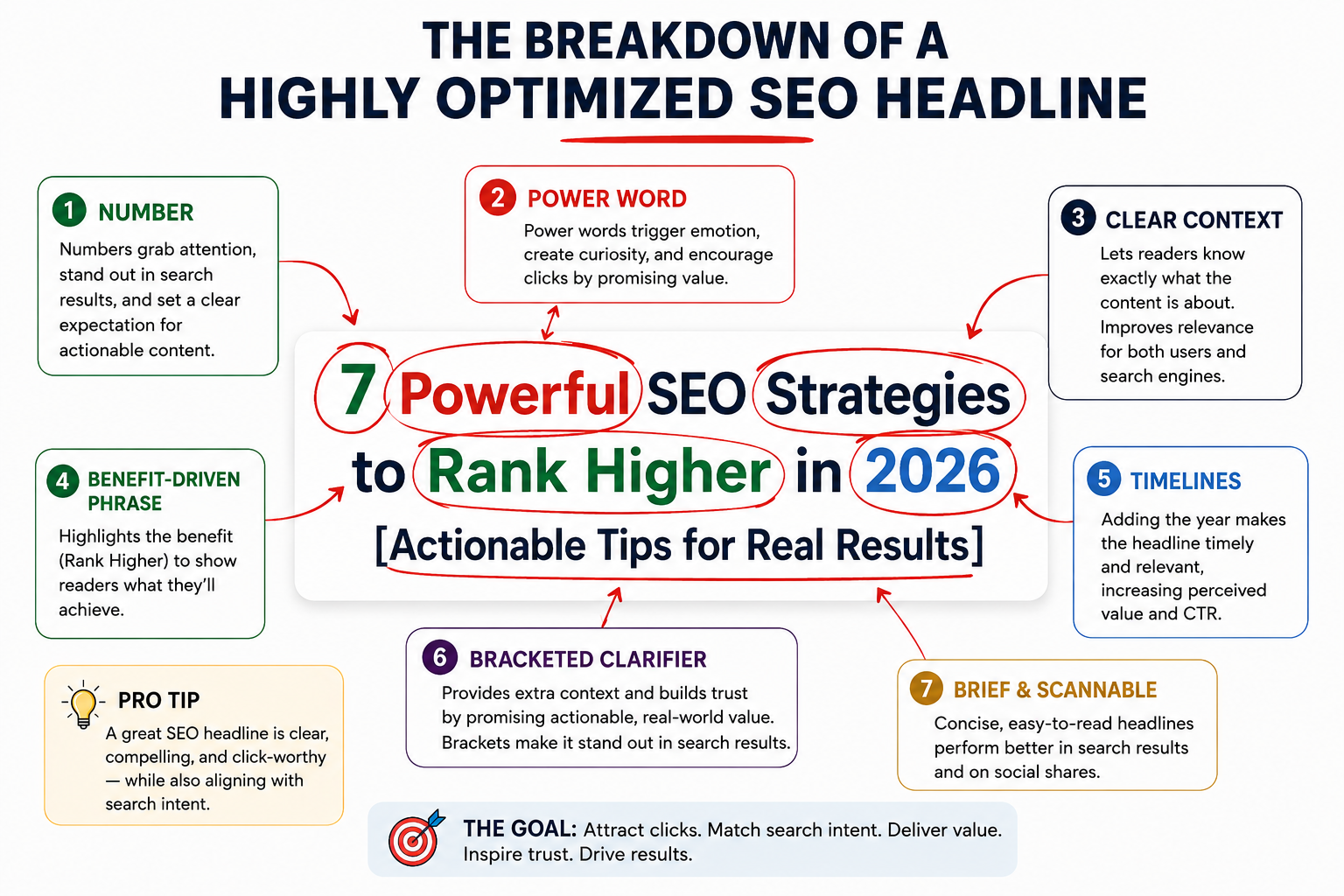
The headline is the title of your blog post; it is the first, and possibly the only thing a searcher contemplates before deciding to click.
It needs to be clear, include your focus keyword, and stay under roughly 60 characters so it doesn’t get cut off in the SERP.
Vague or “clever” headlines that don’t tell the reader what they’ll get upfront tend to underperform in terms of clicks, even when they rank well.
For the full breakdown of headline optimization, see our blog post on how to write SEO headlines that gets clicks.
· A good introduction
Some writers can be a little lax about what they put in their introductions.
After deciding to click, your introduction is the first impression a reader will have of your post and writing style. They decide whether to keep reading within the first few lines, even before they’ve consciously registered the decision.
Tell them plainly and sincerely what they’ll get from the post. Think of it as the abstract of a research paper (a concise summary of the main work).
There are different types of introductions you can use for your blog posts, as explained in one of our Instagram posts.
· An organized, paragraphed layout
Did you know that long paragraphs reduce readability?
Research has discovered that most readers scan the whole post before deciding if it is read-worthy or not.
Long, unbroken paragraphs are one of the fastest ways to lose a scanning reader. Break your ideas into 2–3 sentence chunks, and use subheadings generously enough that someone could understand your post’s structure and flow from the headers alone.
If your blog posts contain long paragraphs, more than half of your readers will bounce out and not likely return.
· Genuinely useful and well-researched content
Length has stopped being a reliable advantage years ago.
What matters most now is whether your content actually answers the reader’s question more completely, more clearly, or more usefully than what’s already ranking.
This is where good research comes in.
You need to identify the pain points of your target audience and give them content that is beneficial to them. Your content should also contain verified facts and visual engagements.
· Links to authority websites
You might think that having an external link in your blog post will make you lose originality, but this couldn’t be more wrong.
Citing credible sources when you reference data, statistics, or claims builds trust with readers and signals credibility to search engines. If readers are able to trust your sources, they will also be able to trust your advice when it comes.
This not only makes your content rankable, it is also good for your overall SEO?
Not sure your current content hits all five? Our SEO consulting service includes a full content audit against this checklist.
11 SEO writing tips for higher ranking
Many writers have been stuck with SEO writing, or as some people call it, SEO blog writing and the frustration can make you question your writing skills. Maybe you own a website, or you hope to take your SEO content writing game to the next level as a freelancer to land high-paying clients.
Whichever class you belong to, I’m here to guide you step by step and show you how to write a compelling, fully optimized blog post.
These SEO writing tips might seem like a lot, but it is achievable and gets easier to implement with consistent practice.
The SEO writing tips for higher ranking:
- Identify your audience
- Know your content bucket
- Come up with topic ideas
- Optimize the topic ideas
- Research the topic ideas
- Research keywords
- Research content around the keywords
- Create your headline
- Create your SEO outline
- Write your content
- Insert visual content
Since SEO writing skills go beyond just blog writing, most of what makes your blog posts optimized is the research you put into it before typing away at your keypads, just like I’m doing right now.
· Identify your audience.
I cannot emphasize this enough!
If you check out our blog post on 12 Ways to make money blogging, I wrote there that one of the most significant milestones that any blogger can cross is the ability to recognize and know their target audience.
Why is this important?
Your target audience is the one interested in your content and will want to click open that blog post because it addresses either their curiosity, fears, or pains. If you don’t know your target audience, you cannot create content relevant to a specific group of people.
You end up with no niche and no audience.
Here’s what to do:
- Map their pain points, fears, and curiosities — what they’re trying to solve.
- Read what competitors are already publishing to see which angles are saturated and which are underserved.
- Check commonly searched terms using free tools like Google’s “People also ask” boxes and autocomplete.
- Talk to real people in that niche directly — DMs, surveys, and comments surface language you’ll want later for keyword research.
· Know your content bucket.
A content bucket is a segment of the entire content you want to relay to your audience. Each content bucket should address various aspects of your business while also reflecting your overall message as a brand/business.
Content buckets are vital because they help you narrow down your ideas and distribute content across your audience.
- List 3–5 buckets that together represent your full brand message (for an SEO agency, that might be content writing, keyword strategy, technical SEO, and local SEO).
- Make sure each bucket maps to a stage of your reader’s journey — some buckets should target beginners, others should target people ready to hire help.
- Avoid overlapping buckets that will compete with each other for the same keywords once you start publishing.
When you want to write a blog post, you select a content bucket and find topic ideas around it.
For example, if you are a fashion blogger, your content bucket might include accessories, dresses, color combinations, or even make-up. If you want to write a blog post, you can find out pain point around accessories for beginners, and experts alike.
· Come up with topic ideas.
This particular process might not need you to go online because you can develop topic ideas based on your experience, expertise, and interactions with people. Otherwise, you can check other similar websites and get inspiration from their content; it is entirely legal.
I recently wrote some ideas for a friend in a different niche from mine. At first, I had no idea what topics were good and not-so-good, but I ended up checking other blogs in the same niche as hers. The summary is that the content was created while also maintaining originality.
If your content bucket of choice as a relationship expert is breakups, you might think of topic ideas like:
- Why new couples breakup
- How to avoid a breakup
- How to maintain long-distance relationships
- What ladies/men do after a terrible breakup
Mind you, these are JUST ideas and have not been verified yet.

Photo by Lukas Müller on Unsplash
· Optimize the topic ideas.
For search engine optimization, you want to ensure your topic ideas are relevant to people’s interests. This is where you can use tools like answerthepublic.
This tool gives you a compilation of all the questions people are asking about a particular keyword.
Now that you have a topic idea, log on to the site, type in your keyword of choice (1-3 words), and watch the magic!
Take, for instance, that your keyword of choice is simply ‘breakup,’ you’ll see a screen similar to this:
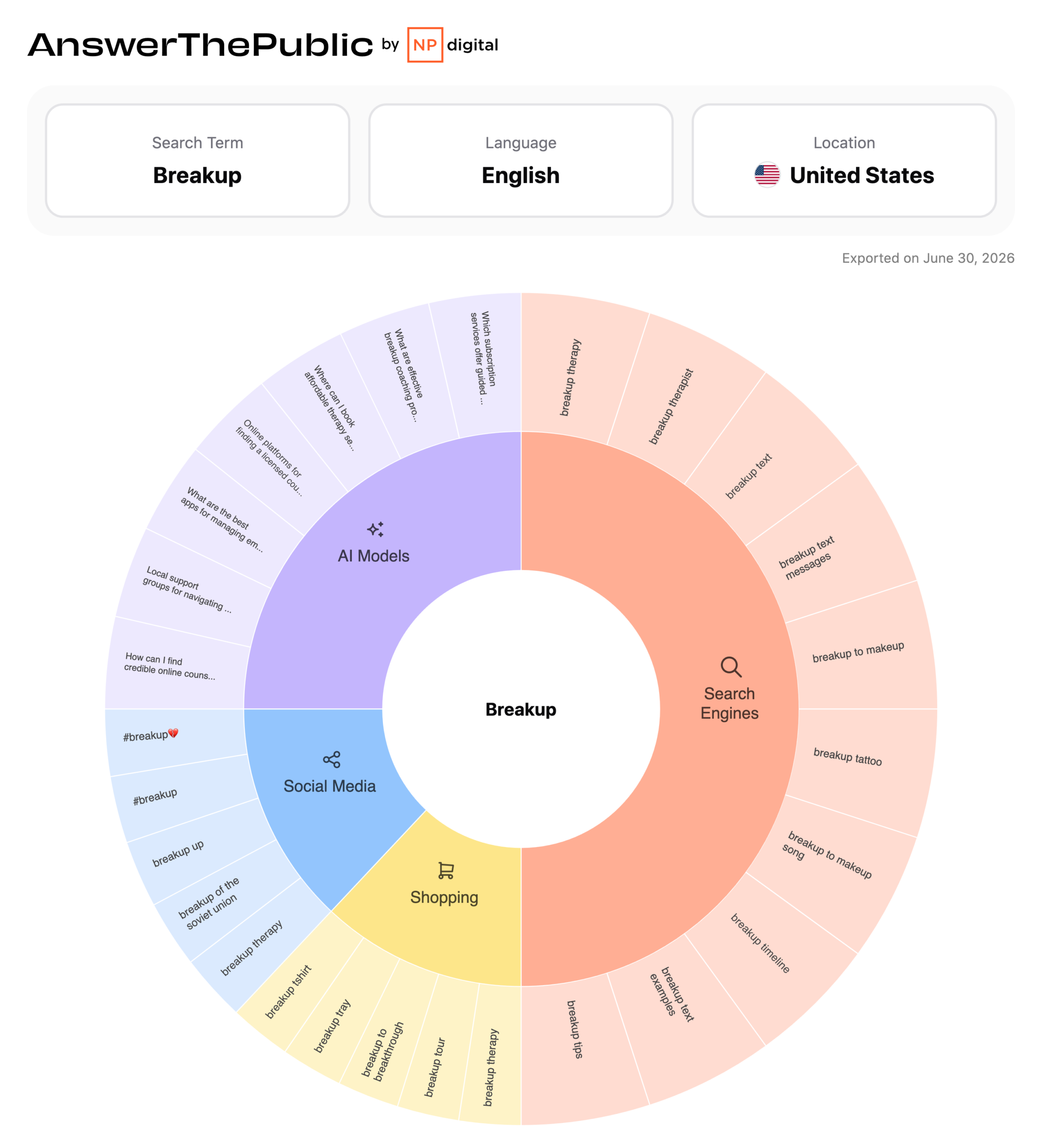
Now, you have dozens of options, and all you have to do is pick one.
The above image is just a part of the result page. You don’t have to be worried about coming up with relevant topic ideas anymore. You have over a hundred ideas in a single content bucket.
Imagine having up to five content buckets! Mind-blowing!
· Research the topic ideas.
You now have a verified idea you can use. The next step is to run that idea through Google.
From answerthepublic.com, your verified idea might be ‘breakup tips’ – this is what you type in Google search.
Why?
You want to compare them with existing blog posts, and you do this by checking the similar keywords used by the top-ranking websites.
In addition to the keywords, you also check the headline structures and the meta description.
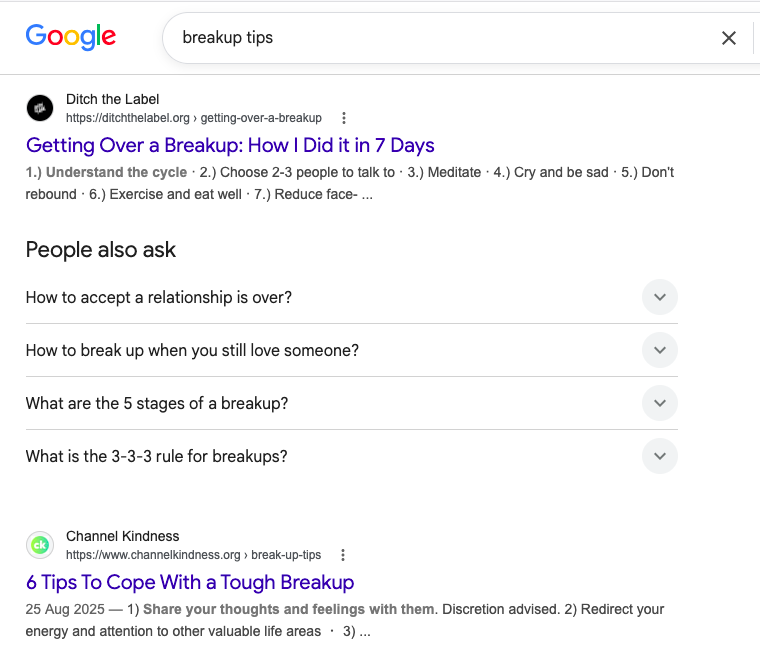
Let me share a tip with you.
One of the points in my SEO checklists is that your focus keyword should be part of your headline and URL. To fully confirm what focus keyword others use, you can check their headlines and URL and then research that keyword.
Any website with its focus keyword in both places is knowledgeable in SEO writing, and you should visit these websites for content inspiration.
Now, you have a keyword to verify.
· Research keyword(s).
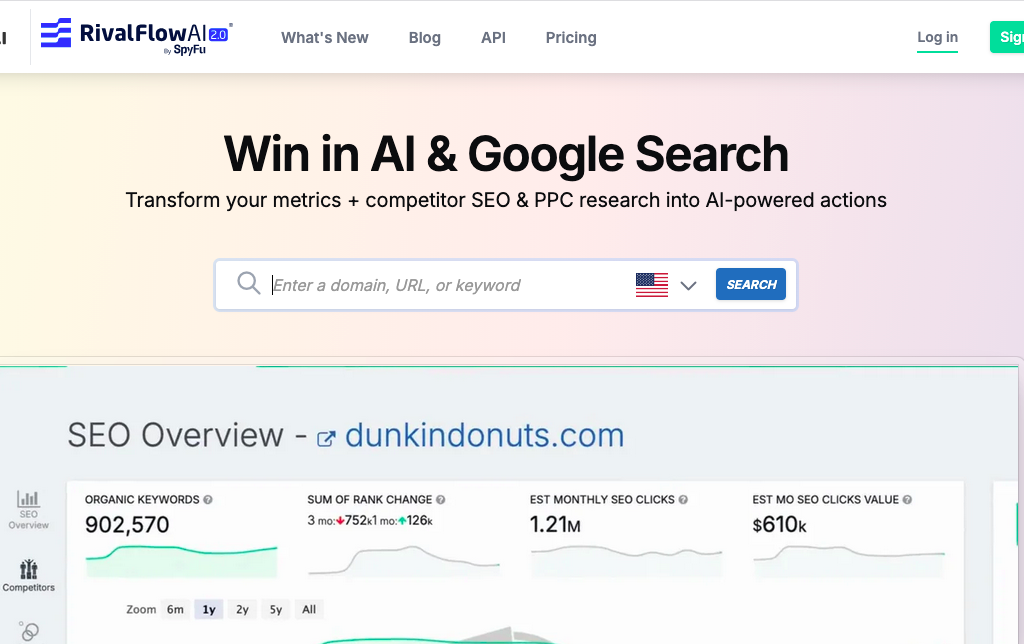
This part is so exciting! Ubersuggest is the best keyword research website out there, in my opinion.
When you upload your keyword on Ubersuggest, it analyzes that word. It gives you real-time data, including search volume, cost per click, SEO difficulty, other keyword ideas, and content ideas you can use along with the keyword you entered.
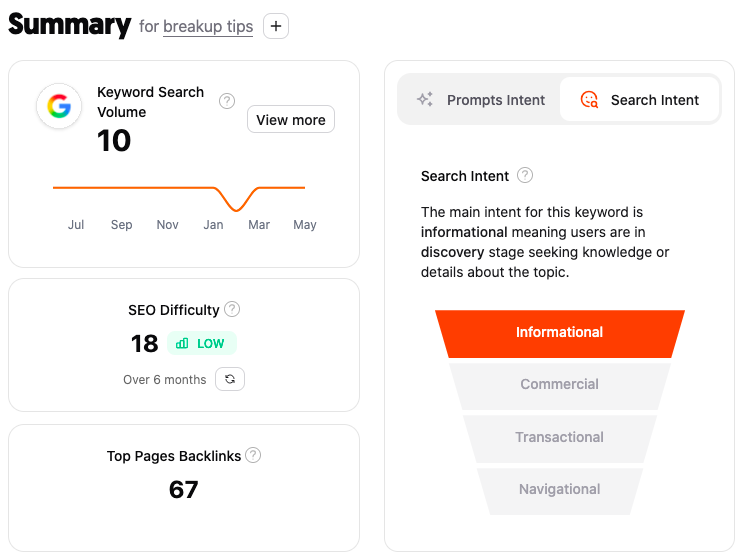
From the above example, you’ll notice the keyword overview, which consists of:
- Search volume
- SEO difficulty
- Top pages backlinks
- Search & prompt intent
Scrolling down, you see the AI prompt ideas and keyword ideas, which give you statistics on other keywords you can use.
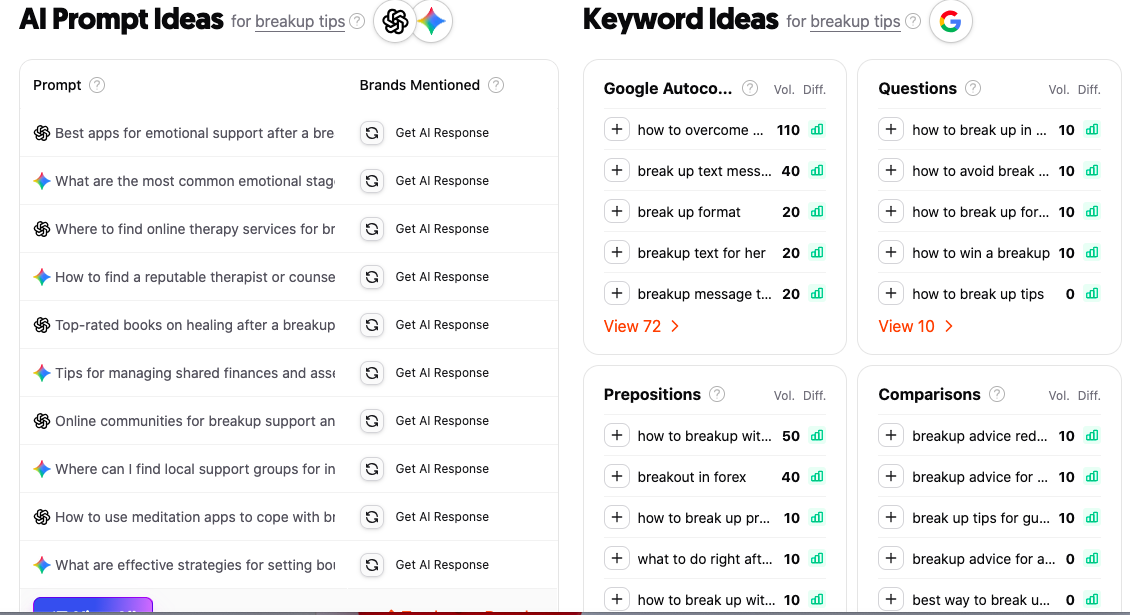
It shows the trend for each keyword and the top-ranking websites for it, alongside the keyword overview statistics for each keyword idea.
You can also check out the ‘content ideas’ segment under ‘competitive research’, where you see existing content with that keyword; in this case, the keyword is ‘breakup tips.’
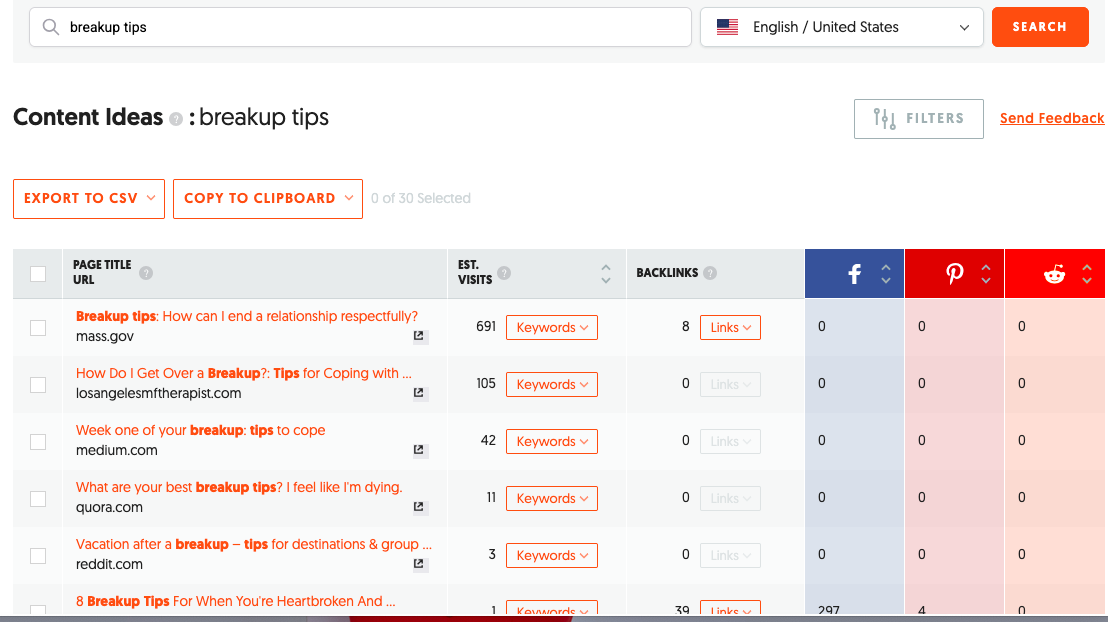
The fantastic thing about this content idea segment is that it shows you the monthly estimated visits to that website and the keywords that bring this organic traffic. It also shows the number of backlinks, so you know if the website is really credible, and the number of social media links (Facebook).
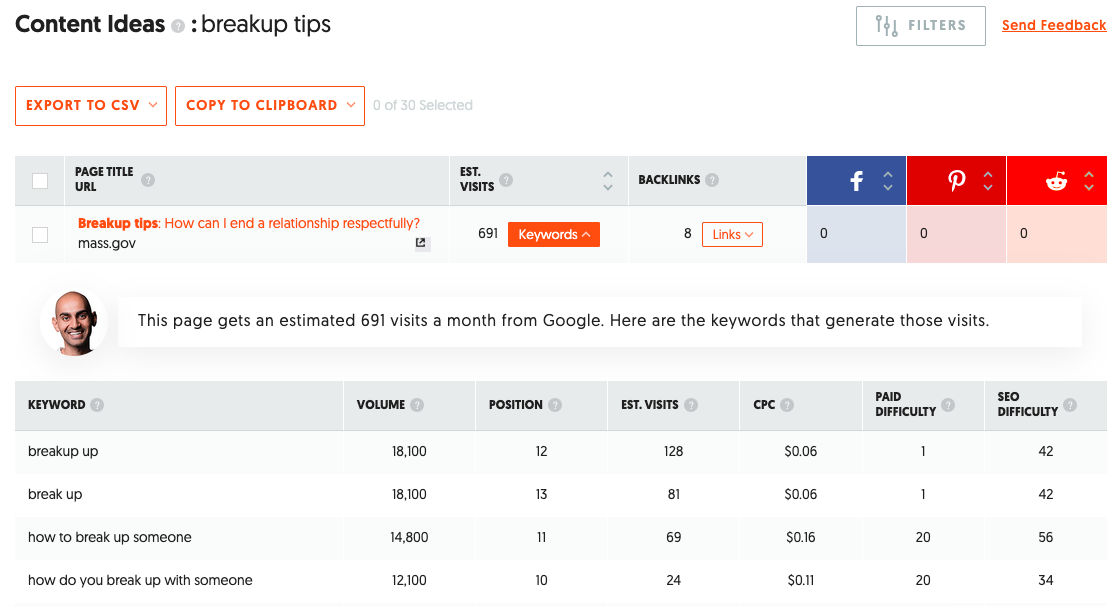
You know what? You get this much information for free and even more information when you subscribe to the paid version.
The paid version, among other features, provides breakdown statistics on which device generates the highest search volume (mobile or desktop).
· Research content around the keywords.
This is the same step as researching the topic ideas from AnswerthePublic. The only difference is that you have several related keywords to type in Google search.
In this case, your keywords of choice can be ‘when to break up with someone’ or ‘break up with him’ which are related to your current focus keyword. Also, you can still go with the focus keyword ‘breakup tips’. The goal is to decide on which keywords will offer you the best possible advantage.
For example, I can decide to go with ‘when to break up with someone’ and make the others my secondary keyword if I have an advantageous position in terms of SEO difficulty and search volume.
Note: One of the best SEO writing tips to hold on to is using a medium tail keyword as your focus keyword and long tail keywords as your other keyword ideas. All your keywords should not be more than five (5) or less than three (3).
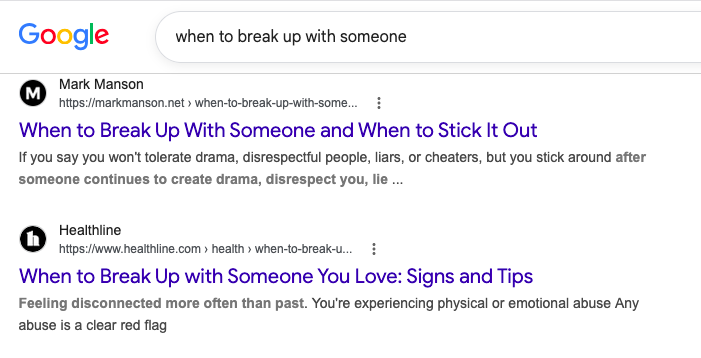
If your focus keyword becomes ‘when to break up with someone,’ you use Google search query to find content related to that query, noting the headline and content structures.
· Create your headline.
From the above SERP of the focus keyword ‘when to break up with someone,’ you can see several headline structures around the keyword.
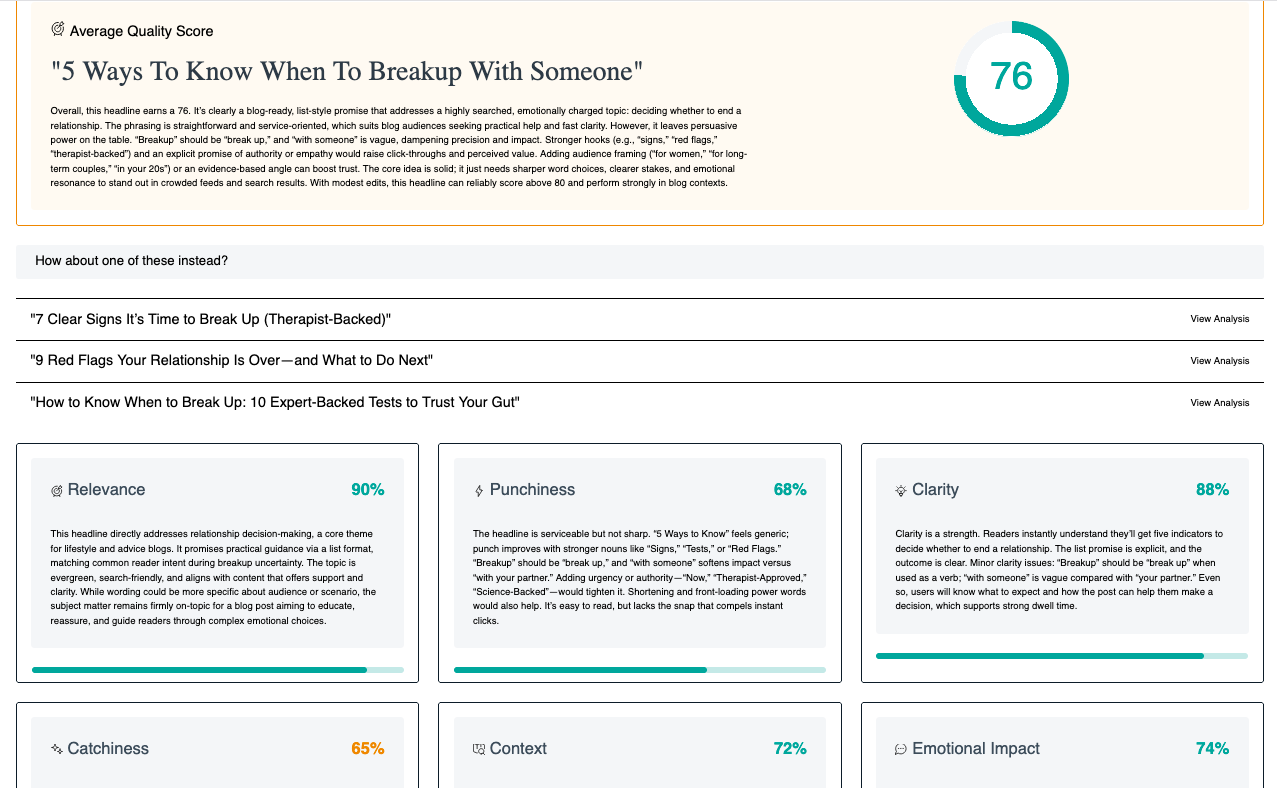
As earlier stated, you need to have a compelling headline that will make the reader want to click on your page. Sharethrough Headline Analyzer is a good, free, and accessible platform for writing a compelling headline, and you can also use it to verify the viability of your headline.

The platform analyzes your headline, gives you a score, and suggests ways you can make it better.
Before you write out a headline, note these points for SEO:
- Your focus keyword must be in your headline with no added word(s) in between. Use any of the formats below:
- Prefix, (focus keyword), suffix.
- (Focus keyword), suffix.
- Prefix, (focus keyword).
- Your headline should not be too long to avoid being cut off like the ones below.
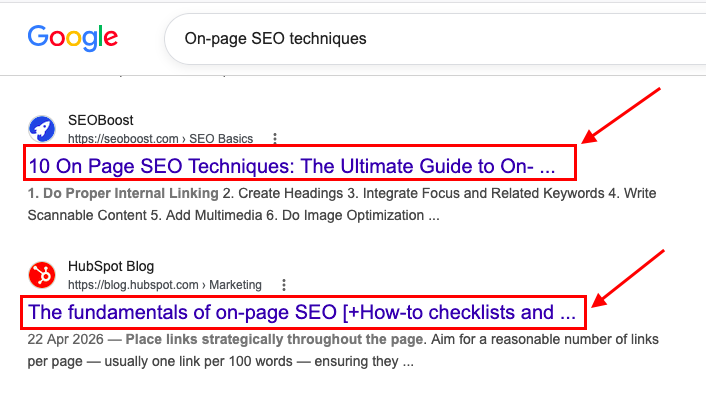
- Use context words.
- Use numbers, preferably odd numbers.
Run any headlines you come up with through the headline analyzer, follow these rules, and ensure your scores are above average.
· Create your SEO outline.
To create your outline, check out the top-ranking websites from the Google search query you carried out.
Compare at least five (5) different websites and note their content structure.
Afterward, create your outline and include a new point that is relevant to your content. OR
You can elaborate on a point mentioned briefly in other posts.
The goal throughout is to give reader value your competitors didn’t provide. That’s the actual reason a post outranks pages with more domain authority.
· Write your content.
You have your keywords, outline, and content inspiration. All you have to do is write.
However, it is important to know that writing isn’t just writing. When it comes to an optimized post, you have to be intentional and a little bit technical, especially when it comes to the placement of your keywords, links, images, and even your subheadings.
Here are my favorite SEO content writing tips to keep in mind when writing your optimized blog posts:
- Go straight to the point.
- Use simple English (8th grade English).
- Include your keywords in your sub-headings.
- Allow sentence flow between paragraphs.
- Build from the basics.
- Include relevant internal and external links.
- Use the right formatting style.
- Use AI minimally.
- Integrate keywords naturally.
· Insert visual content.
Your SEO blog post isn’t complete without visuals. Make sure your images’ sizes are small to reduce your site’s loading speed.
Also, add Alt texts to your images; this is very important for SEO.
FAQs on SEO Writing Tips
Does SEO writing still matter with AI Overviews summarizing search results?
Yes, even more than before.
AI Overviews handle the basic “what is this” answer, which means your content’s job has shifted from informing to earning the click after the answer is already visible.
How long should an SEO blog post be?
Long enough to answer the question completely and out-deliver what’s currently ranking. There’s no fixed word count that guarantees ranking anymore; depth and usefulness matter more than length alone.
What’s the single highest-impact tip in this list?
Keyword research (tip 6). Every other tips including your headline, your outline, your content itself, depends on having the right keyword foundation first.
Can I do all these myself, or should I outsource it?
Plenty of bloggers run this whole process solo, and it’s entirely learnable. If you’re managing it alongside running a business, our SEO writing service and SEO consulting service cover different parts of this depending on how hands-on you want to stay.
What’s the easiest mistake to make in this process?
Skipping tip 1 (identifying your audience) and jumping straight to keywords. Keywords tell you what people are searching; only audience research tells you why.
If you follow these SEO writing tips, your blog posts will be sure to make the front pages.
If you need me to assist you with your SEO writing, or you need more detailed and vocal coaching, you can set up a meeting with me HERE or check out our SEO writing services.