

Most SEO strategies don’t fail because of bad content; they fail because the content has no structure behind it.
You publish multiple blog posts, target a few keywords, maybe even rank for some of them, but there is no real, measurable, or reproducible growth. Your pages compete with each other, important keywords never reach page one, and over time, the website becomes harder to scale.
That’s exactly where keyword mapping for SEO comes in.
If you want your content to rank consistently and create a strategy that provides reproducible growth, you need a clear system that tells search engines which page should rank for what.
Not guessing, no overlapping topics, no publishing blindly.
At SARMLife, this is one of the system behind the content strategies that help some of our pages rank #1 and even appear in AI-driven search results. And in 2026, keyword mapping for SEO isn’t optional anymore especially if you want your content to support topical authority, internal linking, and modern search visibility.
Either you are working with a huge website or managing local SEO strategies for a small business owner, you need to understand the keyword mapping process. It plays a critical role in how search engines understand, index and rank your content.
RELATED BLOG POSTS
- HOW TO RUN AN EFFECTIVE CONTENT GAP ANALYSIS FOR SEO – SARM-LIfe
- 7 SIMPLE WAYS TO BUILD CLUSTER TOPICS FOR SEO – SARMLife
- LATEST ON PAGE SEO PRACTICAL GUIDE FOR BEGINNERS – SARMLife
- THE ULTIMATE PRO GUIDE TO SEO CONTENT WRITING – SARMLife
What is keyword mapping?
Keyword mapping is the process of assigning specific keywords to individual pages. It is the content planning step after keyword research where each page is given a primary keyword along with closely related supporting terms so pages don’t compete.
Think of it like this: the goal of keyword mapping is to stop your pages from stepping on each other’s toes. It does this by clarifying what each page should rank for, guides your content creation and helps search engines understand your site structure faster.
A good keyword map considers the main keyword, secondary keywords, the intent behind the search, the type of page, keyword difficulty and search volume. Every page gets a job and every keyword a home.
Why is keyword mapping important in SEO?
Creating a detailed keyword map helps to keep track of important details including keyword volume, difficulty and more. So, why not just write it down on a piece of paper instead of mapping?
Let me show you some of the benefits of proper keyword mapping for SEO;
Better satisfy search intent
Google ranks pages that match what people are really looking for. Not all keywords represent the same intent. Where some users want information, others want comparisons while some are ready to convert.
Keyword mapping allows you to evaluate:
- Informational intent (guides, explanations)
- Transactional intent (service or product pages)
- Commercial intent (comparisons, benefits)
Assigning every page to one clear primary keyword helps ensure that the content on a page directly matches what a user is looking for.
Prevent keyword cannibalization
The last thing you want is for your content to compete against itself. Keyword cannibalization occurs when multiple pages on your site compete against each other for the same keywords.
Here are some of the results of keyword cannibalization:
- Search engines struggle to determine which page is most relevant
- Link equity is split across competing URLs
- Rankings fluctuate
A solid keyword map keeps each keyword tied to a single page ensuring that each page supports, rather than competes so Google knows exactly where to send traffic.
Strengthen internal linking strategy
Keyword mapping for SEO naturally supports a structured internal linking system. When keywords are mapped correctly:
- Supporting pages link to core pages using descriptive anchor text.
- Search engines understand content relationships.
- Authority flows through topic clusters.
A page targeting keyword mapping benefits can internally link to related topics such as content clusters and search intent which reinforces topical authority.
Identify and fill content gaps
Keyword mapping for SEO turns content creation into a strategic process. As you cluster keywords and assign them to URLs, you’ll not only spot the topics you haven’t covered yet, but also:
- Avoid duplicate topics
- Prioritize pages with the highest SEO value
Those are ready-made opportunities for new content that can pull in traffic you’re missing today. This is important especially for growing websites, e-commerce platforms and blogs.
Keyword mapping isn’t just restricted to organic SEO, it also helps align ads with the right landing pages, improve your quality score and structure ad groups around search intent.
Paid and organic campaigns work better together when they’re built on the same keyword strategy.
Mapping can also lead to higher visibility in relevant SERPs, as long as the content is high quality.
Keyword mapping may take time initially but provides long-term, time-saving benefits, like preventing the need to re-optimize pages later to the point of needing a redirection.
Keyword mapping for SEO is essential for all websites, including small websites and must be updated on a regular basis usually every few months or when you add new content.
How is keyword mapping different from keyword research?
Research finds opportunities while mapping assigns them to pages.
Let me break it down:
Keyword research uncovers high-value terms, checking the competition, volumes and intent. It’s all about discovery, finding the words that can bring the right audience to your site and learning the intent behind those searches.
Keyword mapping however, is assigning specific target keywords to individual website pages, keeps your content organized, avoids keyword cannibalization, and shows search engines a clear roadmap of your site.
After building your list of keywords through research, mapping is the next step is to decide exactly which page each keyword belongs to.
Where research uncovers the opportunities, mapping turns them into a smart content plan.
Although both are necessary because without mapping, keyword research isn’t complete. By using them together you’ll attract the right traffic and give every page a good shot at ranking.
How to start keyword mapping for SEO
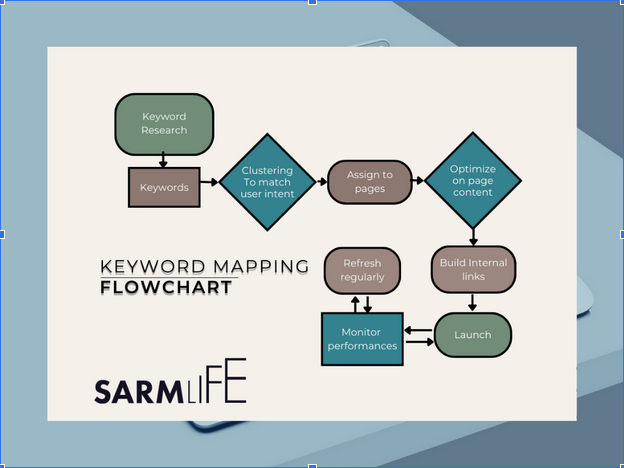
Photo by SARMLife
Here’s a detailed step by step guide to keyword mapping for SEO:
Start with Keyword Research
Begin by searching for the keywords you would like to target, including seed terms, long-tail keywords, primary and secondary keywords. You’ll need to create three keyword lists:
- Pillar page keywords
- Cluster topic keywords
- Keyword variations / semantic keywords
Pillar page keywords are keywords which describe your site’s main topics. You’ll assign them to your site’s pillar page while cluster topic keywords represent subtopics of your pillar page.
Keyword variations/semantic keywords are words or phrases which have similar meanings to the original keywords.
To do this, you need to use a solid tool such as Google Keyword Planner, Ahrefs, SEMrush, or Moz.
Check search volume so you know what people actually type into Google, look at keyword difficulty to know which keywords have the most competition and pay attention to what the user looks for when searching such keywords (user intent) and match what readers want.
This step sets the foundation for everything that follows.
Group and Cluster the Keywords
A topic cluster is a group of related pages interconnected by internal links that includes a pillar page (the main page) and related subpages focused on subtopics.
Pillar pages are in-depth articles or ultimate guides. Cluster posts are subtopics that support a pillar page. Linking a group of pillar and cluster posts to each other creates a “topic cluster” that can boost your site’s topical authority.
Search intent is key when clustering because, if the intent doesn’t match the page, your rankings will struggle.
The types of search intent we have are:
- Informational: The searcher wants to find information about a topic. These belong on blog posts, guides or FAQs. e.g. “what is keyword mapping”.
- Navigational: The searcher is looking for a specific website. These point directly to branded pages. e.g.“SARMLife blog”.
- Transactional: The searcher wants to make a purchase. These belong on product or landing pages. e.g.“buy SEO software”.
- Commercial: The searcher is checking out products and services. These fit comparison pages or reviews. e.g.“best keyword mapping tools”.
What Pages Types Should Keywords Be Mapped To in SEO?
Once you’ve grouped and clustered your keywords based on search intent and topic, the next step is to decide where those keywords should be on your site.
Search engines and users expect specific page types to serve different intents as I’ve said earlier and mapping keywords according to these types helps you prevent overlap, satisfy intent and improve rankings.
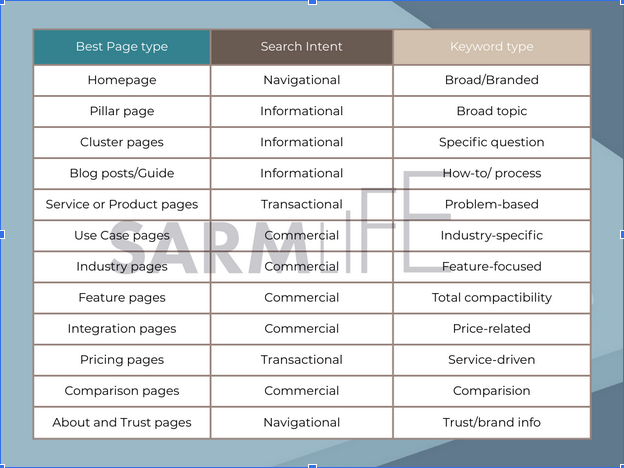
Photo by SARMLife
Here’s how each page works within your keyword map:
- Homepage:
The homepage sets the broadest context for your site. This is the starting point for search engines and users to understand your brand and lead users on where to go next.
- Targets broad, branded and high-level keywords.
- Represents the overall value proposition of the site.
- Should not target long-tail keywords
- Supports other pages through internal links not competition.
Example:
Primary keyword: SEO Agency in Jacksonville.
- Pillar page (Core topic pages)
This page acts as the foundation of your topical authority.
- Target broad, high- volume keywords around a main topic.
- Link out to all related subtopic pages.
- Serve as the central hub for cluster content.
Example:
Primary keyword: keyword mapping
- Cluster pages (Supporting content)
Cluster pages support pillar pages by talking about specific subtopics.
- Target long-tail, specific keyword variations
- Support a pillar page through internal linking
- Focus on one subtopic or question
Example:
Primary keyword: how to create a keyword map
- Blog posts/Guide
These pages basically satisfy informational intent.
- Target informational intent
- Meant to answer questions, explain processes and educate users
- Often form cluster content but can also stand alone.
Example:
Primary keyword: keyword mapping for SEO
- Service or Product pages
These pages are built to convert.
- Target transactional keywords
- Created to convert visitors into customers or leads
- This should be mapped out carefully to avoid overlap
Example:
Primary keyword: SEO writing services
- Use Case pages
They show how a product or service solves specific problems.
- Target problem-solution keywords.
- Assists users self-identify with a scenario
- Sits between informational and transactional intent.
Example:
Primary keyword: keyword mapping results for ecommerce websites.
- Industry pages
Industry pages tailor your offering to specific sectors
- Target industry-specific search terms
- Increase relevance for niche audiences
- Common in agencies and SaaS businesses
Example:
Primary keyword: SEO writing for SaaS companies
- Pricing pages
These pages address conversion-ready users.
- Target pricing,cost and plan related keywords.
- Reduce friction in the user’s decision stage
- Should be clearly mapped and internally supported
Example:
Primary keyword: SEO writing service pricing
- Comparison pages
Comparison pages help users evaluate options.
- Target keywords like “best”, “vs” “tools” and “reviews”
- Capture mid-funnel traffic
- Often linked to pricing and product pages.
Example:
Primary keyword: seo writing vs. blog writing
- About and Trust pages
These pages support navigational intent and credibility
- Target branded and trust based keywords
- Strengthen E-E-A-T signals
- Rarely compete for non-branded keywords
Example:
Primary keyword: about SARMLife
Download our Free Keyword Mapping Template
Now you’re ready to create your keyword map. Download our Free Keyword mapping template. Once you’ve downloaded the template, rename it in the upper left.
These are the data included in our keyword mapping template:
- Page title
What is the page working title?
- Page URL / Slug
The actual URL of the page you’re mapping keywords to.
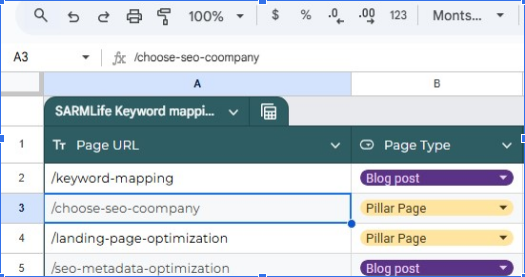
Photo by SARMLife
- Page Type
What is the page about?
- Primary Keyword
The single, main keyword you’re targeting for that page.
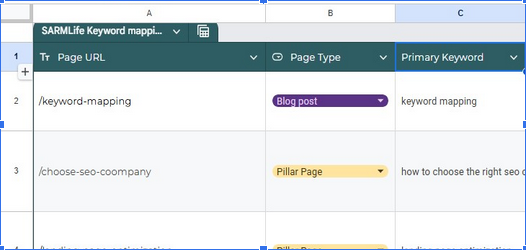
Photo by SARMLife
- Secondary Keywords / Supporting Terms
Semantically related or long-tail keywords
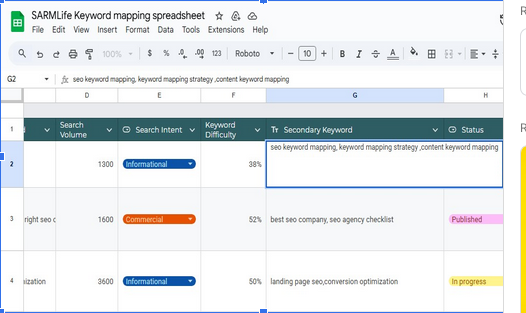
Photo by SARMLife
- Search Intent
Informational, transactional, navigational, or commercial intent.
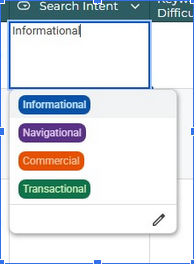
Photo by SARMLife
- Search Volume
Average monthly search volume pulled by each keyword.
- Keyword Difficulty / Competition
The score or measure of how tough it is to rank each keyword.
- Current Ranking or Position
If the page already exists, track where it sits on Google.
- Status / Notes / Content Suggestions
Status of the content ideas.
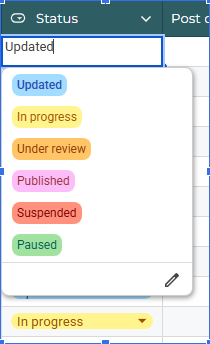
Photo by SARMLife
Assign Clusters to Specific Pages
Once the clusters are ready, match them to specific URLs on your site. This keeps pages from competing with each other and makes it obvious to search engines which page should rank for which query.
Make sure each page follows a strong on-page SEO process so they perform well on SERPs.
Optimize Your Content
Work those keywords naturally.
Place the main keyword in the title, meta description, sub-headings, and opening paragraph. Sprinkle related phrases through the body of the content, where they fit.
Build Internal Linking and Site Structure
Support your content hierarchy with structured internal linking by linking related pages with keyword-rich anchor text and make sure your site structure mirrors those keyword clusters.
This helps readers navigate and makes life easier for search engines.
Monitor Performance
As you refine your map, run an SEO audit process to ensure keywords aren’t duplicated.
Check how each mapped page is doing with Google Analytics, Search Console, or a rank tracker.
Keep an eye on impressions, click-through rates, and keyword positions so you know what’s working and what needs an update.
Refresh the map regularly
Search trends change, competitors publish new content.
Keywords that worked six months ago may be stale today so revisit your keyword map every few months to update clusters, adjust content.
Staying current keeps your site sharp, helps you spot new opportunities and keep rankings steady.
Common FAQs when it comes to keyword mapping for SEO.
Here are some commonly asked questions when it comes to keyword mapping for SEO:
How should you organize your keyword map for SEO?
An effective keyword map isn’t just a list of keywords. It’s a decision-making system which helps you decide what to create, what to optimize and what to fix.
The aim is to balance search volume, difficulty, and intent.
When organizing your keyword map, focus on impact rather than just volume.
You’ll want to:
- Not chasing only high-volume keywords. Mix them with long-tails that show clearer user intent.
- Give priority to keywords that directly solve your audience’s problems or answer common questions.
- Prioritize keywords that align with your core services, products or content pillars.
- Revisit your keyword map at least twice a year to catch shifts in search behavior.
Should you update existing content or create new pages?
One of the most important decisions in keyword mapping is whether a keyword should be assigned to an existing page or a new page.
Update an existing page when:
- The page ranks between positions 5-30
- The search intent matches the page’s purpose
- The keyword is closely related to the current topic
- The page has backlinks
Updating existing content helps you to consolidate authority and avoids keyword cannibalization.
Create a new page when:
- The keyword represents a distinct subtopic
- Expanding an existing page would weaken its focus
- No existing page fully satisfies the search intent
- The keyword has commercial or transactional intent which merits its own URL
Keyword mapping is about optimization before expansion. So keep in mind that publishing more pages is not always the best move.
What You Should Do When Multiple Pages Target the Same Keyword
Keyword cannibalization as we’ve earlier discussed is a huge problem in SEO. When this occurs make sure to:
- Identify the primary page
- Merge overlapping pages and redirect the weaker URL.
- Assign secondary keywords to supporting pages if needed.
- Update internal links to point consistently to the primary page.
- Adjust title, subtopics and anchor text to reinforce intent.
- Monitor performance
How Should You Review and Update Your Keyword Map?
Monitoring performance helps to track rankings, using Google Search Console or a rank-tracking tool. Watch organic traffic changes on pages tied to high-priority keywords, flag pages that slide in rankings for quick fixes.
You can also refresh the keyword map regularly by re-evaluating keywords every quarter or at least twice a year.
Add new terms, drop stale ones, and check if intent has shifted and re-optimize old content where needed. Remember that search behavior changes and your keyword map should change with it.
What are the best tools for Keyword Mapping?
So far, we’ve been able to properly talk about keyword mapping. Here are some tools we recommend and when to use them:
Google Keyword Planner
Google Keyword Planner is a free, data-rich tool straight from the source – Google itself. It’s perfect for beginners and pros who want accurate search-volume stats and keyword ideas.
Why it’s worth using
- Shows keyword search volume, competition, and bid ranges.
- Suggests related keywords so you can spot topic clusters.
- Lets you export keyword lists directly for mapping.
Pricing
Free with a Google Ads account.
Ahrefs

Ahrefs is known for its massive keyword database and excellent competitor analysis. If you’re serious about SEO, it’s one of the best all-in-one platforms.
Why it’s worth using
- Keyword Explorer shows search volume, keyword difficulty, and click-through data.
- Site Explorer reveals which pages your competitors rank for so you can map gaps.
- The Content Gap tool helps you find keywords you’ve missed.
Pricing
Plans start at about $99/month.
SEMrush

SEMrush is a powerhouse for keyword discovery and tracking. It’s great for marketers who need a detailed look at what’s working across different domains.
Why it’s worth using
- Keyword Magic Tool gives endless variations and long-tail ideas.
- Position Tracking monitors how your mapped keywords climb in SERPs.
- Competitor research helps you see where to out-rank rivals.
Pricing
Plans begin around $129.95/month.
Moz Keyword Explorer

Moz offers a clean interface and reliable metrics, making keyword research less of a headache.
Why it’s worth using
- Shows search volume, difficulty, and organic CTR.
- Generates keyword suggestions and SERP analysis.
- Easy to integrate into a simple keyword map.
Pricing
Free for up to 10 queries/month; paid plans start at $99/month.
SpyFu
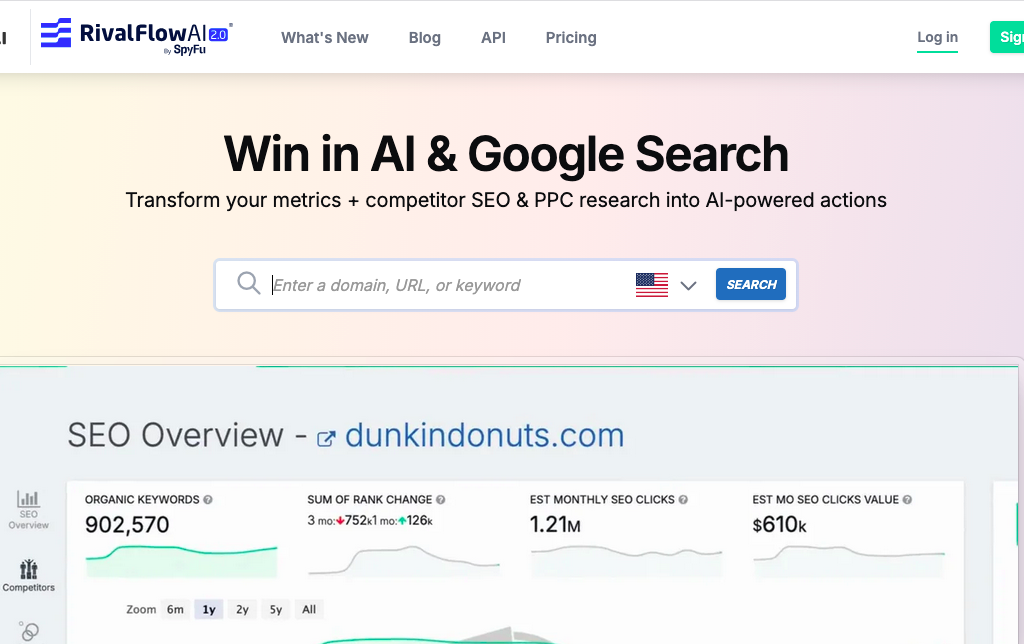
SpyFu is a favorite for competitive research and PPC insight. It’s handy when you want to see how others are bidding on or ranking for your target terms.
Why it’s worth using
- Exposes competitors’ paid and organic keywords.
- Tracks ranking history so you can map keywords by performance trends.
- Provides cost-per-click estimates for PPC planning.
Pricing
Plans start at $39/month.
BuzzSumo
BuzzSumo shines for content research and trend discovery, which helps you align keyword mapping with viral topics.
Why it’s worth using
- Identifies high-performing content by keyword.
- Shows trending topics and popular questions around your niche.
- Useful for brainstorming keyword clusters that attract backlinks and shares.
Pricing
Free limited plan; paid plans start at $119/month.
These tools cover everything from raw keyword discovery to competitor spying and trend tracking. Choose one or two based on your budget and how deep you need to dig, and you’ll have everything required to create a sharp, well-structured keyword map.
Final Thoughts
Creating a keyword map involves more than dropping a few phrases into a spreadsheet. It’s about researching the right terms, grouping them by intent, matching them to specific pages, and revisiting the plan as your content grows.
This process keeps your site organized and signals to search engines exactly which page deserves to rank for each topic.
In case you’re not sure where to start, we’ve shared a detailed free keyword mapping template you can copy right now.
It’s built to easily guide you step by step through keyword mapping for your website and by pairing it with recommended tools like Google Keyword Planner, Ahrefs, SEMrush, Moz, BuzzSumo, and SpyFu to help you uncover the best keywords and track performances while avoiding some of the common mistakes.
If you’re new to SEO and want professionals to turn your keyword mapping into a broader strategy, SARMLife can help.
Our SEO services cover everything from detailed keyword research to on-page optimization and content planning, to enable you to focus on growing your brand while we handle the technical side.
With this solid map and our expertise, your site is set up for progressive, steady and long-term growth.
FAQs on keyword mapping for SEO
What is keyword mapping?
Keyword mapping is the process of assigning a main keyword plus a few related terms to each page on your site so every page targets a specific search query.
Why is keyword mapping important in SEO?
Keyword mapping is important in SEO because it keeps each page focused on the right search intent, prevents keyword cannibalization, and reveals content gaps you can fill for more traffic.
How do you create a keyword map?
You create a keyword map by researching keywords, grouping them by topic or intent, and assigning one primary keyword to each URL. Keep everything in a spreadsheet or SEO tool so updates are easy.
How often should I update my keyword map?
You should update your keyword map every few months or whenever you add new pages, refresh content, or notice ranking changes.
What’s the best way to organize my keyword map?
The best way to organize your keyword map is with a simple spreadsheet that includes columns for page URL, main keyword, supporting keywords, search intent, and notes.
How is keyword mapping different from keyword research?
Keyword mapping is different from keyword research because research finds the search terms, while mapping assigns those terms to specific pages so your content strategy is clear.
How do I know if my site is suffering from keyword cannibalization?
You know your site is suffering from keyword cannibalization if multiple pages rank for the same keyword and keep swapping positions in search results.
Can I use the same keyword on multiple pages without hurting SEO?
You can mention related terms across pages, but you should not target the exact same primary keyword on multiple URLs.
What’s the difference between keyword mapping and content planning?
The difference is that keyword mapping assigns keywords to pages, while content planning sets the schedule and format for publishing new material.
Do I need a keyword map even if I have only a small website?
You need a keyword map even with a small site so every page has a defined purpose and no two pages compete.
Is keyword mapping helpful for PPC campaigns too?
Keyword mapping is helpful for PPC campaigns because it shows which pages fit specific search terms, making ad groups and landing pages more precise.
Can keyword mapping improve my site’s internal linking strategy?
Keyword mapping can improve your internal linking strategy because it shows which page owns each keyword and helps you create smart internal links.
Explore SARMLife SEO Services and discover new ways to improve your on page SEO
READ MORE: UNDERSTANDING KEYWORD OPTIMIZATION IN SEO – SARMLife
Add a Comment