
There’s a quiet shift happening in search and most websites are missing it.
Search engines are no longer just scanning pages for keywords. They’re trying to understand content the way a human would.
Context matters, relationships between ideas matter, and more importantly, clarity matters.
That’s where structured data for SEO starts becoming a competitive advantage.
Think about it this way: you could write the most valuable, well-researched content in your niche, but if search engines struggle to interpret what your page is actually about, you’re leaving visibility (and traffic) on the table.
Structured data for SEO fixes that gap; it translates your content into a language search engines instantly understand.
And the impact goes beyond just rankings.
Structured data for SEO influences how your content appears in search. In this new era of search constantly driven by AI summaries, featured snippets, and zero-click results, that visibility layer is everything.
When it comes to generative engine optimization, structured data provides the winning edge for most businesses. If there is anything AI models love, it’s structured data.
For businesses and SEO teams trying to stay ahead, this isn’t about chasing another tactic. It’s about aligning with how search actually works now and where it’s going next.
RELATED BLOG POSTS:
- How to Do Generative Engine Optimization in 2025
- How to Optimize Your Content for Zero-Click Searches in 11 Ways
- How to Increase Your Reach in 2025 with Answer Engine Optimization
- HOW TO REDUCE YOUR BOUNCE RATE: 9 PROVEN FIXES IN 2026
What is Structured Data Markup?
Structured data for SEO is a standardized format used to classify and organize website content in a way that search engines can easily understand.
It’s a way of adding extra information to your website’s code that helps search engines understand the content of your web pages more clearly. It helps search engines recognize key information on your website, such as business details, articles, products, events, and more.
This not only boosts visibility but it also improves how users engage with your website by presenting your content more clearly in search results.

Is Structured Data Markup the same as Schema Markup?
No, structured data markup is not the same as schema markup, although often used interchangeably, they are closely related.
Schema markup is a specific type of structured data, using the standardized vocabulary from Schema.org to help search engines properly understand and categorize content and context.
Structured data is the broader concept, referring to any code that organizes information for search engines, which schema markup is the most common implementation of.
How Structured Data for SEO Works
Here’s a breakdown of how structured data for SEO works:
1. Choosing the Right Schema Type
First begin by identifying the type of content you have (e.g., a recipe, a product, a service, an event).
Schema.org provides a wide number of schema types, each with identical properties relevant to that content.
For example, a recipe might have properties for ingredients, cooking time, and calorie count.
2. Adding the Markup
After identifying the schema type, you embed the structured data directly into your webpage’s HTML code.
The most common formats for this are JSON-LD (JavaScript Object Notation for Linked Data) and Microdata. JSON-LD is generally recommended as it’s easier to implement and maintain.
3. Search Engine Processing
When search engines crawl your website, they encounter this structured data and then process it to gain a deeper understanding of your content.
4. Enabling Rich Results
This allows search engines to display your content in more informative and visually appealing ways in search results, known as “Rich results” or “Rich snippets.”
Examples include: star ratings for reviews, images for recipes or products, event dates, and more.
These rich results can significantly improve the visibility and click-through rate of your pages in search.
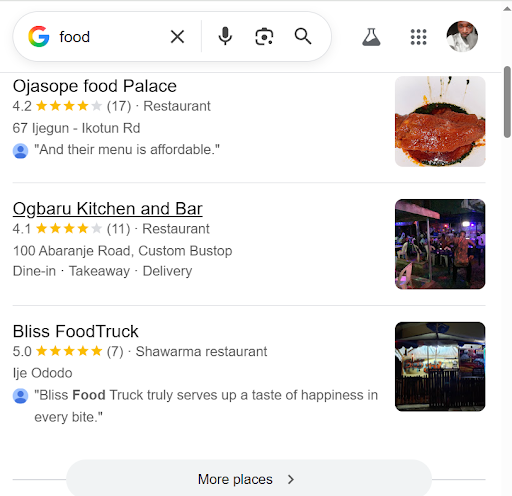
Photo by SARMLife
Importance of structured data for SEO
Here are some of the key benefits or importance of Structured Data in SEO:
1. Improved search engine understanding
Structured data acts as a translator, helping search engine crawlers clearly understand the context and meaning of your content.
Without it, crawlers rely heavily on assumptions, trying to interpret headings, keywords, and page structure to figure out what your content actually means. With structured data markup (like Schema.org), you remove that guesswork completely.
You’re no longer just saying, “this is a product page” or “this is an article.” You’re explicitly defining elements like product name, price, author, FAQs, events, and more.
This clarity strengthens semantic SEO by helping search engines connect entities, relationships, and intent behind your content.
The result?
Better indexing, more accurate categorization, and stronger alignment with search intent. Instead of hoping Google understands your page, you’re creating a structure where Google and AI models have no choice but to understand your page.
2. Improved search visibility
Visibility today goes beyond ranking on page one, it’s about how you appear.
Structured data for SEO helps your website appear in more prominent and creative ways in search results like rich results, knowledge panels, and AI Overviews. This increases the number of touchpoints users have with your brand.
This means your content can take up more real estate on the SERP (Search Engine Results Page), pushing competitors further down.

Photo by Arkan Perdana on Unsplash
3. Rich snippets and results
One of the most immediate benefits of structured data for SEO is eligibility for rich snippets. These are enhanced listings that go beyond the basic title, URL, and meta description.
Think star ratings, product prices, availability status, event dates, recipe cook times, or even FAQ dropdowns directly in search results. These additional elements give users more information before they even click.
4. Increased click-through rates (CTR)
When your presence in search results looks more informative and engaging, users are naturally more inclined to click.
That’s where structured data for SEO directly influences user behavior.
Rich snippets create a stronger first impression. A listing with reviews, pricing, or quick answers feels more trustworthy and complete compared to a plain blue link. It reduces uncertainty and answers key questions upfront.
This leads to higher click-through rates (CTR), even if your ranking position stays the same. Over time, improved CTR sends positive engagement signals to search engines, reinforcing the relevance of your page and increasing rankings.
5. Better performance in voice and AI search
Search is evolving rapidly toward conversational queries and AI-generated responses. Structured data for SEO plays a critical role in this shift.

Voice assistants and AI-driven search systems rely heavily on structured, machine-readable data to deliver accurate answers. When your content is clearly marked up, it becomes easier for these systems to extract precise information and present it in voice results, featured snippets, or AI summaries.
It enables them to understand your content’s context, which is crucial for voice search queries and for AI-driven search features that rely on deep semantic understanding.
In other words, structured data positions your content not just for traditional search, but for the future of search, where context and semantic understanding drive visibility.
6. Potential for higher rankings
While structured data for SEO is not a direct ranking factor, the visibility and CTR benefits from structured data can indirectly lead to higher rankings when search engines see your content as more relevant and useful.
Better visibility leads to more impressions. Rich snippets lead to higher CTR. Higher CTR and engagement signal relevance and usefulness to search engines.
Over time, these factors can contribute to improved rankings.
It’s a compounding effect.
7. Accurate local and brand information
Structured data helps search engines build a clearer, more reliable understanding of your brand.
By defining key details like business name, location, operating hours, services, and contact information, you contribute to a more accurate knowledge graph.
With structured data for SEO, your business is more likely to appear with consistent and correct information across search features like knowledge panels and local search results.
This is especially critical for local SEO.
8. Enhanced Crawl Efficiency
Search engines allocate a limited crawl budget to every website. The easier it is for them to understand your content, the more efficiently they can crawl and index your pages.
Structured data for SEO streamlines this process by clearly defining what each page is about. Instead of spending time interpreting ambiguous content, crawlers can quickly process and categorize your pages.
This improved efficiency can be especially beneficial for larger websites, where faster indexing and better prioritization can directly impact visibility and performance.
9. An Edge Over Competitors
Despite its impact, many websites still underutilize structured data. That gap creates an opportunity.
By implementing structured data for SEO, you position your content to outperform competitors who rely solely on traditional optimization. Your listings become more engaging, more informative, and more aligned with how modern search works.
In competitive niches, small advantages compound quickly. Better visibility leads to more clicks. More clicks lead to stronger signals. Stronger signals lead to better performance.
And while others are still catching up, you’re already ahead.

Photo by Nathana Rebouças on Unsplash
How to add Structured Data to your Website
There are different ways you can add structured data to your website depending on your technical level, CMS, and how much control you have over your site.
1. Add JSON-LD Markup (JavaScript Object Notation for Linked Data)
This is the most recommended method for adding structured data to your website. It allows you to add structured data as a script in your page’s <head> or body without interfering with visible content.
It’s clean, flexible, and preferred by search engines because it separates structured data from your HTML design.
You can define key elements like articles, products, FAQs, events, and more clearly telling search engines what each page represents.
2. Use CMS Plugins and Built-In Tools
This is the easiest way to include structured data on your website and pages.
If your website runs on a CMS like WordPress, you don’t need to manually write code to benefit from structured data for SEO.
Plugins like Yoast SEO, Rank Math, or Schema Pro allow you to automatically generate structured data for different page types.
These tools simplify the process by letting you select schema types (like articles, products, or FAQs) and fill in fields through a user-friendly interface. It’s the fastest way to implement structured data without technical complexity.
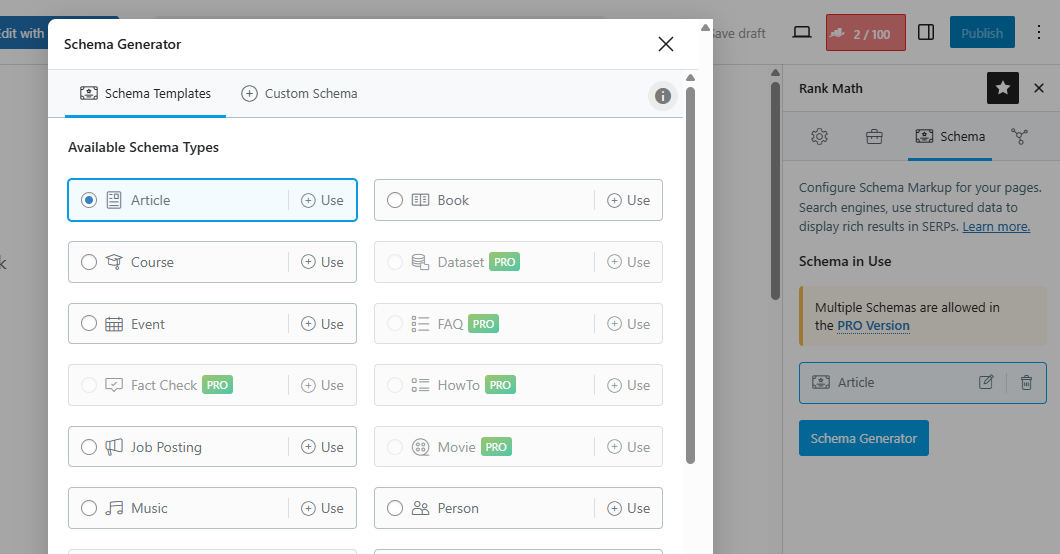
Photo by SARMLife
3. Use Google’s Structured Data Markup Helper
For beginners, Google Structured Data Markup Helper offers a guided way to generate structured data.
You simply paste your page URL, highlight elements (like titles, images, prices), and the tool generates the corresponding markup for you. While it’s not as scalable as other methods, it’s a great starting point to understand how structured data for SEO works in practice.
4. Implement Schema Directly in HTML (Microdata)
Another method is adding structured data directly into your HTML using microdata. This involves embedding tags within your existing content to define specific elements.
While this approach works, it can get messy especially for larger websites because it mixes structured data with your front-end code. Compared to JSON-LD, it’s less flexible and harder to maintain.
That’s why most modern SEO strategies prioritize cleaner implementations.
5. Validate and Test Your Structured Data
Adding structured data is only half the job, validation is what ensures it actually works.
Tools like Google Rich Results Test and Schema Markup Validator help you check for errors, confirm eligibility for rich results, and ensure your markup is properly implemented.
This step is critical.
Even small errors can prevent your structured data from being recognized, which means you miss out on the full SEO benefits.

Photo credits: islander11 on iStock
Final Thoughts
Although not a direct Google ranking factor yet, structured data for SEO is one of the most effective and proven ways to boost your website’s visibility and SEO performance.
Whether it’s a product, article, recipe, business, event, or review, through organized, easy-to-read information to your site’s HTML, you help search engines clearly understand your content.
This allows Google to display your pages as rich results, such as star ratings, FAQs, images, product details, and more, which naturally improves your search visibility and click-through rates.
Schema markup, the most popular form of structured data, uses Schema.org vocabularies to label your content accurately.
When used correctly (usually with JSON-LD), it enhances indexing, supports voice and AI search, boosts local SEO, strengthens brand knowledge panels, and gives you a competitive edge since many websites still don’t use it.
Overall, the importance of structured data for SEO depends greatly on how it can improve search engine understanding, make crawling efficient, and make your content more engaging in search results.
With the right schema type, proper formatting, and careful testing, structured data markup can significantly improve how users find and interact with your website.
Get our AI SEO service that captures the benefits of structured data for SEO and offers Basic schema & structured data setup, content structure optimization for AI summaries, and so on.
Add a Comment